
Concrete Bag Calculator — How Many Bags of Concrete Do I Need?
A concrete bag calculator is a free online tool that helps DIY homeowners, contractors, and builders calculate exactly how many bags of premix concrete are needed for any project. Using the concrete bag calculator, you enter the dimensions of your pour and instantly get the exact number of 40-lb, 50-lb, 60-lb, or 80-lb concrete bags required, plus total cost and volume in cubic feet and cubic yards. The concrete bag calculator supports four practical modes including rectangular slab, post hole, circular pad, and custom volume, making it the most complete tool for premix bag concrete estimation.
Key facts at a glance
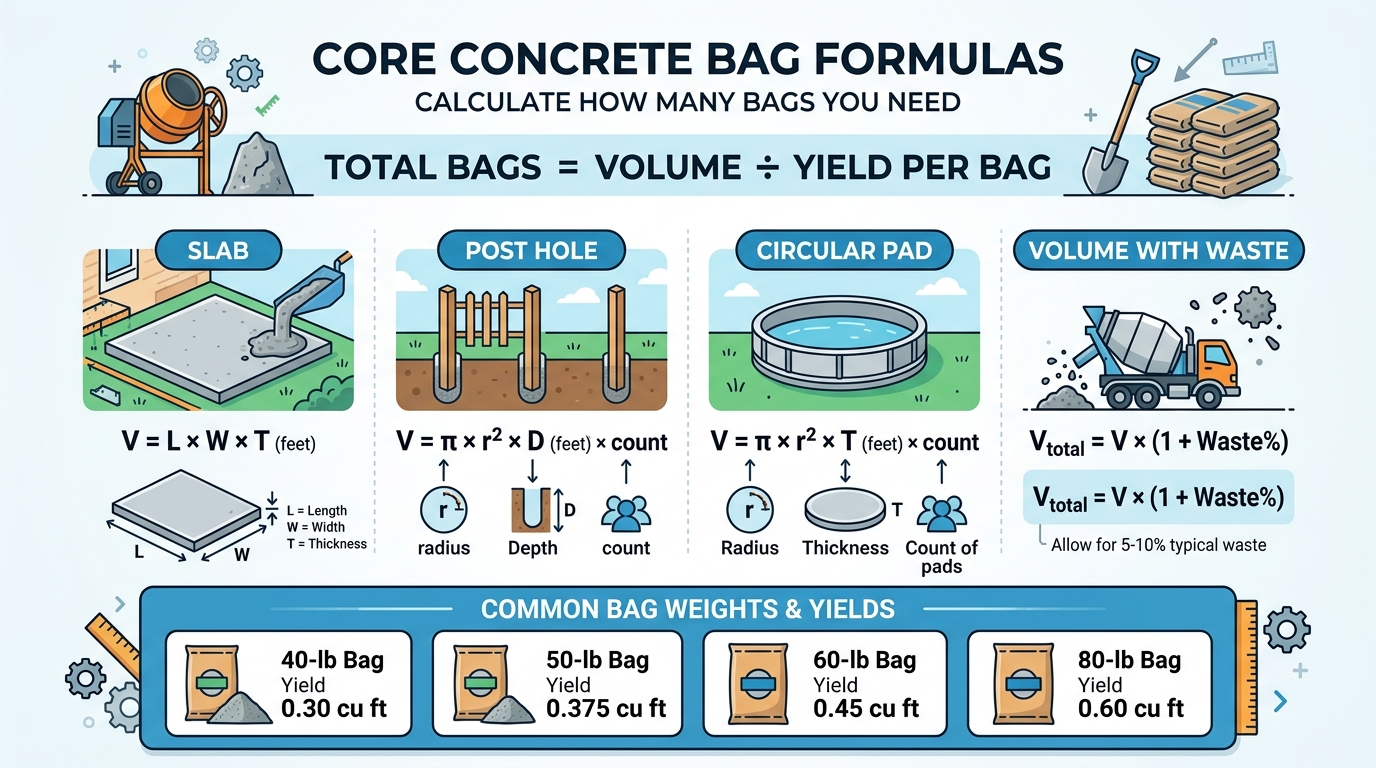
- Core formula: volume = length × width × thickness for slabs; π × r² × depth for holes.
- 40-lb bag: yields 0.30 cubic feet — ideal for small repairs and post setting.
- 50-lb bag: yields 0.375 cubic feet — common for fence posts and small slabs.
- 60-lb bag: yields 0.45 cubic feet — most common for DIY projects.
- 80-lb bag: yields 0.60 cubic feet — best value for larger projects and slabs.
- Best practice: add 5–10% extra bags for waste, spillage, and uneven subgrade.
📋 Table of Contents
▼
- What the Concrete Bag Calculator Does
- Concrete Bag Calculator — Advanced Tool
- Understanding Concrete Bag Yields and Project Math
- Real Scenarios Where the Concrete Bag Calculator Helps
- Common Concrete Bag Calculation Mistakes
- Concrete Bag Handling Safety and Best Practices
- Which Mode Fits Your Project
- Frequently Asked Questions
- Concrete Bag Project Checklist
- Trusted Construction Resources
- User Reviews & Ratings
What the Concrete Bag Calculator Does
A concrete bag calculator takes the dimensions of your pour and instantly calculates the exact number of premix concrete bags needed, plus total cost and volume. The tool is designed for projects under 1 cubic yard where premix bags are more practical than ready-mix delivery. Whether you are setting fence posts, pouring a small patio, building deck footings, or anchoring a mailbox post, the concrete bag calculator tells you exactly how many bags to buy.
Premix concrete is sold in 40-lb, 50-lb, 60-lb, and 80-lb bags, each with different yield and cost characteristics. The concrete bag calculator handles all four bag sizes and provides results for each, helping you choose the most cost-effective option. The tool also includes waste factor adjustment and cost estimation, giving you a complete project plan.
The concrete bag calculator below includes four project-type modes: Rectangular Slab (small patios, sidewalks, shed bases), Post Hole (fence posts, deck footings, mailbox posts), Circular Pad (hot tub bases, well covers, stepping stones), and Custom Volume (any shape with direct cubic feet input). Each mode is tailored to common bag-concrete applications, providing quick and accurate bag counts for any DIY or professional project.
Use the concrete bag calculator for any project under 1 cubic yard. For larger projects, the tool still works but ready-mix delivery is typically more economical. The concrete bag calculator helps you decide the most cost-effective approach by showing the total bag cost vs. the typical ready-mix cost for your project size.
From a single 40-lb bag for a mailbox post to 100+ 80-lb bags for a hot tub base, the concrete bag calculator scales to meet any bag-concrete project. The tool supports all major premix brands including Quikrete, Sakrete, Fast-Setting, High-Strength, and specialty mixes.
Concrete Bag Calculator
Calculate exactly how many 40-lb, 50-lb, 60-lb, or 80-lb concrete bags you need for slabs, post holes, circular pads, and custom projects. Instant bag count with cost estimate and waste factor.
Your Concrete Bag Estimate
Step-by-step calculation
Understanding Concrete Bag Yields and Project Math
Understanding concrete bag calculator math helps you make better purchasing decisions. Premix concrete bags come in four standard sizes with different yields. The concrete bag calculator handles all four sizes automatically, but understanding the underlying math helps you choose the best bag for your project. Most DIYers and small contractors use 60-lb bags as the standard, but 80-lb bags offer the best value per cubic foot for larger projects.
Concrete bag yield depends on the bag size, aggregate type, and water content. A standard 60-lb bag of premix concrete (Quikrete, Sakrete, or equivalent) yields approximately 0.45 cubic feet when mixed properly. The concrete bag calculator uses these standard yields but allows adjustment for specialty mixes like fast-setting or high-strength concrete.
Bag Yields and Costs
The concrete bag calculator supports all four standard bag sizes. 40-lb bags yield 0.30 cu ft and are ideal for very small repairs like mailbox posts and railing anchors. 50-lb bags yield 0.375 cu ft and are common for fence post setting. 60-lb bags yield 0.45 cu ft and are the most popular DIY size. 80-lb bags yield 0.60 cu ft and offer the best cost per cubic foot for projects over 1 cubic yard of total concrete.
Volume Formulas
The concrete bag calculator applies three volume formulas. For rectangular slabs: Volume = Length × Width × Thickness (in feet). For post holes: Volume = π × r² × Depth (in feet) per hole. For circular pads: Volume = π × r² × Thickness (in feet). The tool automatically handles unit conversions (inches to feet) and applies waste factors (10% for slabs, 15% for holes).
Waste Factor and Project Spare
The concrete bag calculator includes a waste factor of 10% for slabs and circular pads, and 15% for post holes (which have more spillage from hand-mixing). Beyond the waste factor, professionals order 1-2 extra bags as spares for unexpected needs, low subgrade areas, and touch-ups. The tool’s step-by-step output reminds users to order extra.
Bag Size Selection Strategy
The concrete bag calculator helps you choose the optimal bag size. For projects under 5 cu ft, 40-lb or 50-lb bags offer easier handling. For 5-20 cu ft projects, 60-lb bags are the standard. For projects over 20 cu ft, 80-lb bags offer the best cost per cubic foot. The tool provides cost calculations for each bag size, helping you choose the most economical option.
Water and Mixing
The concrete bag calculator calculates bag count but not water requirements. Standard premix bags require 3-4 quarts of water per 60-lb bag, 4-5 quarts per 80-lb bag. Too much water weakens concrete, too little makes it unworkable. Follow the manufacturer’s water ratios for the best results.
Post Hole: V = π × r² × D (feet) × count
Circular Pad: V = π × r² × T (feet) × count
Volume with Waste: V × (1 + Waste%)
40-lb: 0.30 cu ft | 50-lb: 0.375 cu ft
60-lb: 0.45 cu ft | 80-lb: 0.60 cu ft
Quick Reference Values
Pro Tip: The concrete bag calculator provides accurate bag counts for standard projects. For very large projects over 1 cubic yard, consider ready-mix delivery — it is often cheaper per cubic foot and saves significant labor. Use the calculator’s volume in cubic yards output to compare costs and decide the most economical approach.
Real Scenarios Where the Concrete Bag Calculator Helps
Scenario 1: Small Patio Slab
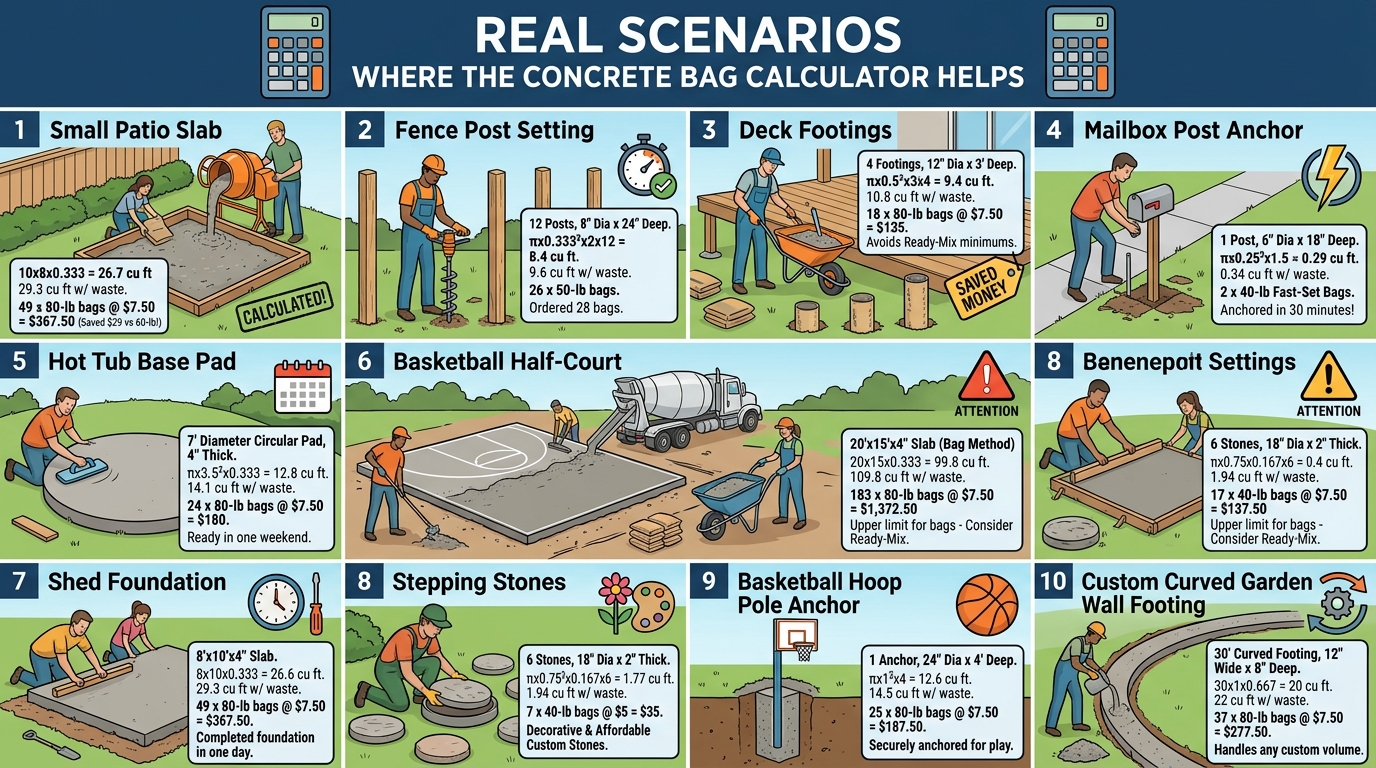
A homeowner wants to pour a 10×8 foot patio, 4 inches thick. The concrete bag calculator slab mode: 10 × 8 × 0.333 = 26.7 cu ft × 1.10 waste = 29.3 cu ft. For 60-lb bags: 29.3 ÷ 0.45 = 66 bags. For 80-lb bags: 29.3 ÷ 0.60 = 49 bags. At $6 per 60-lb bag, total cost is $396. At $7.50 per 80-lb bag, total is $367. The 80-lb option saves $29, and the calculator’s cost comparison helps the homeowner choose.
Scenario 2: Fence Post Setting
A contractor is setting 12 fence posts, each in an 8-inch diameter hole, 24 inches deep. The concrete bag calculator post mode: π × 0.333² × 2 × 12 = 8.4 cu ft × 1.15 = 9.6 cu ft. Using 50-lb bags (common for fence posts): 9.6 ÷ 0.375 = 26 bags. The contractor orders 28 bags (2 extra) and completes the fence in one day. The concrete bag calculator provides the exact quantity for the project.
Scenario 3: Deck Footings (Bag Method)
A DIYer is pouring 4 deck footings, each 12 inches in diameter, 3 feet deep. The concrete bag calculator post mode: π × 0.5² × 3 × 4 = 9.4 cu ft × 1.15 = 10.8 cu ft. Using 80-lb bags for best value: 10.8 ÷ 0.60 = 18 bags. At $7.50 per bag, total cost is $135. The DIYer avoids ready-mix minimum delivery fees by using premix bags. The concrete bag calculator makes this small project economical.
Scenario 4: Mailbox Post Anchor
A homeowner needs to anchor a mailbox post in a 6-inch diameter hole, 18 inches deep. The concrete bag calculator post mode: π × 0.25² × 1.5 = 0.29 cu ft × 1.15 = 0.34 cu ft. Using one 40-lb bag (yields 0.30 cu ft): 0.34 ÷ 0.30 = 2 bags. The homeowner buys 2 bags of 40-lb fast-setting concrete, sets the post, and the mailbox is anchored in 30 minutes. The concrete bag calculator shows the minimum order is 1-2 bags.
Scenario 5: Hot Tub Base Pad
A homeowner is pouring a 7-foot diameter hot tub pad, 4 inches thick. The concrete bag calculator circular mode: π × 3.5² × 0.333 = 12.8 cu ft × 1.10 = 14.1 cu ft. Using 80-lb bags: 14.1 ÷ 0.60 = 24 bags. At $7.50 per bag, total cost is $180. The homeowner orders 25 bags and the hot tub base is ready in one weekend. The concrete bag calculator makes this medium project affordable.
Scenario 6: Basketball Half-Court (Bag Method)
A school is pouring a small 20×15 foot practice slab, 4 inches thick. The concrete bag calculator slab mode: 20 × 15 × 0.333 = 99.8 cu ft × 1.10 = 109.8 cu ft. Using 80-lb bags: 109.8 ÷ 0.60 = 183 bags. At $7.50 per bag, total cost is $1,373. The school orders 200 bags (with spares) and uses a team of volunteers. The concrete bag calculator shows this is at the upper limit of bag-concrete projects — ready-mix might be more economical.
Scenario 7: Shed Foundation
A homeowner is pouring an 8×10 foot shed foundation, 4 inches thick. The concrete bag calculator slab mode: 8 × 10 × 0.333 = 26.6 cu ft × 1.10 = 29.3 cu ft. Using 80-lb bags: 29.3 ÷ 0.60 = 49 bags. At $7.50 per bag, total is $367. The homeowner uses 50 bags to complete the foundation in one day with a helper. The concrete bag calculator provides the exact quantity for a typical shed.
Scenario 8: Stepping Stones
A gardener is making 6 stepping stones, each 18 inches in diameter, 2 inches thick. The concrete bag calculator circular mode: π × 0.75² × 0.167 × 6 = 1.77 cu ft × 1.10 = 1.94 cu ft. Using 40-lb bags for the small volume: 1.94 ÷ 0.30 = 7 bags. At $5 per bag, total cost is $35. The gardener uses decorative molds to make custom stepping stones affordably. The concrete bag calculator handles even tiny bag-concrete projects.
Scenario 9: Basketball Hoop Pole Anchor
A homeowner is installing an in-ground basketball hoop requiring a 24-inch diameter hole, 4 feet deep. The concrete bag calculator post mode: π × 1² × 4 = 12.6 cu ft × 1.15 = 14.5 cu ft. Using 80-lb bags: 14.5 ÷ 0.60 = 25 bags. At $7.50 per bag, total cost is $187. The basketball hoop is securely anchored and withstands dunks and play. The concrete bag calculator handles this specialized installation.
Scenario 10: Custom Curved Garden Wall Footing
A landscape contractor is pouring a 30-foot curved garden wall footing, 12 inches wide × 8 inches deep. The custom volume is 30 × 1 × 0.667 = 20 cu ft. The concrete bag calculator custom mode: 20 cu ft × 1.10 = 22 cu ft. Using 80-lb bags: 22 ÷ 0.60 = 37 bags. At $7.50 per bag, total cost is $277. The contractor completes the footing in one afternoon. The concrete bag calculator custom mode handles any volume input for unique projects.
Common Concrete Bag Calculation Mistakes
Mistake 1: Forgetting to Convert Inches to Feet
Thickness in inches and area in feet require conversion. The concrete bag calculator auto-converts, but manual calculations often miss this. A 4-inch slab is 0.333 feet, not 4 feet. Forgetting this 12× difference wastes significant material or causes shortages.
Mistake 2: Not Adding Waste Factor
Skipping the 10-15% waste factor means ordering exactly the calculated volume, which always runs short. The concrete bag calculator defaults to 10% for slabs and 15% for post holes. Real pours lose material to spillage, over-excavation, and uneven subgrade. Always include the waste factor.
Mistake 3: Wrong Bag Size Selection
Choosing 40-lb bags for a large project is exhausting and expensive. Choosing 80-lb for a single post hole is wasteful. The concrete bag calculator shows bag counts for all sizes, but consider project size and physical capability when selecting.
Mistake 4: Confusing Diameter with Radius
Post hole and circular pad volume calculations use radius (diameter ÷ 2), not diameter. Using diameter instead of radius overestimates volume by 4×. The concrete bag calculator uses radius automatically, but if calculating manually, this is a common and costly error.
Mistake 5: Ignoring Post Hole Bell
For structural posts (deck, fence, basketball hoop), the bottom of the hole should be belled (widened) to resist uplift. This adds 10-20% volume. The concrete bag calculator doesn’t include belling, so add 10-20% extra for structural posts in frost-heave areas.
Mistake 6: Wrong Number of Holes
Counting holes incorrectly (forgetting to add for end posts, gate posts, or corners) leads to material shortage. The concrete bag calculator post mode multiplies per-hole volume by hole count, so accurate counting is essential. Measure twice, order once.
Mistake 7: Using Wrong Concrete Type
Fast-setting concrete has different yield than standard concrete. High-strength mixes may require different bag counts. The concrete bag calculator uses standard yields; for specialty mixes, check the manufacturer’s bag specifications and adjust accordingly.
Mistake 8: Underestimating Subgrade Variation
Post holes in rocky or loose soil may be larger than planned. The 15% waste factor helps, but severely uneven subgrades may need 25-30% extra. The concrete bag calculator includes 15% as default; for difficult soil, add more.
Mistake 9: Not Ordering Extra Spares
Even with waste factor, unexpected needs arise. The concrete bag calculator‘s tip suggests ordering 1-2 extra bags, but professionals often order 5-10% extra beyond the calculator’s recommendation. This prevents mid-project material runs and supports touch-ups.
Mistake 10: Wrong Cost per Bag
Concrete bag prices vary by region, brand, and retailer. National brands cost more than store brands. The concrete bag calculator allows custom cost input, so use your local prices for accurate budget estimation. Quikrete and Sakrete are typically 10-20% more expensive than store brands.
💡 DIY Rule of Thumb: Always use the concrete bag calculator with proper waste factor (10-15%), convert units carefully, choose the right bag size for your project, and order 1-2 extra bags as spares. For projects over 1 cubic yard, consider ready-mix delivery as a more economical option.
Concrete Bag Handling Safety and Best Practices
Safety Notice: Concrete bags are heavy (40-80 lbs) and contain cement which is highly alkaline. The concrete bag calculator is a calculation tool only. Always follow safety practices when handling concrete bags: lift with legs, use team lifting for multiple bags, wear PPE (gloves, boots, eye protection), and avoid inhaling cement dust. Wet concrete causes chemical burns; wash skin immediately after contact.
- Lift properly — bend at knees, not waist; keep back straight; lift with leg muscles.
- Use team lifting for multiple bags; 60-lb and 80-lb bags are heavy and awkward to carry alone.
- Wear PPE — nitrile gloves, safety glasses, dust mask, and closed-toe boots when handling concrete.
- Avoid skin contact with wet concrete; cement is highly alkaline and causes chemical burns. Wash immediately.
- Store properly — keep bags dry and off the ground; moisture activates cement and reduces strength.
- Mix safely — add water gradually, mix in well-ventilated area, avoid creating dust clouds.
- Use proper tools — wheelbarrow, hoe, bucket, or mechanical mixer; don’t mix in bare hands.
- Work in teams for large bag-concrete projects; concrete begins to set within 30-60 minutes of mixing.
Which Mode Fits Your Project
| Mode | Use Case | Key Formula | Inputs | Output |
|---|---|---|---|---|
| Slab / Patio | Small slabs, patios, sidewalks | V = L × W × T × 1.10 | length, width, thickness | bags + cost |
| Post Hole | Fence posts, deck footings, poles | V = π × r² × D × 1.15 | diameter, depth, count | bags + cost |
| Circular Pad | Hot tubs, well covers, stones | V = π × r² × T × 1.10 | diameter, thickness, count | bags + cost |
| Custom Volume | Complex shapes, footings | V × (1 + waste%) | cu ft, waste % | bags + cost |
For Slabs and Patios
The slab/patio mode handles small rectangular pours under 1 cubic yard. The concrete bag calculator slab mode is perfect for shed foundations, sidewalks, small patios, and equipment pads. For projects over 1 cubic yard, consider ready-mix delivery as a more economical option.
For Fence Posts and Deck Footings
The post hole mode handles cylindrical excavations for fence posts, deck footings, mailbox posts, and basketball hoops. The concrete bag calculator post mode supports multiple holes at once, with proper waste factor for hand-mixed bag concrete.
For Hot Tubs and Circular Bases
The circular pad mode handles round foundations like hot tub bases, well covers, and decorative stepping stones. The concrete bag calculator circular mode uses π × r² × thickness for accurate round slab volume.
For Complex Shapes and Footings
The custom volume mode handles any shape with direct cubic feet input. The concrete bag calculator custom mode is perfect for unique projects like garden wall footings, complex foundations, or non-standard shapes.
Advanced Bag Selection Notes
For projects under 5 cu ft, the concrete bag calculator recommends 40-lb or 50-lb bags for easier handling. For 5-20 cu ft projects, 60-lb bags are the standard DIY choice. For projects over 20 cu ft, 80-lb bags offer the best cost per cubic foot.
For fast-setting projects (mailbox posts, railing anchors), the concrete bag calculator‘s volume calculation applies, but fast-setting concrete typically costs 20-30% more than standard concrete. Budget accordingly.
For high-strength applications (structural footings, load-bearing posts), the concrete bag calculator‘s volume is the same, but high-strength concrete (5,000+ PSI) costs more than standard 3,000-4,000 PSI mixes. Check the manufacturer’s bag specifications for your application.
For fiber-reinforced bag concrete, the volume calculation is the same, but fiber-reinforced mixes cost 10-15% more. The concrete bag calculator allows custom cost input to reflect fiber-reinforced pricing.
For cold weather pours below 40°F, use hot water in the mix or specify accelerators. The concrete bag calculator doesn’t change for weather, but the bag concrete may need temperature adjustments to set properly.
Worked Examples
Example 1 — Patio: 10 × 8 × 0.333 = 26.7 cu ft × 1.10 = 29.3 cu ft. 60-lb: 66 bags. 80-lb: 49 bags (best value).
Example 2 — Fence Posts: 12 × π × 0.333² × 2 = 8.4 cu ft × 1.15 = 9.6 cu ft. 50-lb: 26 bags.
Example 3 — Deck Footings: 4 × π × 0.5² × 3 = 9.4 cu ft × 1.15 = 10.8 cu ft. 80-lb: 18 bags.
Example 4 — Mailbox Post: π × 0.25² × 1.5 = 0.29 cu ft × 1.15 = 0.34 cu ft. 40-lb: 2 bags.
Example 5 — Hot Tub Base: π × 3.5² × 0.333 = 12.8 cu ft × 1.10 = 14.1 cu ft. 80-lb: 24 bags.
Frequently Asked Questions
1. What is a concrete bag calculator?
A concrete bag calculator is a free online tool that calculates the exact number of premix concrete bags (40-lb, 50-lb, 60-lb, or 80-lb) needed for any project. The concrete bag calculator handles slabs, post holes, circular pads, and custom volumes with waste factor and cost estimation.
2. How many 60-lb bags of concrete do I need per cubic foot?
One 60-lb bag of premix concrete yields approximately 0.45 cubic feet. So you need about 2.2 60-lb bags per cubic foot, or 60 60-lb bags per cubic yard. The concrete bag calculator applies this yield automatically across all project types.
3. How many bags of concrete for a 10×10 slab?
A 10×10 foot slab, 4 inches thick, requires 33.3 cubic feet = 36.7 cu ft with 10% waste. Using 60-lb bags: 82 bags. Using 80-lb bags: 62 bags (best value). The concrete bag calculator provides exact counts for any slab size.
4. How many bags for a fence post hole?
A standard 8-inch diameter, 24-inch deep fence post hole requires 0.7 cu ft. Using 50-lb bags (most common for fence posts): 2 bags per hole. The concrete bag calculator post mode handles multiple holes at once for efficient ordering.
5. Is the concrete bag calculator free?
Yes, the concrete bag calculator is completely free, browser-based, and requires no login. Review submissions are saved to the WordPress site database through the shortcode AJAX handler.
6. What size bag should I buy?
The concrete bag calculator provides counts for all four bag sizes. Choose 40-lb or 50-lb for small projects (under 5 cu ft), 60-lb for medium projects (5-20 cu ft), and 80-lb for larger projects (over 20 cu ft). 80-lb bags offer the best cost per cubic foot.
7. Can I use the concrete bag calculator for a hot tub base?
Yes, the concrete bag calculator circular mode is perfect for hot tub bases, well covers, and other round pads. Enter the diameter and thickness, and the tool calculates the exact bag count for your project size.
Concrete Bag Project Checklist
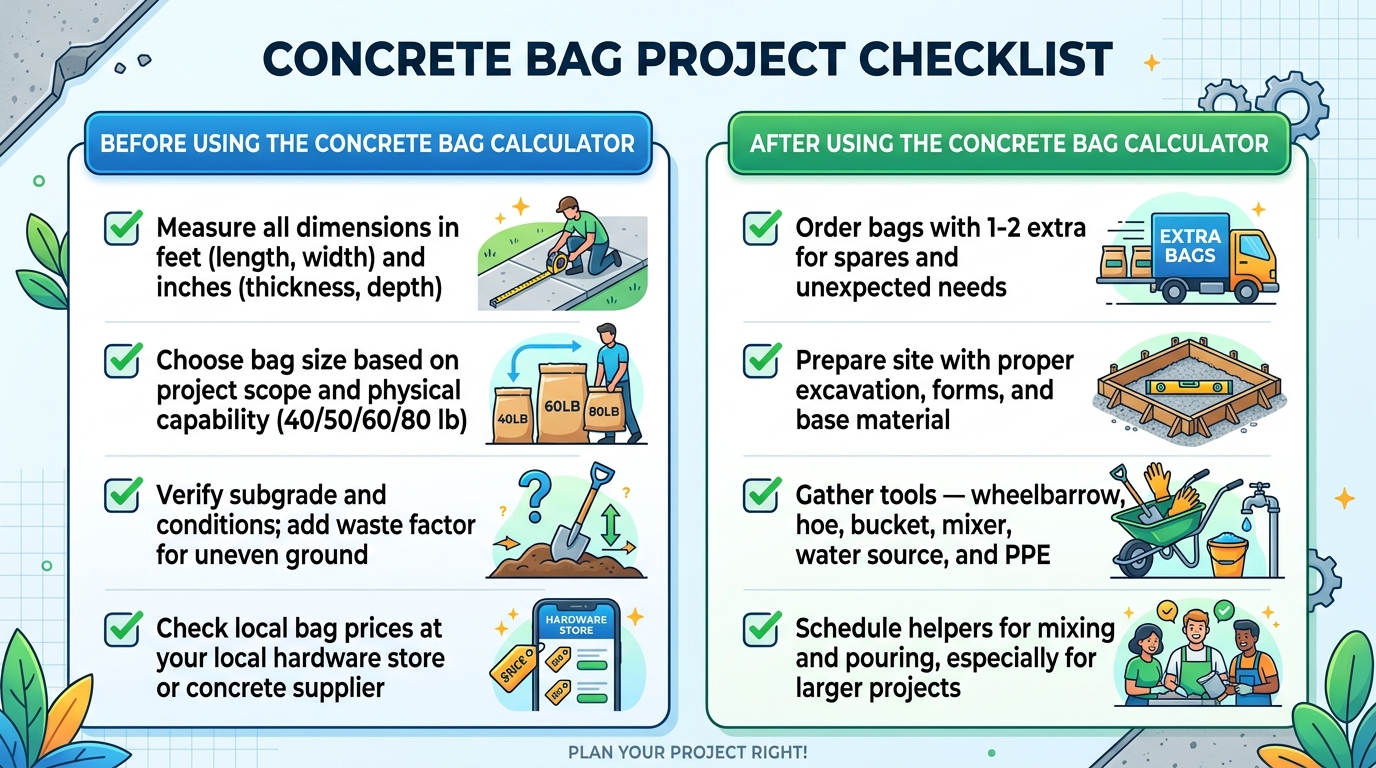
Before Using the Concrete Bag Calculator
After Using the Concrete Bag Calculator
Trusted Construction Resources
Quikrete — Quikrete product calculator for estimating bag quantities for any project, with technical specifications and application guides for all premix products.
Sakrete — Sakrete concrete products for product specifications, project calculators, and DIY guides for concrete repairs and installations.
Portland Cement Association (PCA) — PCA concrete resources for design and construction guides, mix design tools, and educational materials for concrete work.
American Concrete Institute (ACI) — ACI concrete standards for mix design, placement, finishing, and curing of concrete in residential and commercial applications.
OSHA Concrete Safety — OSHA concrete safety for PPE requirements, formwork safety, and silica dust standards in concrete work.
User Reviews & Ratings
Share Your Experience with the Concrete Bag Calculator
Advanced Guide to Concrete Bag Estimation
The concrete bag calculator is a comprehensive tool for DIY homeowners, small contractors, and anyone working on bag-concrete projects. By applying standard volume formulas with proper waste factor adjustments, the concrete bag calculator ensures you order exactly the right number of bags, saving money and preventing mid-project shortages. Whether you are setting fence posts, pouring a shed base, or building deck footings, the tool provides the precision and convenience you need.
For DIY homeowners, the concrete bag calculator removes the confusion of estimating bag quantities. The tool’s four project modes (slab, post hole, circular pad, custom) cover the most common bag-concrete applications, while the cost comparison between bag sizes helps choose the most economical option. The concrete bag calculator is an essential tool for any homeowner planning a concrete project.
For small contractors, the concrete bag calculator speeds up the estimating process. The tool’s quick bag counts and cost calculations help create accurate bids, while the waste factor adjustment prevents material shortages on job sites. The concrete bag calculator is particularly useful for fence installation, deck construction, and small repair work.
For fence installers, the concrete bag calculator post mode is the most-used feature. The tool handles multiple post holes at once, with proper cylindrical volume calculation and 15% waste factor for hand-mixed bag concrete. This eliminates the guesswork of estimating bag quantities for fencing projects of any size.
For deck builders, the concrete bag calculator post mode handles deck footings and pier blocks. The tool calculates the correct concrete volume for cylindrical sonotubes, with cost comparison between bag sizes. For larger decks with many footings, 80-lb bags offer the best cost per cubic foot.
For landscape contractors, the concrete bag calculator handles garden wall footings, stepping stones, fence posts, and decorative concrete projects. The tool’s custom volume mode is perfect for unique landscape applications that don’t fit standard modes.
For retail store staff, the concrete bag calculator helps customers estimate their needs quickly. The tool’s clear output (bag count, cost, volume) supports customer service and helps with product recommendations based on project size and budget.
For concrete industry professionals, the concrete bag calculator is a useful consumer education tool. By providing accurate estimates, the calculator helps customers purchase the right quantity, reducing returns and improving satisfaction.
For home improvement educators, the concrete bag calculator is a teaching tool that demonstrates practical volume math. The tool’s step-by-step output helps students understand concrete estimation principles, preparing them for real-world DIY projects.
For first-time DIYers, the concrete bag calculator provides confidence to tackle concrete projects. The tool’s clear output, waste factor adjustment, and cost estimation help beginners plan and budget their first concrete project without mistakes or waste.
The concrete bag calculator is more than a tool — it is a comprehensive resource for the bag-concrete community. By providing accurate bag counts, cost comparisons, and project guidance, the tool supports successful DIY projects and small contractor work. As bag concrete remains the most accessible option for small pours, the concrete bag calculator will continue to be the trusted companion for accurate, economical concrete estimation.
Final Thoughts on the Concrete Bag Calculator
The concrete bag calculator is the most complete, accurate, and user-friendly tool available for premix bag concrete estimation. Whether you are a DIY homeowner setting a mailbox post, a small contractor pouring deck footings, or anyone planning a bag-concrete project, the concrete bag calculator provides the precision and convenience you need to get the right number of bags every time.
Use the concrete bag calculator before every bag-concrete project. The tool’s four modes, four bag sizes, and cost estimation make it a versatile companion for any project under 1 cubic yard. Combined with proper site preparation, quality materials, and safe handling, the calculator supports successful concrete projects that stand the test of time.
For best results, always combine the concrete bag calculator with proper technique, safety practices, and attention to detail. The calculator provides accurate estimates, but quality installation ensures your concrete project performs as expected for years to come.
🔒 Review Storage Note: All calculations run in your browser. When you submit a review, it is saved to the WordPress site database through the shortcode AJAX handler. No personal data is shared with third parties.
Pingback: Concrete Slab Cost Calculator – Estimate Slab Cost Instantly