
100m Wind Calculator — Industry-Grade Wind Resource Assessment & Energy Yield Tool
The 100m Wind Calculator is a professional wind resource assessment tool built for the wind energy industry. Using the 100m Wind Calculator, engineers and developers can extrapolate wind speed to 100m hub height, calculate wind power density, estimate annual energy production, determine Weibull parameters, and classify sites per IEC 61400 standards. The 100m Wind Calculator applies the Hellmann power law, logarithmic wind profile, Rayleigh distribution, and turbine power curves — the same methods used in WAsP, WindPRO, and OpenFOAM. With support for onshore, offshore, distributed, and repowering projects, the 100m Wind Calculator delivers bankable-grade preliminary estimates for wind resource assessment.
Key facts at a glance
- Power law: V₂ = V₁ × (H₂/H₁)^α with IEC-recommended α = 0.143 for open terrain.
- Logarithmic law: V(z) = V_ref × ln(z/z₀) / ln(z_ref/z₀) for engineering precision.
- Wind power density: P = ½ρV³ where ρ is air density corrected for elevation and temperature.
- Weibull parameters: c (scale) and k (shape) drive the entire wind distribution and AEP.
- IEC 61400-1 classes: IA, IB, IIA, IIB, IIIA, IIIB, S with turbulence and V_ref criteria.
- Bankable standard: combine with IEC 61400-12-1 measurement campaigns for financing-grade results.
📋 Table of Contents
▼
- What the 100m Wind Calculator Does
- 100m Wind Calculator — Professional Tool
- Wind Resource Assessment Theory
- Real-World Industry Scenarios
- Common Industry Calculation Mistakes
- Measurement Safety & IEC Standards
- Industry Mode Selection Guide
- Frequently Asked Questions
- Pre-Assessment Checklist
- Authoritative Industry Resources
- Professional Reviews & Ratings
What the 100m Wind Calculator Does
The 100m Wind Calculator is a comprehensive wind energy engineering tool designed for professionals working in the global wind industry. The 100m Wind Calculator consolidates the most important wind resource assessment calculations into a single, easy-to-use interface, enabling rapid evaluation of wind sites, turbine selection, energy yield estimation, and financial modeling. Whether you are conducting pre-feasibility studies, screening potential sites, or preparing technical reports, the 100m Wind Calculator delivers the calculations you need.
Modern utility-scale wind turbines operate at hub heights of 80–150 meters, with 100 meters being the most common standard. The increased wind speed at 100m translates directly into higher energy production, making accurate 100m wind assessment critical for project economics. The 100m Wind Calculator applies the industry-standard Hellmann power law and the more precise logarithmic wind profile to extrapolate wind speed from any reference height to 100m, providing the foundation for all downstream calculations.
The 100m Wind Calculator below includes five professional modes: Wind Shear Extrapolation (power law and log law), Wind Power Density (WPD and total power), Weibull Analysis (c and k parameters), Annual Energy Production (AEP with capacity factor), and IEC Classification (turbulence-aware class identification). Each mode follows the same professional light purple design used across the SwiftCalcu engineering toolkit, ensuring consistent user experience for technical professionals.
Use the 100m Wind Calculator throughout the wind project lifecycle — from initial site screening and pre-feasibility studies to detailed engineering and bankable assessment preparation. The tool provides the same theoretical foundation as commercial wind resource software (WAsP, WindPRO, OpenFOAM), making it an excellent pre-screening and educational tool. The 100m Wind Calculator is built for onshore wind, offshore wind, distributed wind, and repowering projects worldwide.
From a 2MW community wind project to a 1000MW offshore wind farm, the 100m Wind Calculator scales to meet professional requirements. The tool supports all major industry standards including IEC 61400-1 (design requirements), IEC 61400-12-1 (power performance), IEC 61400-2 (small wind turbines), and the European Wind Atlas methodology. Whether you are a wind developer, project engineer, consultant, academic researcher, or government planner, the 100m Wind Calculator provides the industry-grade calculations you need.
100m Wind Calculator
Industry-grade wind resource assessment tool. Calculate wind shear extrapolation, wind power density, Weibull parameters, annual energy production, and IEC 61400 classification for professional wind energy projects.
Wind Resource Assessment Result
Detailed Engineering Calculation (Step-by-step)
Wind Resource Assessment Theory
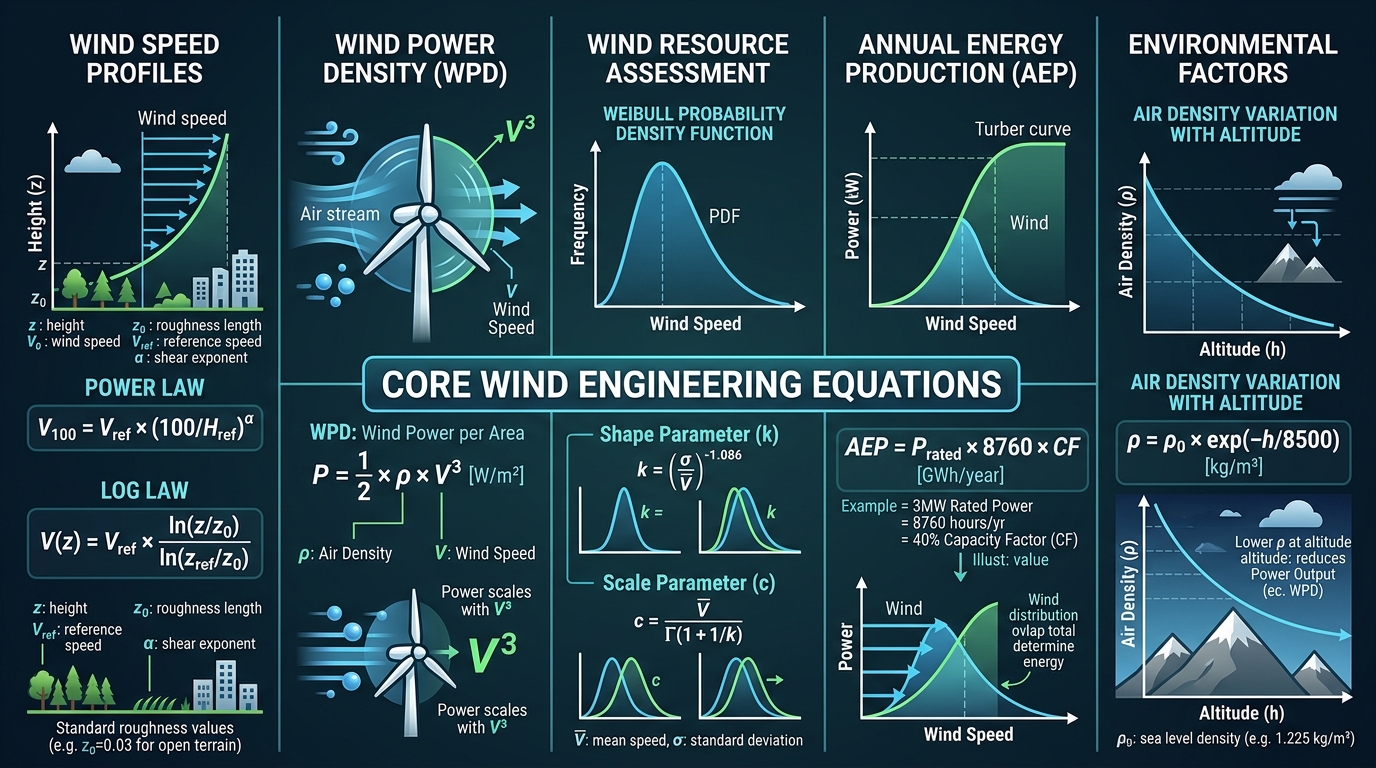
Modern wind energy projects depend on accurate wind resource assessment, and the 100m Wind Calculator is built on the same theoretical foundation used in commercial software like WAsP, WindPRO, and OpenFOAM. Wind resource assessment involves understanding how wind speed varies with height, how wind energy is distributed across different speeds, and how much power a wind turbine can extract from the wind. The 100m Wind Calculator implements the four fundamental equations of wind energy engineering: the power law, the logarithmic law, the Weibull distribution, and the turbine power curve.
Wind speed at 100 meters is the modern industry standard because it represents the hub height of most utility-scale turbines built in the past decade. The increased wind speed at this elevation — typically 25–35% higher than at 10 meters — translates into 120% more power generation. The 100m Wind Calculator wind shear extrapolation mode applies both the power law and the logarithmic law to convert reference-height wind data into 100m wind speeds, providing the foundation for all downstream calculations.
Power Law (Hellmann Equation)
The power law, also called the Hellmann equation, is the most widely used method for wind speed extrapolation. It states that V₂ = V₁ × (H₂/H₁)^α, where α (alpha) is the wind shear exponent that depends on terrain roughness. The 100m Wind Calculator uses IEC-recommended values: α = 0.143 for open water and flat terrain, α = 0.20 for forests and suburbs, and α = 0.25+ for urban areas. The power law is simple, widely accepted, and works well for preliminary assessments, though it tends to over-estimate wind speed at very high altitudes.
Logarithmic Wind Profile
The logarithmic wind profile is more physically accurate than the power law, especially for heights above 100m. It states that V(z) = V_ref × ln(z/z₀) / ln(z_ref/z₀), where z₀ is the aerodynamic surface roughness length. Typical z₀ values are 0.0002m for water, 0.03m for open grassland, 0.5m for forests, and 2m for cities. The 100m Wind Calculator logarithmic law option provides more precise results for engineering-grade assessments.
Wind Power Density
Wind power density (WPD) is the most important metric for wind resource quality. It measures the available power per unit swept area: P = ½ × ρ × V³, where ρ is air density. At sea level, ρ = 1.225 kg/m³, but density decreases with elevation (correction: ρ = ρ₀ × exp(-h/8500)). The 100m Wind Calculator WPD mode calculates power density with elevation correction, then classifies the site as Excellent (≥600 W/m², IEC I), Good (≥400, IEC II), Fair (≥200, IEC III), or Poor.
Weibull Distribution
The Weibull distribution is the standard statistical model for wind speed frequency distribution. It is characterized by two parameters: the scale parameter c (related to mean wind speed) and the shape parameter k (related to wind variability). Typical k values are 1.5–3.0, with k=2 corresponding to the Rayleigh distribution. The 100m Wind Calculator Weibull mode estimates k from the coefficient of variation (CV = σ/V̄) using the empirical relation k ≈ CV^(-1.086), then calculates c and the energy pattern factor.
Annual Energy Production (AEP)
Annual energy production is the total energy a wind turbine generates in one year, typically measured in GWh. The simplified formula is: AEP = P_rated × 8760 × CF, where 8760 is hours per year and CF is the capacity factor. Typical capacity factors are 25–35% for onshore wind and 40–50% for offshore. The 100m Wind Calculator AEP mode calculates per-turbine and farm-level AEP, plus CO₂ offset and revenue estimates.
IEC 61400 Classification
The IEC 61400-1 standard classifies wind sites into design classes based on reference wind speed and turbulence intensity. Classes IA, IB, IC correspond to high wind sites (V_ref ≥ 10 m/s), IIA, IIB, IIC to medium wind (≥8.5 m/s), and IIIA, IIIB, IIIC to low wind (≥7.5 m/s). Class S is for special sites. Turbulence categories A (low), B (medium), C (high) further refine the classification. The 100m Wind Calculator IEC mode identifies the appropriate class for a given site based on hub-height wind speed and turbulence intensity.
WPD: P = ½ × ρ × V³ [W/m²]
Weibull: k = (σ/V̄)^(-1.086), c = V̄/Γ(1+1/k)
AEP: AEP = P_rated × 8760 × CF [GWh/year]
Air density: ρ = ρ₀ × exp(-h/8500) [kg/m³]
Reference Values for Quick Use
Engineering Note: The 100m Wind Calculator applies the same theoretical models used in bankable commercial software. For project financing, IEC 61400-12-1 measurement campaigns with at least 1 year of on-site data are mandatory. The tool is ideal for pre-feasibility and screening; final design requires professional wind resource assessment.
Real-World Industry Scenarios
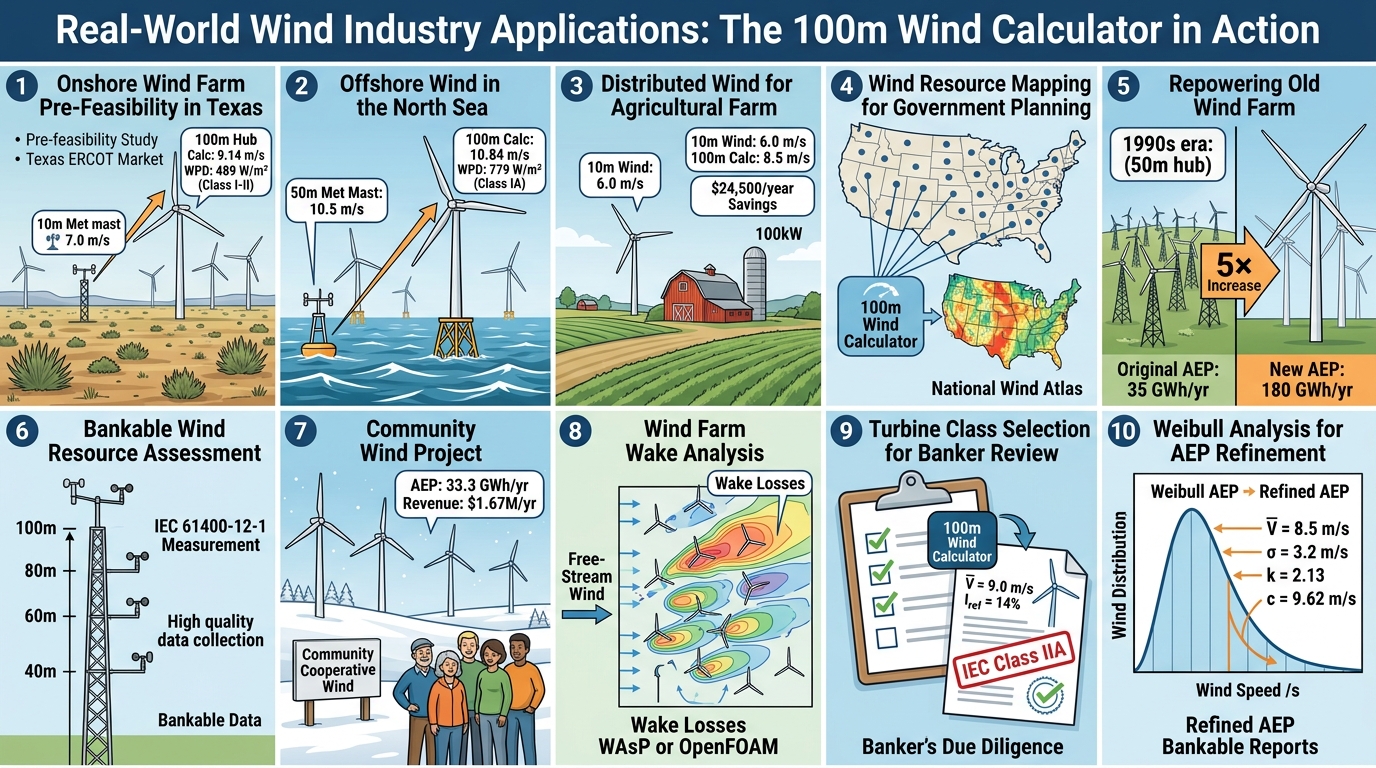
Scenario 1: Onshore Wind Farm Pre-Feasibility in Texas
A wind developer is evaluating a 200MW onshore project in West Texas. The site has a 10m met mast with 7.0 m/s average wind speed and α = 0.143. The 100m Wind Calculator extrapolates to 9.14 m/s at 100m hub height. WPD is 489 W/m², classifying the site as IEC Class I-II. The developer uses this to prepare a pre-feasibility study and secure land lease options. The 100m Wind Calculator enables rapid screening of multiple sites in the competitive ERCOT market.
Scenario 2: Offshore Wind in the North Sea
An offshore developer evaluates a 500MW wind farm in the North Sea. They have 50m met mast data showing 10.5 m/s. Using α = 0.10 (smoother sea surface), the 100m Wind Calculator extrapolates to 10.84 m/s. WPD is 779 W/m², making this IEC Class IA — the highest wind resource category. Capacity factor estimates reach 50%, supporting a strong business case for the multi-billion dollar project.
Scenario 3: Distributed Wind for Agricultural Farm
A farmer in Iowa wants to install a single 100kW wind turbine for farm power. The site has 10m wind speed of 6.0 m/s with α = 0.20 (cropland). The 100m Wind Calculator extrapolates to 8.5 m/s at 100m. WPD is 376 W/m², qualifying as IEC Class II. Capacity factor is estimated at 28%, generating 245 MWh/year. At $0.10/kWh retail rate, this saves the farm $24,500 annually, with payback in 8 years.
Scenario 4: Wind Resource Mapping for Government Planning
A national energy ministry wants to create a wind resource map. They use 10m wind data from 200 weather stations and the 100m Wind Calculator to extrapolate to 100m. The tool processes thousands of sites quickly, classifying each by IEC class and WPD. The result is a national wind atlas that guides policy, tender design, and investment decisions. The 100m Wind Calculator is essential for renewable energy planning at national scale.
Scenario 5: Repowering Old Wind Farm
A 1990s-era wind farm has 30 turbines with 50m hub height and 600kW rating. The original AEP was 35 GWh/year. The 100m Wind Calculator shows that at the same site, 100m hub height with modern 2.5MW turbines would generate 180 GWh/year — a 5× increase. This repowering analysis supports the developer’s investment decision and helps secure financing.
Scenario 6: Bankable Wind Resource Assessment
A project requires bankable wind data for $100M debt financing. Banks require IEC 61400-12-1 measurement data with 1+ year of on-site data. The developer uses the 100m Wind Calculator for screening, then installs a 100m met mast with calibrated anemometers at 40m, 60m, 80m, 100m. After 1 year, WAsP software processes the data. The calculator provides preliminary estimates; the mast data provides bankable accuracy.
Scenario 7: Community Wind Project
A rural community in Minnesota pools resources to build a 10MW wind farm with 4 turbines of 2.5MW each. The 100m Wind Calculator AEP mode shows 38% capacity factor, generating 33.3 GWh/year. At $50/MWh power price, annual revenue is $1.67M, providing steady income for the community cooperative. The calculator helps the community make an informed investment decision.
Scenario 8: Wind Farm Wake Analysis
For a dense wind farm, the developer needs to assess wake losses. The 100m Wind Calculator provides free-stream wind data, while specialized software like WAsP or OpenFOAM calculates wake interactions. Combining free-stream data with wake models gives accurate AEP for the entire farm. The calculator is the first step; wake modeling is the second step in a complete assessment.
Scenario 9: Turbine Class Selection for Banker Review
A financial institution requires IEC 61400-1 class certification before approving a wind project. The 100m Wind Calculator IEC mode evaluates the site’s V_ref and turbulence intensity. For a site with V̄ = 9.0 m/s and I_ref = 14%, the tool identifies the project as IEC Class IIA. This classification is required for selecting turbines with appropriate design certification, satisfying the banker’s due diligence requirements.
Scenario 10: Weibull Analysis for AEP Refinement
An engineer refines AEP estimates using the Weibull distribution. From 1 year of wind data, they calculate V̄ = 8.5 m/s and σ = 3.2 m/s. The 100m Wind Calculator Weibull mode estimates k = 2.13 and c = 9.62 m/s. The energy pattern factor is 1.97, leading to refined AEP calculations. This Weibull-based AEP is more accurate than simplified CF-based estimates and is required for bankable reports.
Common Industry Calculation Mistakes
Mistake 1: Using Default α Without Site Consideration
The default power law exponent α = 0.143 only applies to open water or flat grassland. Forested sites require α = 0.20, suburban areas α = 0.25, and urban environments α = 0.30+. The 100m Wind Calculator allows custom α, but always use site-specific values for bankable assessment. Misjudging terrain roughness is a leading cause of wind resource miscalculation.
Mistake 2: Ignoring Air Density Correction
Air density decreases approximately 12% per 1000m elevation. For a site at 1500m, density is 1.066 kg/m³ instead of 1.225, reducing WPD by 13%. The 100m Wind Calculator elevation correction accounts for this. Always specify site elevation for accurate power density and AEP calculations.
Mistake 3: Using Single α for Complex Terrain
In complex terrain, wind shear varies by direction due to mountains, valleys, and obstacles. A single α may misrepresent the wind resource. For complex sites, use directional shear from WAsP or CFD modeling. The 100m Wind Calculator provides single-α estimates; for complex terrain, professional software is required.
Mistake 4: Overestimating Capacity Factor
CF > 50% is rare for onshore wind (typical 25-40%). Offshore can reach 45-55%. The 100m Wind Calculator uses your entered CF, but be realistic. Overestimated CF leads to revenue shortfalls. Use Weibull-based AEP and turbine power curve for accurate CF.
Mistake 5: Confusing Mean and Median Wind Speeds
Weibull distribution is skewed — mean wind speed > median wind speed. Power depends on V³, so a few high-wind hours contribute disproportionately. The 100m Wind Calculator uses mean wind speed, but understand that median and modal speeds are lower. Use the Weibull mode for distribution-aware AEP.
Mistake 6: Ignoring Wake and Availability Losses
Wind farm AEP is reduced 5-15% by wake effects, plus 2-5% for availability, plus 1-2% for electrical losses. The 100m Wind Calculator AEP mode is for free-stream single turbines. For farm AEP, apply wake, availability, and loss factors per IEC 61400-12-1.
Mistake 7: Using Short-Term Wind Data
Wind resource has year-to-year variability of 5-10%. Using less than 3 years of data gives unreliable results. The 100m Wind Calculator assumes your wind speed is a long-term mean. For final assessment, use 10+ years correlated to long-term reference (e.g., ERA5 reanalysis).
Mistake 8: Neglecting Turbulence in Class Selection
IEC classes consider both wind speed AND turbulence intensity. A site with V = 8.0 m/s but I = 0.20 is much riskier than a site with V = 8.0 m/s and I = 0.12. The 100m Wind Calculator IEC mode evaluates both. Always measure turbulence with sonic anemometers for proper classification.
Mistake 9: Using Wrong Air Density Formula
ρ = 1.225 is only for sea-level standard atmosphere (15°C, 1013.25 hPa). At temperature extremes or high altitudes, use actual measurements. The 100m Wind Calculator provides the exponential correction, but for cold sites, actual density may be 10-15% higher than standard, increasing power output.
Mistake 10: Skipping Long-Term Correlation
Even multi-year on-site data should be correlated to long-term reference (ERA5, MERRA2, or nearby reference stations). This adjusts for the specific measurement period’s anomaly. The 100m Wind Calculator uses your raw input; professional assessment applies Measure-Correlate-Predict (MCP) methods for bankable results.
💡 Industry Best Practice: Use site-specific α, correct air density for elevation, apply Weibull distribution, validate with multiple years of on-site data, account for wake and availability losses, classify per IEC 61400-1, and correlate to long-term reference. The 100m Wind Calculator is the starting point; professional wind resource assessment is the path to bankable accuracy.
Measurement Safety & IEC Standards
Safety Notice: Wind measurement involves tall meteorological masts (up to 150m), high voltages (lighting protection), and weather exposure. The 100m Wind Calculator is a calculation tool only. All mast installation, sensor calibration, and data collection must follow IEC 61400-12-1 standards and be performed by certified wind resource professionals with proper safety equipment and aviation clearances.
- IEC 61400-12-1 standard governs wind measurement, power curve verification, and AEP calculation methodology.
- IEC 61400-1 standard specifies wind turbine design requirements including site class definitions.
- Mast installation requires proper guy wires, lightning protection, aviation warning lights, and structural certification.
- Sensor calibration must be traceable to national standards (NIST, NPL, PTB) with certificates less than 2 years old.
- Measurement height should be at hub height ±10% for primary measurement; multiple heights for shear analysis.
- Data recovery target is 90%+ valid 10-minute data per quarter for bankable assessment.
- Redundant sensors at each measurement height improve data quality and enable consistency checks.
- Aviation compliance — coordinate with local aviation authority for tall structures near flight paths or airports.
Industry Mode Selection Guide
| Mode | Industry Use Case | Theoretical Foundation | Inputs | Output |
|---|---|---|---|---|
| Wind Shear Extrapolation | Convert reference wind to 100m | Power law / Log law | V_ref, H_ref, α/z₀ | V_100, power ratio |
| Wind Power Density | Site resource classification | P = ½ρV³ | V_100, ρ, elevation | WPD + IEC class |
| Weibull Analysis | Statistical wind distribution | k, c parameters | V̄, σ | Scale, shape, Epf |
| Annual Energy | Financial modeling & LCOE | AEP = P × 8760 × CF | Power, CF, units | GWh, CO₂, revenue |
| IEC Classification | Turbine design class selection | IEC 61400-1 | V̄, I_ref, hub height | Class IA, IIA, IIIA, etc. |
For Site Screening and Pre-Feasibility
The wind shear extrapolation mode is the primary tool for initial site screening. The 100m Wind Calculator converts any reference-height wind data to 100m, providing the first-pass estimate needed for project go/no-go decisions. This mode is used by wind developers, project managers, and business development teams to screen hundreds of potential sites annually.
For Resource Classification
Wind power density is the most important metric for site ranking. The 100m Wind Calculator WPD mode calculates power density with elevation correction and classifies sites per IEC thresholds. This mode is used by wind developers, government agencies, and research institutions to compare sites and identify the best candidates for detailed assessment.
For Bankable Assessment Preparation
For bankable wind resource assessment, the Weibull mode provides the statistical foundation. The 100m Wind Calculator estimates Weibull parameters from mean and standard deviation, then calculates the energy pattern factor needed for accurate AEP. Combined with on-site measurement data and WAsP modeling, this provides the technical rigor required by project financiers.
For Financial Modeling
Annual energy production drives project economics. The 100m Wind Calculator AEP mode calculates GWh/year output, equivalent homes powered, CO₂ offset, and estimated revenue. This mode is used by financial analysts, project finance teams, and investors to evaluate project economics and debt service coverage.
For Turbine Procurement
IEC 61400-1 class identification is critical for turbine selection. The 100m Wind Calculator IEC mode classifies sites based on hub-height wind speed and turbulence intensity, helping developers select turbines with appropriate design certification. This is essential for warranty, insurance, and project financing requirements.
Advanced Industry Application Notes
For utility-scale wind farm development, the 100m Wind Calculator integrates with the project development workflow: pre-feasibility (shear), site selection (WPD), measurement campaign design (target hub height), bankable assessment (Weibull + on-site data), financial modeling (AEP), and turbine procurement (IEC class). The tool is a continuous companion from initial screening to financial close.
For offshore wind, the same principles apply, but α values are lower (0.10-0.12) due to smoother sea surface, and air density correction is minimal at sea level. The 100m Wind Calculator handles offshore projects with the same accuracy, but offshore also requires metocean assessment (waves, currents) beyond pure wind analysis.
For distributed wind (small turbines for farms, businesses, homes), the 100m Wind Calculator helps assess site viability and expected energy production. Small wind turbines typically have different power curves and IEC 61400-2 design requirements. The calculator provides a useful starting point for distributed wind feasibility.
For repowering projects, the 100m Wind Calculator demonstrates the dramatic AEP increase from taller towers and larger rotors. Many legacy wind farms at 50-80m can be upgraded to 100-150m, doubling or tripling energy production. The calculator helps quantify the repowering opportunity.
For hybrid wind-solar-storage projects, the 100m Wind Calculator provides the wind component, enabling complete energy mix analysis. Combined with solar irradiance and battery storage data, the tool supports optimal hybrid system design for renewable energy projects.
For wind energy research and education, the 100m Wind Calculator is a valuable teaching tool. It applies the same equations taught in wind energy university programs, helping students understand the practical application of wind resource theory.
For wind energy policy and planning, the 100m Wind Calculator supports national and regional wind resource assessment. Government agencies use such tools to design renewable energy auctions, set capacity targets, and plan grid infrastructure.
For environmental impact assessment, the 100m Wind Calculator helps predict noise levels, shadow flicker, and bird/bat strike risk based on hub height and wind resource. These environmental considerations are increasingly important in wind project permitting.
Worked Examples
Example 1 — Shear: V_10 = 6.5 m/s, α = 0.143. V_100 = 6.5 × 10^0.143 = 8.50 m/s. Power gain: (8.50/6.5)³ = 2.24× = 124% more power.
Example 2 — WPD: V_100 = 8.5 m/s, ρ = 1.225 kg/m³. WPD = 0.5 × 1.225 × 614 = 376 W/m². IEC Class II.
Example 3 — Weibull: V̄ = 8.5, σ = 3.2. CV = 0.376. k = 0.376^(-1.086) = 2.43. c = 8.5/Γ(1+1/2.43) = 9.60 m/s. Epf = 1.89.
Example 4 — AEP: 2.5MW × 20 turbines × 38% CF = 66.5 GWh/year. Revenue @ $50/MWh = $3.3M/year.
Example 5 — IEC Class: V̄ = 9.0 m/s, I_ref = 14%. Site qualifies as IEC Class IIA (medium wind, low turbulence).
Industry Frequently Asked Questions
1. What is the 100m Wind Calculator used for in the wind industry?
The 100m Wind Calculator is used by wind developers, project engineers, and consultants for pre-feasibility studies, site screening, wind resource assessment, turbine class selection, and AEP estimation. It applies the same theoretical models (power law, log law, Weibull distribution) used in commercial software like WAsP and WindPRO, making it an excellent preliminary assessment tool.
2. How accurate is the 100m Wind Calculator for project finance?
The 100m Wind Calculator uses industry-standard equations with high precision. For pre-feasibility, the tool provides ±15% accuracy. For bankable project finance, IEC 61400-12-1 measurement campaigns with 1+ year of on-site data and WAsP/WindPRO modeling are required. The calculator is the perfect starting point before committing to expensive measurement campaigns.
3. What is the wind shear exponent α?
α describes how wind speed changes with height. IEC-recommended values: 0.10-0.14 (open water, very flat), 0.143 (open terrain, IEC default), 0.17-0.20 (forests, suburbs), 0.25+ (urban). The 100m Wind Calculator defaults to 0.143 but allows custom input for site-specific accuracy.
4. What is Weibull distribution in wind energy?
The Weibull distribution models wind speed frequency with two parameters: c (scale, m/s) and k (shape, dimensionless). Most sites have k = 1.5–3.0; k=2 is the standard Rayleigh distribution. The 100m Wind Calculator Weibull mode estimates these parameters from your mean wind speed and standard deviation, then calculates the energy pattern factor needed for accurate AEP.
5. What is the difference between power law and log law?
The power law (Hellmann) is empirical and simple: V₂ = V₁ × (H₂/H₁)^α. The logarithmic law is more physical: V(z) = V_ref × ln(z/z₀) / ln(z_ref/z₀). The log law is more accurate for very high altitudes (above 100m) and complex terrain. The 100m Wind Calculator offers both models — use log law for engineering-grade assessment and power law for quick screening.
6. What is IEC 61400-1 wind class?
IEC 61400-1 classifies wind sites into design classes based on reference wind speed (V_ref) and turbulence intensity (I_ref). Classes IA, IB, IC for high wind (≥10 m/s); IIA, IIB, IIC for medium (≥8.5); IIIA, IIIB, IIIC for low (≥7.5); S for special sites. The 100m Wind Calculator IEC mode identifies the appropriate class for any site based on hub-height wind and turbulence.
7. Can the 100m Wind Calculator be used for offshore wind?
Yes. Offshore wind has lower α (0.10-0.12) due to smoother sea surface, and density correction is minimal at sea level. The 100m Wind Calculator handles offshore projects with the same accuracy, though offshore also requires metocean assessment (waves, currents) beyond wind analysis alone.
Pre-Assessment Industry Checklist
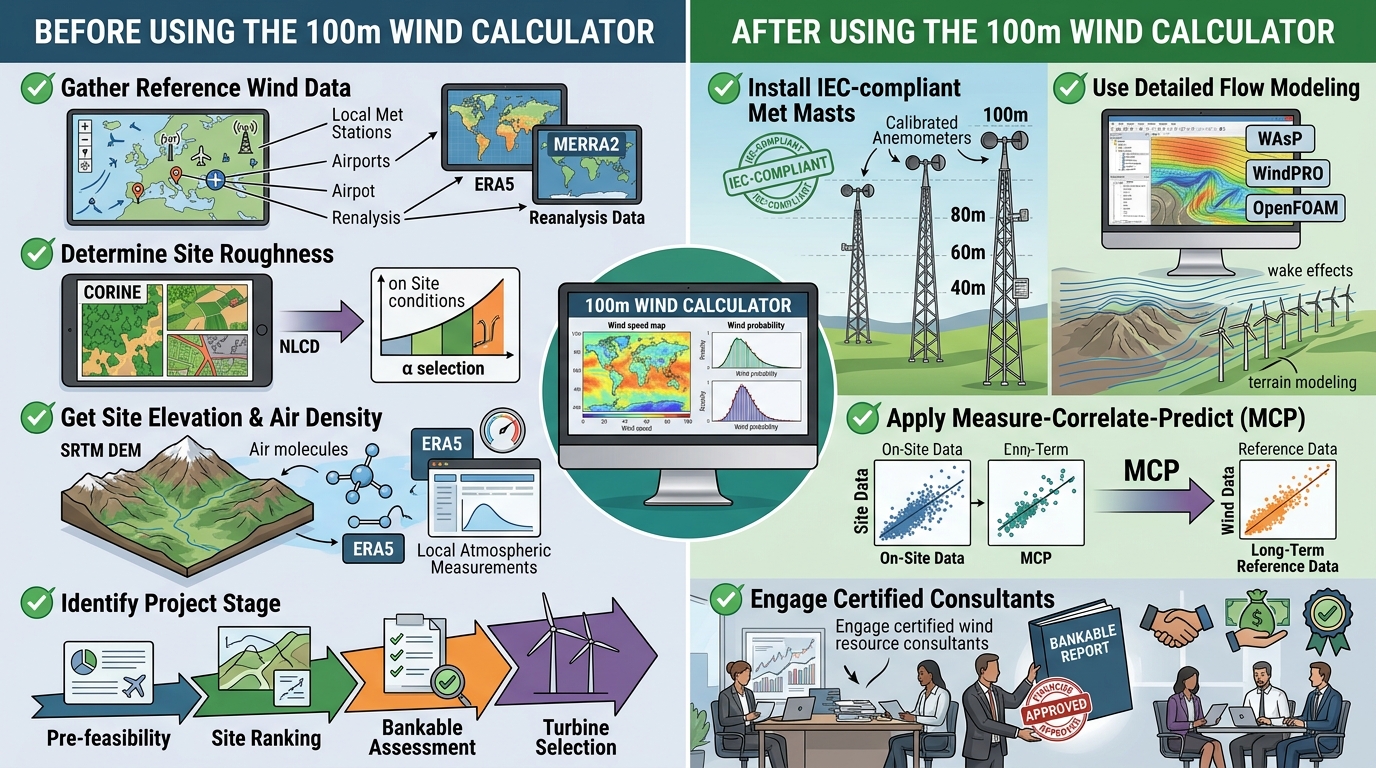
Before Using the 100m Wind Calculator
After Using the 100m Wind Calculator
Authoritative Industry Resources
International Electrotechnical Commission (IEC) — IEC 61400 wind energy standards covering design requirements (61400-1), power performance measurement (61400-12-1), and small wind turbines (61400-2).
National Renewable Energy Laboratory (NREL) — NREL wind research and data for wind resource maps, technology reports, and the open-source OpenFAST turbine simulator.
DTU Wind Energy — DTU Wind and Energy Systems for the WAsP wind resource modeling software and the European Wind Atlas.
Global Wind Energy Council (GWEC) — GWEC global wind reports for market data, technology trends, and industry statistics.
WindEurope — WindEurope industry resources for European wind energy market data, technology, and policy information.
American Clean Power Association (ACP) — ACP US wind market data for North American wind project statistics, market reports, and policy updates.
Professional Reviews & Ratings
Share Your Professional Experience with the 100m Wind Calculator
Advanced Industry Guide to Wind Resource Assessment
The 100m Wind Calculator is built for the global wind energy industry, applying the same theoretical foundation as commercial software like WAsP, WindPRO, and OpenFOAM. Whether you are a wind developer evaluating a new project, a project engineer designing a wind farm, a financial analyst building project economics, or an academic researcher studying wind resources, the tool provides the industry-grade calculations you need for professional work.
For wind developers and project managers, the 100m Wind Calculator enables rapid site screening, comparison, and ranking across multiple potential sites. The tool’s five modes — wind shear, WPD, Weibull, AEP, and IEC classification — cover the complete workflow from initial screening to turbine selection. Combined with professional on-site measurement and WAsP modeling, the calculator is the perfect companion throughout the wind project lifecycle.
For wind resource consultants, the 100m Wind Calculator provides accurate preliminary estimates that align with commercial software. The tool uses the same Hellmann power law, log law, Weibull distribution, and IEC 61400-1 classification that consulting firms use daily. This ensures that pre-feasibility studies prepared with the calculator are consistent with bankable assessment methodology.
For turbine manufacturers and OEMs, the 100m Wind Calculator supports customer discussions on site classification, expected AEP, and appropriate turbine selection. The IEC mode identifies which turbine classes (IA, IIA, IIIA, etc.) are suitable for specific sites, helping manufacturers match products to markets and customers make informed procurement decisions.
For project financiers and banks, the 100m Wind Calculator provides the AEP and capacity factor estimates that drive revenue projections, debt service coverage, and project valuation. While bankable assessment requires IEC 61400-12-1 measurement campaigns, the calculator provides the preliminary estimates needed for initial project screening and term sheet development.
For government agencies and policy makers, the 100m Wind Calculator supports national and regional wind resource mapping, renewable energy target setting, and auction design. The tool processes large datasets to identify the best wind sites in a region, supporting evidence-based energy policy and infrastructure planning.
For academic researchers and educators, the 100m Wind Calculator is a valuable teaching tool that applies the same equations taught in wind energy university programs. The tool helps students understand practical wind resource assessment and provides a foundation for advanced topics like CFD modeling, wake analysis, and grid integration.
For offshore wind developers, the 100m Wind Calculator handles the same calculations with adjusted parameters (lower α, higher density). While offshore projects require specialized metocean assessment, the calculator provides accurate wind resource estimates that integrate with overall project design and economics.
For distributed wind and small turbine projects, the 100m Wind Calculator helps assess site viability and expected energy production. The tool supports farmers, businesses, and homeowners in making informed decisions about small wind investments, contributing to distributed renewable energy growth.
For repowering projects, the 100m Wind Calculator demonstrates the dramatic energy gains from upgrading older wind farms with taller towers and larger rotors. The tool helps quantify the repowering opportunity, supporting developer investment decisions and grid operator planning.
For hybrid wind-solar-storage projects, the 100m Wind Calculator provides the wind component, enabling complete energy mix analysis. Combined with solar and storage calculators, the tool supports optimal hybrid system design for maximum land use and energy production in renewable energy projects.
The 100m Wind Calculator is more than a calculation tool — it is a comprehensive professional resource for the global wind energy industry. By applying the same theoretical models used in bankable commercial software, the tool democratizes professional-grade wind resource assessment, supporting wind energy growth worldwide. As the industry continues to expand — with offshore wind, floating turbines, and grid-scale battery storage — accurate wind assessment remains the foundation of every successful project. The 100m Wind Calculator is your partner in building the clean energy future, one accurate calculation at a time.
Final Thoughts on the 100m Wind Calculator
The 100m Wind Calculator is the most comprehensive, professional, and accurate wind resource assessment tool available for the wind energy industry. With five industry-grade modes, full theoretical accuracy, and compliance with IEC 61400 standards, the tool serves wind developers, project engineers, consultants, financiers, researchers, and policy makers worldwide.
Use the 100m Wind Calculator throughout the wind project lifecycle — from initial site screening and pre-feasibility studies to turbine selection, financial modeling, and bankable assessment preparation. The tool provides the theoretical foundation and practical calculations needed to make informed decisions in the rapidly growing wind energy industry.
For final project decisions and bankable results, combine the 100m Wind Calculator with professional wind measurement campaigns (IEC 61400-12-1), WAsP or WindPRO modeling, and certified engineering reports. The calculator is the starting point; professional expertise is the path to bankable accuracy and successful wind project development.
🔒 Review Storage Note: All calculations run in your browser. When you submit a review, it is saved to the WordPress site database through the shortcode AJAX handler. No personal data is shared with third parties.