
Solar Load Calculator — Solar Panel Sizing, Inverter Sizing, Battery Backup & Energy Requirement Tool
A Solar Load Calculator is a free online tool that helps homeowners, businesses, and installers calculate the total electrical load, required solar panel wattage, inverter capacity, battery backup size, and daily energy consumption for any solar PV system. Using the Solar Load Calculator, you can enter your appliance wattage, quantity, and daily usage hours, and it instantly calculates your total daily energy requirement in watt-hours (Wh) or kilowatt-hours (kWh), peak load in watts, recommended inverter size, and required solar panel capacity. The Solar Load Calculator supports five practical modes: total load calculation, solar panel sizing, inverter sizing, battery backup sizing, and complete off-grid system design, making the Solar Load Calculator a comprehensive solar planning tool for residential, commercial, and industrial users worldwide.
Key facts at a glance
- Core formula: daily energy (Wh) = appliance wattage × quantity × hours of use per day.
- Total load: sum of (watts × quantity) for all appliances gives the peak load in watts.
- Solar panel sizing: required solar wattage = daily energy ÷ peak sun hours ÷ system efficiency.
- Inverter sizing: inverter size (W) = total peak load × 1.25 safety factor.
- Battery sizing: battery capacity (Wh) = daily energy × backup days ÷ battery depth of discharge.
- Best practice: add 20–30% overage for system losses, future expansion, and cloudy days.
📋 Table of Contents
▼
- What a Solar Load Calculator Does
- Solar Load Calculator — Advanced Tool
- How Solar Load Calculations Work
- Real Scenarios Where the Solar Load Calculator Helps
- Common Solar Load Calculation Mistakes
- Solar Installation Safety and Planning Essentials
- Which Mode Fits Your Solar Project
- Frequently Asked Questions
- Solar System Planning Checklist
- Trusted Solar Reference Resources
- User Reviews & Ratings
What a Solar Load Calculator Does
A Solar Load Calculator takes your appliance list, their wattage, quantity, and daily usage hours, then combines them using standard electrical and solar formulas to give you the complete energy requirement for any solar PV system. The Solar Load Calculator eliminates guesswork and instantly shows you the total daily energy consumption, peak load, recommended inverter size, solar panel capacity, and battery backup needed for your specific project.
Whether you are designing a small home solar system, a backup power solution for essential appliances, a complete off-grid cabin system, or a large commercial installation, accurate load calculation is the foundation of every successful solar project. The Solar Load Calculator standardizes this process using industry-accepted formulas, making it accessible to homeowners, electricians, solar installers, engineers, and project managers across the world.
The Solar Load Calculator below includes five practical modes: Total Load Calculator (sum all appliances), Solar Panel Sizing (calculate required panel wattage), Inverter Sizing (find the right inverter capacity), Battery Backup Sizing (calculate battery bank size for autonomy), and Complete Off-Grid System (full system design with all components). Each mode follows the same elegant light purple design used across the SwiftCalcu toolkit, ensuring a smooth and consistent user experience.
Use the Solar Load Calculator as your planning companion before purchasing any solar equipment. The tool helps you estimate the correct system size, avoid under-sizing or over-sizing, calculate expected costs, and prepare accurate quotations for customers. The Solar Load Calculator does not replace a professional site survey or a certified solar installer, but it gives you a reliable preliminary design that saves time and prevents costly mistakes.
From a 1kW home backup system to a 100kW commercial installation, the Solar Load Calculator scales to meet your needs. Whether you live in Pakistan, India, USA, UK, UAE, Saudi Arabia, Nigeria, South Africa, Australia, or any other country, the underlying formulas remain the same. The Solar Load Calculator works for grid-tied systems, off-grid systems, hybrid systems, and solar water pumping applications.
Solar Load Calculator
Calculate total electrical load, solar panel sizing, inverter capacity, battery backup, and complete off-grid system design with step-by-step output for residential, commercial, and industrial solar projects.
Your Solar Load Result
Step-by-step calculation
How Solar Load Calculations Work
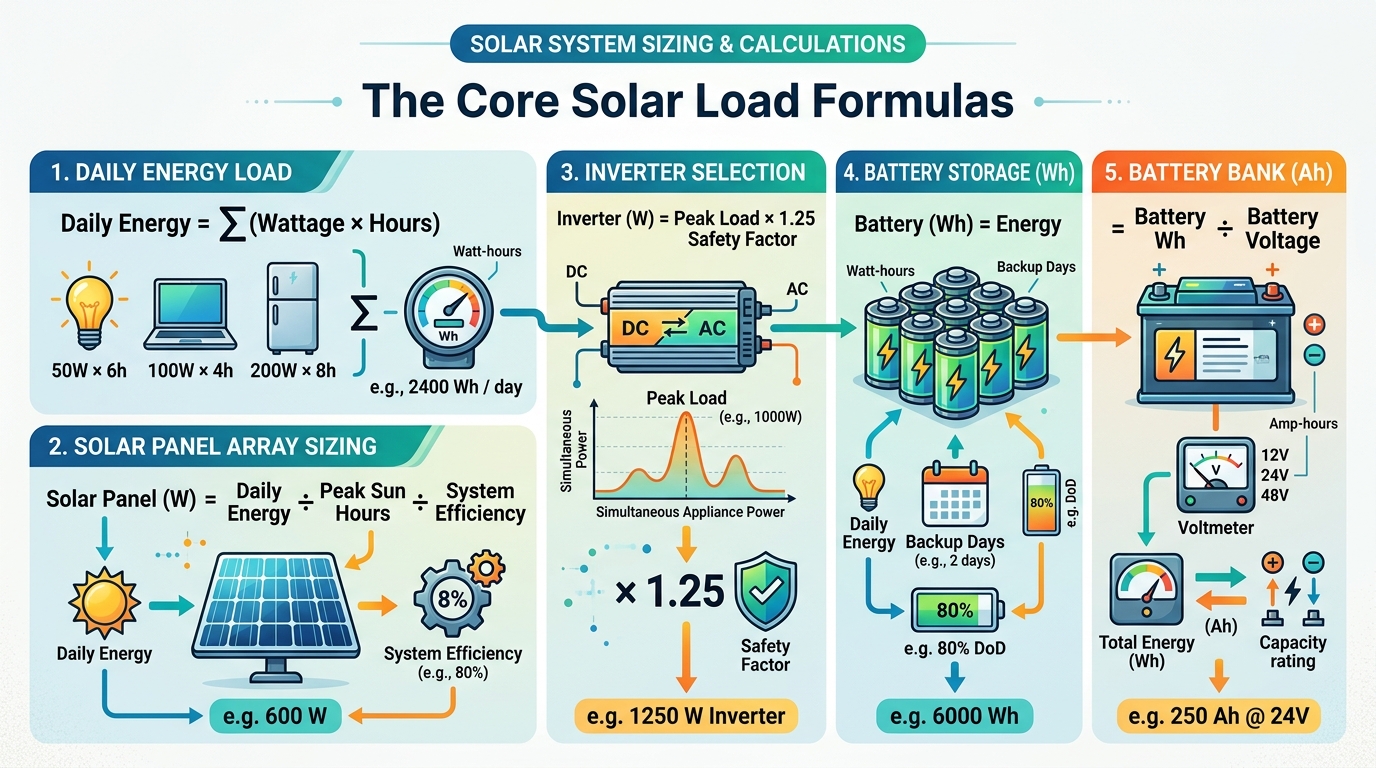
A Solar Load Calculator applies industry-standard electrical and solar formulas to determine the size, capacity, and components required for a complete solar PV system. The calculation begins with your appliance list, where each appliance is measured by its wattage (W) and the number of hours it runs per day. The product of wattage and hours gives the daily energy consumption in watt-hours (Wh), which forms the foundation of every solar system design. The Solar Load Calculator automates this entire process and provides accurate results in seconds.
The most fundamental formula in solar load calculation is: daily energy (Wh) = appliance wattage (W) × quantity × daily usage hours. For example, five 10W LED bulbs running 6 hours per day consume 5 × 10 × 6 = 300 Wh per day. The Solar Load Calculator applies this formula to all your appliances and sums the results to give total daily energy consumption. This figure is then used to size solar panels, batteries, and inverters.
Total Daily Energy Consumption
The first step in any solar design is calculating total daily energy consumption. Sum the energy used by every appliance — lights, fans, refrigerator, air conditioner, TV, washing machine, water pump, computer, and any other electrical device. The Solar Load Calculator total load mode does this automatically. For a typical 3-bedroom home, daily consumption ranges from 10 kWh to 30 kWh depending on the appliances used and lifestyle. A commercial office may consume 50–200 kWh per day, while a small shop may use only 5–10 kWh.
Solar Panel Sizing
Once daily energy is known, the next step is to size the solar panel array. The formula is: required solar wattage (W) = daily energy (Wh) ÷ peak sun hours ÷ system efficiency. Peak sun hours depend on your location and season — typically 4–6 hours in most regions. System efficiency accounts for losses in wiring, inverter, temperature, dust, and shading, usually 70–80%. The Solar Load Calculator solar panel mode applies this formula and recommends the total panel wattage and the number of 400W or 550W panels required.
Inverter Sizing
The inverter converts DC electricity from solar panels and batteries into AC electricity for home appliances. Inverter size is based on peak load with a safety margin: inverter size (W) = total peak load × 1.25. The 1.25 factor accounts for surge currents from motors, compressors, and inductive loads. The Solar Load Calculator inverter mode calculates the recommended inverter capacity, which is usually the next standard size up (e.g., 3kW, 5kW, 10kW) to ensure safe operation.
Battery Backup Sizing
Batteries store energy for use at night or during grid outages. Battery capacity is calculated as: battery capacity (Wh) = daily energy × backup days ÷ depth of discharge. Depth of discharge (DoD) depends on battery type: 50% for lead-acid, 80% for lithium-ion, 60% for tubular. The Solar Load Calculator battery mode calculates the required capacity in watt-hours and amp-hours, and recommends the number of standard batteries (e.g., 150Ah, 200Ah) to use.
Inverter (W) = Peak Load × 1.25 Safety Factor
Battery (Wh) = Daily Energy × Backup Days ÷ Depth of Discharge
Battery (Ah) = Battery Wh ÷ Battery Voltage
Quick Reference Values
Remember: The Solar Load Calculator provides a preliminary design based on standard formulas. Actual system performance depends on site conditions, equipment quality, installation practices, weather, and maintenance. Always consult a certified solar installer for a professional site survey and final system design before purchasing equipment.
Real Scenarios Where the Solar Load Calculator Helps
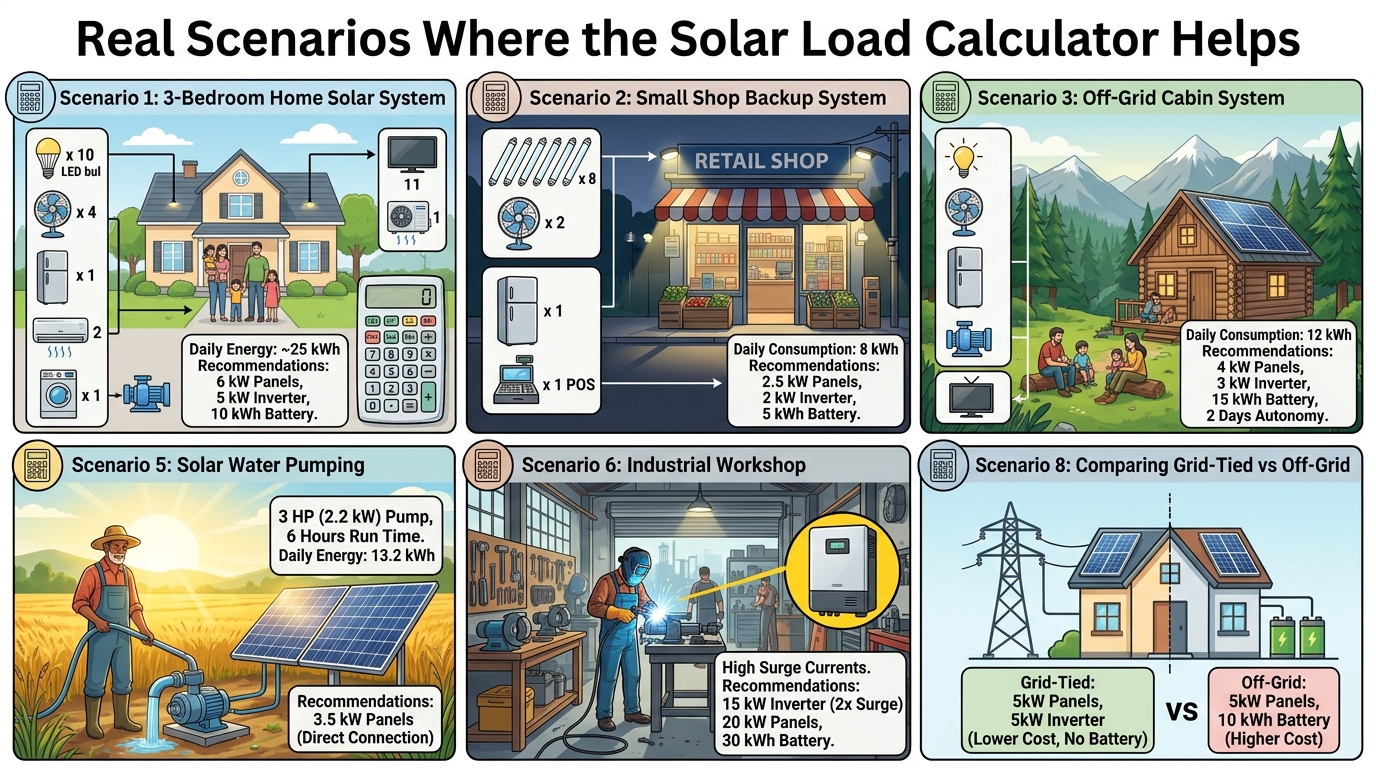
Scenario 1: 3-Bedroom Home Solar System
A family wants to install a 5kW solar system for their 3-bedroom home. They have 10 LED bulbs, 4 fans, 1 refrigerator, 2 AC units, 1 TV, 1 washing machine, and 1 water pump. Using the Solar Load Calculator, they calculate daily energy of approximately 25 kWh. The tool recommends 6 kW of solar panels, a 5kW inverter, and a 10 kWh lithium battery bank. This preliminary design helps them get accurate quotes from installers and budget effectively. The Solar Load Calculator prevents the common mistake of under-sizing or over-sizing the system.
Scenario 2: Small Shop Backup System
A small retail shop needs a 2kW backup system for essential loads during load-shedding. They have 8 tube lights, 2 fans, 1 refrigerator, and 1 POS system. The Solar Load Calculator shows daily consumption of 8 kWh, recommending 2.5kW of panels, a 2kW inverter, and a 5kWh battery bank. The shop owner uses this design to negotiate with installers and choose the right hybrid inverter. The Solar Load Calculator ensures they get a system that meets their needs without overspending.
Scenario 3: Off-Grid Cabin System
A family builds a remote cabin in a mountainous area with no grid access. They need 100% solar power for basic needs: lights, fans, refrigerator, water pump, and a small TV. The Solar Load Calculator complete system mode calculates 12 kWh daily consumption, recommending 4kW solar panels, 3kW inverter, and 15 kWh battery bank for 2 days of autonomy. This off-grid design is reliable year-round with proper sun exposure. The Solar Load Calculator is essential for off-grid planning.
Scenario 4: Commercial Office Building
A 50-person office building wants to install a 50kW solar system to reduce electricity bills. They have extensive lighting, 30 computers, 10 AC units, elevators, and kitchen equipment. The Solar Load Calculator shows daily consumption of 200 kWh, recommending 60kW of solar panels, a 50kW inverter, and a grid-tied system with net metering. The tool helps the project manager prepare a detailed ROI analysis and present it to management. The Solar Load Calculator scales from small homes to large commercial installations.
Scenario 5: Solar Water Pumping
A farmer wants to install a solar water pump for irrigation. The pump requires 3 HP (2.2 kW) and runs 6 hours per day. The Solar Load Calculator shows daily energy of 13.2 kWh, recommending 3.5kW of solar panels directly connected to the pump (no battery needed for daytime operation). This simple, reliable system saves the farmer thousands in diesel costs. The Solar Load Calculator handles solar pumping applications with equal accuracy.
Scenario 6: Industrial Workshop
A welding workshop needs solar power to run welding machines, grinders, and basic lighting. Welding machines have high surge currents, so the Solar Load Calculator inverter mode recommends a 15kW inverter with a 2x surge factor, 20kW of solar panels, and a 30 kWh battery bank. This industrial system handles heavy loads efficiently. The Solar Load Calculator accounts for surge requirements in industrial applications.
Scenario 7: School or Hospital Backup
A rural school or small hospital needs reliable backup power for lighting, fans, computers, and medical equipment. The Solar Load Calculator designs a hybrid system with 10kW solar, 8kW inverter, and 20 kWh battery for 1-day backup. This reliable system supports critical operations during outages. The Solar Load Calculator is perfect for institutional projects where reliability is essential.
Scenario 8: Comparing Grid-Tied vs Off-Grid
A homeowner wants to compare grid-tied and off-grid systems. Using the Solar Load Calculator complete system mode, they calculate two designs: a 5kW grid-tied system (no battery, lower cost) and a 5kW off-grid system (with 10 kWh battery, higher cost). The tool helps them understand the cost difference and make an informed decision. The Solar Load Calculator supports all solar system types and configurations.
Common Solar Load Calculation Mistakes
Mistake 1: Ignoring Surge and Starting Currents
Many users calculate based on running wattage only, forgetting that motors, compressors, and inductive loads draw 3–7 times more power during startup. An air conditioner running at 1500W may need 4500W at startup. The Solar Load Calculator inverter mode includes a surge factor to handle this. Always account for surge currents in your inverter sizing, or your system will trip or fail during appliance startup.
Mistake 2: Forgetting System Losses
Solar panels don’t deliver their full rated wattage due to temperature, dust, shading, wiring losses, inverter efficiency, and battery round-trip losses. A system with 25% total losses is typical. The Solar Load Calculator solar panel mode lets you set efficiency, and recommends a default of 75%. Ignoring this leads to under-sized systems that don’t meet your energy needs.
Mistake 3: Underestimating Future Loads
Many users design for current loads only and forget future expansion. Adding new appliances, family growth, or electric vehicle charging can quickly exceed system capacity. The Solar Load Calculator complete system mode adds a 20–30% safety margin by default. Plan for future needs, not just present consumption.
Mistake 4: Wrong Battery Depth of Discharge
Using the wrong DoD for battery type drastically affects battery life and capacity. Lead-acid batteries should not discharge below 50%, while lithium-ion can safely go to 80–90%. The Solar Load Calculator battery mode includes battery type selection to apply the correct DoD. Using 100% DoD for lead-acid will damage batteries quickly.
Mistake 5: Ignoring Peak Sun Hours Variation
Peak sun hours vary by location and season. A location with 4 sun hours in summer may have only 2 in winter. The Solar Load Calculator solar panel mode lets you input your specific sun hours. For reliable year-round operation, use the lowest seasonal value, not the average.
Mistake 6: Mixing AC and DC Loads
Some loads are DC (LED lights, fans with DC drivers, USB devices) and don’t need inverter conversion. For DC loads, you can connect directly to batteries, saving inverter losses. The Solar Load Calculator assumes all loads are AC by default. For DC-only systems, efficiency is much higher.
Mistake 7: Wrong Inverter Type
Pure sine wave inverters are needed for sensitive electronics, while modified sine wave inverters can damage some equipment. The Solar Load Calculator doesn’t specify inverter type but recommends the correct size. Always choose a pure sine wave inverter for modern electronics, medical equipment, and AC motors.
Mistake 8: Skipping Professional Site Survey
While the Solar Load Calculator provides accurate preliminary sizing, a professional site survey is essential for final design. Roof orientation, shading, structural capacity, local codes, and grid interconnection requirements must be assessed by qualified installers. Use the calculator for planning, but always verify with professionals before installation.
💡 Rule of Thumb: Always add 20–30% safety margin, account for surge currents, choose the right battery type, verify peak sun hours for your location, and consult a certified installer for final design. The Solar Load Calculator is a planning tool that saves time and prevents major sizing errors.
Solar Installation Safety and Planning Essentials
Safety: Solar PV systems involve high DC voltages, battery banks, and grid connections that can be dangerous. The Solar Load Calculator provides sizing only. All installation, wiring, and commissioning must be done by licensed electricians and certified solar installers following local electrical codes and safety standards.
- Use certified equipment only — choose solar panels, inverters, and batteries with IEC, UL, or equivalent certifications.
- Hire a licensed installer — DIY solar installation is dangerous and may void warranties or violate local laws.
- Follow electrical codes — NEC, IEC, or local standards must be followed for all wiring, grounding, and overcurrent protection.
- Maintain proper ventilation — batteries and inverters generate heat and may emit gases that need ventilation.
- Install proper grounding — lightning protection and equipment grounding are essential for safety.
- Use proper PPE — insulated tools, gloves, and safety glasses when working on solar systems.
- Get grid-tie permits — connecting to the grid requires utility approval and net metering agreements.
Which Mode Fits Your Solar Project
| Mode | Use Case | Key Formula | Inputs | Output |
|---|---|---|---|---|
| Total Load | Sum appliance energy | Wh = W × hours | watts, hours, margin | daily Wh + peak W |
| Solar Panel | Size PV array | W = Wh ÷ sun ÷ eff | energy, sun, efficiency | panel wattage needed |
| Inverter Sizing | Size inverter | W = load × 1.25 | load, surge, efficiency | inverter capacity |
| Battery Backup | Size battery bank | Wh = daily × days ÷ DoD | energy, days, DoD, V | battery Wh + Ah |
| Complete System | Full off-grid design | all combined | load, energy, sun, days | complete system spec |
For Quick Load Estimation
For a quick estimate of your home or office load, the Solar Load Calculator total load mode is the easiest. Enter your total appliance wattage and average daily usage hours to get instant daily energy consumption. This is the first step in any solar design and helps you understand the scale of system you need.
For Solar Panel Sizing
For sizing the solar panel array, the Solar Load Calculator solar panel mode applies the standard formula and recommends panel wattage. Enter your daily energy, peak sun hours, and system efficiency to get the exact panel capacity required. The tool also suggests the number of standard 400W or 550W panels needed.
For Inverter Sizing
For sizing the inverter, the Solar Load Calculator inverter mode includes surge factors and efficiency losses. Enter your peak load, surge factor, and efficiency to get the recommended inverter size. This ensures your inverter handles both running and starting loads without tripping.
For Battery Backup Design
For sizing battery banks, the Solar Load Calculator battery mode considers battery type, depth of discharge, and backup days. Enter your daily energy, backup requirements, and battery voltage to get the required capacity in Wh and Ah, plus the number of standard batteries needed.
For Complete System Design
For a complete solar system design including all components, the Solar Load Calculator complete system mode combines all formulas. Enter your total load, daily energy, sun hours, and backup days to get a full system specification including panel capacity, inverter size, battery bank, and estimated cost.
Advanced Solar Planning Notes
For professional solar projects, the Solar Load Calculator provides a reliable starting point, but a detailed site survey is essential. Consider roof orientation (south-facing is best in northern hemisphere), tilt angle, shading from trees or buildings, structural load capacity, local weather patterns, and grid-tie regulations. All these factors affect actual system performance.
For battery selection, consider cycle life, depth of discharge, temperature performance, maintenance requirements, and warranty. Lithium-ion batteries have higher upfront cost but longer life and better DoD. Lead-acid batteries are cheaper but require maintenance and have shorter lifespan. The Solar Load Calculator battery type selection helps you choose the right technology for your needs.
For hybrid systems with grid backup, the Solar Load Calculator can size the solar portion, but grid-tie inverter and net metering agreements are additional considerations. Many regions offer net metering or feed-in tariffs that affect ROI calculations. Consult local utilities and installers for grid-tie specifics.
For off-grid systems, the Solar Load Calculator complete system mode provides a complete design. However, consider generator backup for extended cloudy periods, especially in areas with seasonal variation. A hybrid system with solar + battery + generator provides the most reliable off-grid power.
For solar water pumping, the Solar Load Calculator solar panel mode works well, but consider pump controller efficiency, water storage for cloudy days, and pump depth. Submersible pumps require different calculations than surface pumps, and AC pumps need inverters while DC pumps can connect directly to panels.
For commercial installations, the Solar Load Calculator scales to large systems. However, three-phase power, demand charges, peak vs off-peak rates, and power factor correction are additional considerations. Professional engineering design is essential for systems above 50kW.
For solar farms and utility-scale projects, the Solar Load Calculator provides rough sizing, but detailed engineering with PVsyst, SAM, or Helioscope software is required. These tools account for shading, soiling, temperature, and grid interconnection at scale.
Worked Examples
Example 1 — Home: 2500W load, 6 hours, 20% margin. Daily = 15 kWh, peak = 3kW, inverter = 3.75kW.
Example 2 — Solar Panels: 15 kWh daily, 5 sun hours, 75% efficiency. Panels = 4 kW (10 × 400W panels).
Example 3 — Inverter: 2500W load, 1.25x surge, 95% efficiency. Inverter = 3.3kW (use 3.5kW or 4kW).
Example 4 — Battery: 15 kWh daily, 1 backup day, 50% DoD, 12V. Battery = 30 kWh = 2500Ah at 12V (17 × 150Ah batteries).
Example 5 — Complete System: Load 2500W, Energy 15kWh, Sun 5h, 1 day backup, 75% eff, 50% DoD. Panels = 4kW, Inverter = 3.75kW, Battery = 30kWh (2500Ah).
Frequently Asked Questions
1. What is a Solar Load Calculator?
A Solar Load Calculator is a free online tool that calculates the total electrical load, required solar panel capacity, inverter size, battery backup, and complete system design for any solar PV installation. The tool supports residential, commercial, and industrial solar projects.
2. How does the Solar Load Calculator calculate total load?
The Solar Load Calculator multiplies the wattage of each appliance by its quantity and daily usage hours, then sums all values to give total daily energy in watt-hours. It also adds a configurable safety margin to account for future expansion and system losses.
3. Is the Solar Load Calculator free?
Yes, the Solar Load Calculator is completely free, browser-based, and requires no login. Review submissions are saved to the WordPress site database through the shortcode AJAX handler.
4. Can I use the Solar Load Calculator for off-grid systems?
Yes, the Solar Load Calculator complete system mode is specifically designed for off-grid installations. It calculates panel capacity, inverter size, and battery bank for any autonomy period. For grid-tied systems, the solar panel mode and inverter mode are sufficient.
5. How accurate is the Solar Load Calculator?
The Solar Load Calculator uses industry-standard formulas with high precision. Results are accurate for preliminary design. Final system design should account for site-specific factors like shading, orientation, temperature, and equipment specifications.
6. What battery type should I choose?
The Solar Load Calculator supports lead-acid, lithium-ion, and tubular batteries. Lithium-ion offers the best cycle life and DoD (80–90%), lead-acid is cheaper but limited to 50% DoD, and tubular is a middle-ground option. Choose based on budget, space, and expected lifespan.
7. Should I rely on the Solar Load Calculator for final installation?
Use the Solar Load Calculator for planning, budgeting, and preliminary design. Always consult a certified solar installer and licensed electrician for final system design, permitting, installation, and grid interconnection. The calculator saves time but professional expertise ensures safety and code compliance.
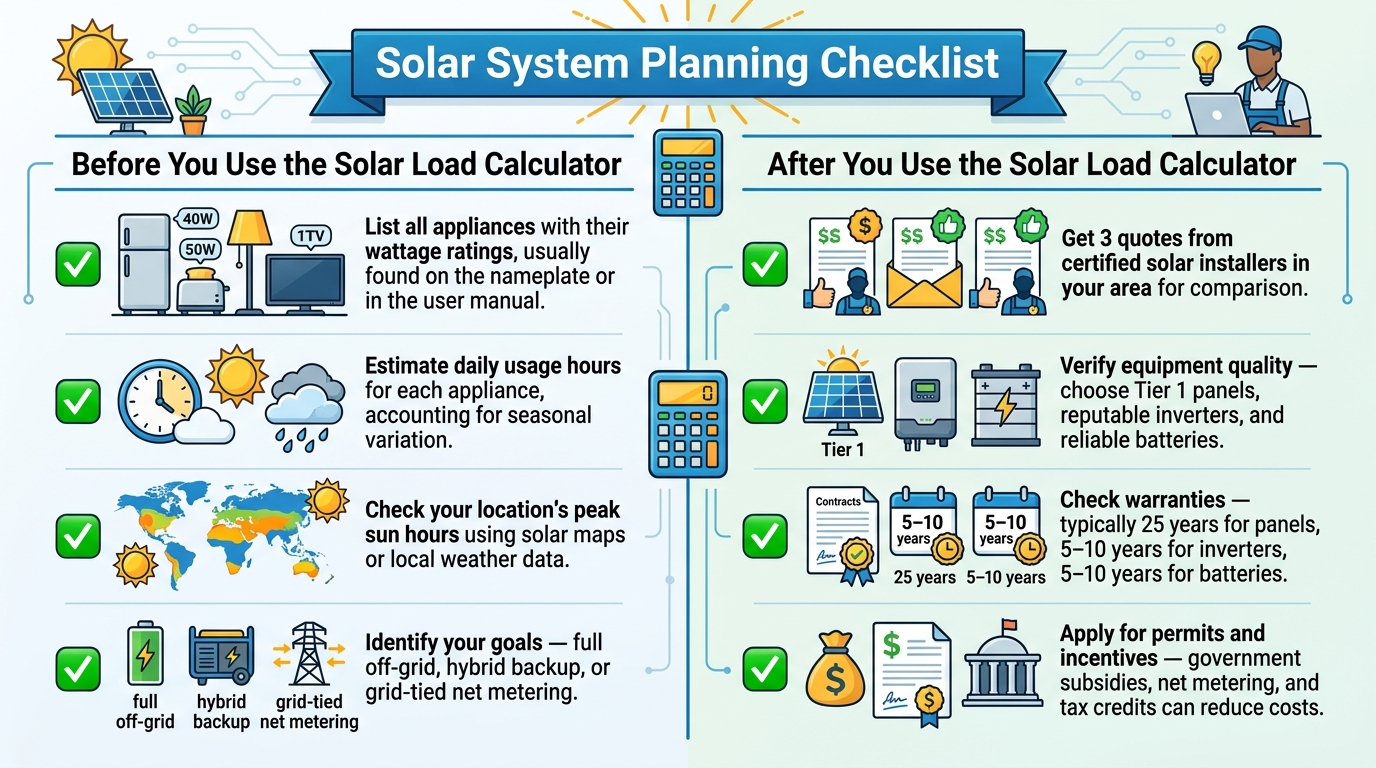
Solar System Planning Checklist
Before You Use the Solar Load Calculator
After You Use the Solar Load Calculator
Trusted Solar Reference Resources
National Renewable Energy Laboratory (NREL) — NREL solar resource data and tools for peak sun hours, PV system design, and renewable energy research.
Solar Energy Industries Association (SEIA) — SEIA solar industry information for market data, policy updates, and consumer guides.
EnergySage — EnergySage solar guides and calculators for homeowners comparing solar quotes and system sizes.
PVsyst — PVsyst professional solar software for detailed PV system simulation and design.
International Energy Agency (IEA) Photovoltaic — IEA-PVPS solar PV reports for global PV trends, technology, and policy information.
User Reviews & Ratings
Share Your Experience with the Solar Load Calculator
Advanced Guide to Solar Load Planning
The Solar Load Calculator is a comprehensive planning tool that helps homeowners, businesses, and solar professionals design accurate, reliable, and cost-effective solar PV systems. By applying industry-standard formulas for load calculation, panel sizing, inverter sizing, and battery backup, the Solar Load Calculator removes the guesswork from solar design and provides a reliable starting point for any project, from a small home system to a large commercial installation.
For maximum benefit, use the Solar Load Calculator early in the planning process, before contacting installers or purchasing equipment. Start with the total load mode to estimate daily energy consumption, then use the solar panel mode to size the array, the inverter mode to choose the right inverter capacity, and the battery mode to design the backup system. The complete system mode ties everything together for a unified preliminary design.
For homeowners, the Solar Load Calculator provides confidence in dealing with installers. Instead of relying solely on installer quotes, you can verify their sizing, compare multiple options, and choose the system that best fits your needs and budget. The tool also helps you understand the relationship between appliance usage, system size, and cost, enabling informed decisions.
For solar installers, the Solar Load Calculator speeds up the quotation process. Instead of manual calculations for every client, you can quickly generate preliminary designs, present professional-looking proposals, and focus on-site surveys and final engineering. The tool reduces errors and improves customer trust through transparent calculations.
For solar engineers, the Solar Load Calculator provides a quick check on detailed PVsyst or SAM designs. While professional software is essential for final engineering, the calculator helps verify initial sizing and explore alternative scenarios efficiently. The five modes cover all major components of a solar system.
For commercial projects, the Solar Load Calculator scales to large systems. From a 5kW shop to a 500kW factory, the same formulas apply. The tool helps project managers evaluate feasibility, estimate ROI, and present proposals to management or clients. Combined with net metering calculations, it provides a complete financial picture.
For off-grid and remote applications, the Solar Load Calculator is invaluable. Whether designing a mountain cabin, a remote telecom tower, or a rural health clinic, the tool’s complete system mode ensures reliable power with proper battery autonomy. The key is accurate load assessment and conservative system sizing.
For solar water pumping, the Solar Load Calculator simplifies sizing. The solar panel mode determines the array size needed to run the pump during peak sun hours, while the inverter mode (for AC pumps) calculates the required inverter capacity. This is especially useful in agricultural applications where reliable irrigation is critical.
For battery selection, the Solar Load Calculator supports multiple technologies. Lithium-ion offers the best cycle life and DoD, making it ideal for daily cycling. Lead-acid is cost-effective for backup-only systems. Tubular batteries are a durable middle-ground option. The battery type selector applies the correct depth of discharge for accurate sizing.
For hybrid systems with grid backup, the Solar Load Calculator sizes the solar portion, but grid interaction adds complexity. Net metering, feed-in tariffs, time-of-use rates, and demand charges all affect ROI. Use the calculator for solar sizing, then consult local utilities for grid-tie specifics.
For seasonal variation, the Solar Load Calculator lets you input different peak sun hours for different seasons. Design for the worst-case scenario (lowest sun hours) to ensure year-round performance, especially in areas with significant winter reduction in solar irradiance. Add extra panel capacity if needed.
For environmental impact, the Solar Load Calculator helps you estimate the CO2 offset of your solar system. A typical 5kW system offsets about 5–7 tons of CO2 per year, equivalent to planting 100+ trees annually. This is a powerful argument for solar adoption and environmental responsibility.
For financial planning, the Solar Load Calculator complete system mode includes an estimated cost. While actual costs vary by region, equipment quality, and installer, the tool provides a ballpark figure for budgeting. Most residential systems pay back in 3–7 years, depending on local electricity rates and incentives.
For long-term reliability, the Solar Load Calculator designs account for component lifespan. Solar panels last 25+ years, inverters 10–15 years, and batteries 5–15 years depending on type. Plan for inverter and battery replacement in your long-term budget, and choose equipment with strong warranties and local support.
The Solar Load Calculator is more than a sizing tool — it is a comprehensive planning companion that supports the entire solar journey, from initial assessment to final installation. By combining accurate formulas with a user-friendly interface, the Solar Load Calculator makes solar energy accessible to everyone, regardless of technical background. Whether you are a homeowner exploring solar for the first time or a professional designing complex systems, the tool provides the foundation for a successful solar project.
Final Thoughts on the Solar Load Calculator
The Solar Load Calculator is a complete, accurate, and user-friendly tool for anyone planning a solar PV system. Whether you are designing a small home backup system, a complete off-grid installation, or a large commercial solar project, the Solar Load Calculator provides the calculations you need to make informed decisions.
Use the Solar Load Calculator before purchasing equipment, before contacting installers, and before committing to any solar project. The tool’s five modes cover all major components — total load, solar panel sizing, inverter sizing, battery backup, and complete system design — giving you a comprehensive view of your solar needs.
For best results, always combine the Solar Load Calculator with a professional site survey and consultation with certified solar installers. The calculator provides the math; the installer provides the expertise. Together, they ensure a safe, efficient, and reliable solar system that meets your needs for decades to come.
🔒 Review Storage Note: All calculations run in your browser. When you submit a review, it is saved to the WordPress site database through the shortcode AJAX handler. No personal data is shared with third parties.