Mastering Weight Converting: Your Ultimate Guide to Using the Weight Converter Tool
Introduction
In our interconnected global society, the ability to understand different measurements is more than just a mathematical skill; it is a necessity for navigating daily life, international commerce, and personal health. Whether you are a professional chef attempting to replicate an authentic European recipe, a logistics manager calculating freight costs for international shipping, or a fitness enthusiast tracking progress across different standard systems, accurate measurement translation is vital. This process, known broadly as weight converting, acts as the bridge between disparate systems of measurement that define how we perceive mass and heaviness. Without this bridge, we are left with numbers that lack context, potentially leading to errors that range from minor culinary mishaps to significant financial losses in trade.
The modern world relies heavily on the seamless interchange of data, and physical weight is one of the most fundamental data points we encounter. From the grocery store scale to the industrial weighbridge, the need to switch between units like kilograms, pounds, stones, and ounces is constant. This guide explores the deep functionality of our Weight Converter Tool, a digital solution designed to simplify these complexities. By automating the math and providing instant accuracy, the tool removes the cognitive load associated with manual calculations. Throughout this comprehensive article, we will explore why weight converting is so essential and how mastering this simple tool can enhance efficiency in almost every aspect of your professional and personal life.
What Is Weight Measurement?
At its core, weight measurement is the quantification of the heaviness of an object or substance. While scientifically, there is a distinction between mass (the amount of matter in an object) and weight (the force of gravity acting on that object), in daily usage, we use these terms interchangeably to describe how heavy something is. This measurement is the foundational metric for commerce, health, and science.
Since the dawn of civilization, humans have needed standard ways to trade grain, gold, and goods, leading to the development of various systems. Today, we primarily navigate between the Metric system and the Imperial system, which often creates confusion for those unaccustomed to switching between them.
The concept of measurement goes beyond simple numbers; it provides a universal language for value and quantity. When you buy produce, send a package, or mix concrete, you are relying on a predetermined standard of weight to ensure fairness and accuracy. However, because different regions of the world settled on different standards—such as the kilogram in most of the world and the pound in the United States—we are often faced with a language barrier of numbers.
This is where the importance of weight converting becomes apparent. It allows us to translate this value from one “language” to another, ensuring that a kilogram of flour in Paris is understood as the correct amount of pounds in New York. Understanding the basics of these measurements is the first step to utilizing conversion tools effectively.
Understanding Kilograms and Pounds
To truly master conversions, one must understand the two giants of the weight world: the kilogram and the pound. The kilogram (kg) is the base unit of mass in the International System of Units (SI), widely known as the metric system. It is used by the vast majority of countries globally for everything from body weight to grocery items.
Its base on multiples of ten makes it incredibly logical and easy to scale. For instance, moving from grams to kilograms is a simple matter of moving a decimal point. This simplicity is why the scientific community and most international bodies rely exclusively on the kilogram for standardization.
On the other side of the spectrum lies the pound (lb), a unit of mass used in the imperial and US customary systems. While less common globally, it remains the standard in the United States, keeping it relevant in international media, trade, and cultural exchange.
The pound is historically complex, defined today exactly in relation to the kilogram, yet it feels intuitive to those raised with it. The relationship between these two units is the most common reason users seek out tools for weight converting. Because one kilogram is approximately 2.20462 pounds, the mental math required to switch between them is cumbersome and prone to error. Understanding the distinct history and usage of these units helps explain why we can’t simply choose one global standard overnight and why conversion remains a daily necessity.
Why People Convert kg to lbs and lbs to kg
The reasons for converting between kilograms and pounds are as diverse as the people using the tools. A primary driver is globalization. As we consume media, buy products, and share information across borders, we inevitably encounter units we aren’t familiar with.
For example, a US resident watching a European sporting event might hear an athlete’s weight in kilograms and have no frame of reference for that size without converting it. Similarly, international travelers often face baggage limits expressed in kilograms, while their home scales measure in pounds. This discrepancy drives the immediate need for weight converting to avoid excess baggage fees or travel complications.
Furthermore, the rise of global e-commerce has made understanding these conversions critical for consumers. When purchasing goods from overseas, shipping weights are often listed in the origin country’s standard unit. A shopper needs to know if the “10 kg” package they are ordering is manageable or if it requires special handling.
In the medical field, precise dosages are often weight-dependent, and while medicine is largely metric, patient records in some countries may still reflect pounds, necessitating careful conversion. Consequently, the process of weight converting is not just a convenience; it is a mechanism for safety, financial clarity, and cultural literacy. We convert to understand the world around us and to interact with it more effectively.
Common Situations Where Weight Conversion Is Needed
Consider the culinary arts, where precision is the difference between a delicious meal and a disaster. Professional chefs and home bakers alike frequently source recipes from the internet, which has no borders. A baker in London might find the perfect cake recipe on an American blog. The ingredients will be listed in ounces and pounds, while the baker’s kitchen scale reads in grams and kilograms. In this scenario, weight converting is the critical first step in the cooking process. A slight miscalculation in the amount of flour or sugar can ruin the chemistry of the bake, rendering the final product inedible.
Another common situation arises in the world of fitness and competitive sports. Powerlifting, bodybuilding, and Olympic weightlifting all have specific standards. While the Olympics use kilograms, many local American gyms use plates measured in pounds.
An athlete training for an international competition must constantly translate their lifts to ensure they are meeting the required standards. If they fail to engage in accurate weight converting, they may arrive at a competition unprepared for the actual weight on the bar. Similarly, boxing and MMA have weight classes that are strictly enforced. Fighters often cut weight based on specific limits, and knowing exactly where they stand in both lbs and kg can be a matter of qualification or disqualification.
How This Weight Converter Tool Works
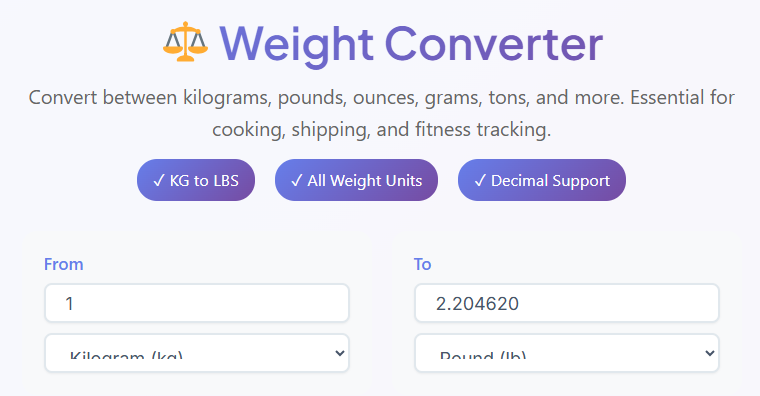
Our Weight Converter Tool is designed with user simplicity as the highest priority, eliminating the need for complex mental arithmetic or manual calculator inputs. The user experience is streamlined to ensure that anyone, regardless of technical ability, can obtain accurate results in seconds. The process begins with the input field, clearly marked for the numeric value you wish to convert. Users simply type the number associated with their current weight measurement. There is no need to worry about decimal placement or formatting; the tool is built to interpret standard numeric inputs intuitively.
Once the value is entered, the user interacts with the “From” and “To” dropdown menus. These menus are populated with a comprehensive list of units including kilograms, pounds, grams, ounces, stones, and tons. The user selects the unit they currently have in the “From” slot and the unit they desire in the “To” slot.
This selection process triggers the backend logic instantly. There is no “submit” button required in many modern iterations, as the result populates in real-time, or with a single click of a conversion button. This immediate feedback loop is essential for users who are weight converting multiple items in quick succession. The interface is clean, distraction-free, and focused entirely on delivering the precise number you need without unnecessary clutter.
Weight Converting Between Popular Units
The most frequent use of our tool revolves around the conversion between the metric and imperial giants. Converting kg to lbs is a daily ritual for many, especially in international business and travel contexts. When a user inputs a kilogram value, the tool applies the precise conversion factor to deliver the pound equivalent. This is vital because the rough estimate of “multiply by two” that many people use is inaccurate for higher values. True weight converting requires precision, as the decimal points add up significantly over large quantities.
Conversely, changing a kilogram to pound value or vice versa often brings up questions about other related units. Users frequently need to perform a kilo to pounds calculation for body weight, but they also might encounter scenarios where they need to understand how many ounces are in that pound, or how that relates to stones (common in the UK). Our tool handles these variations effortlessly. Even if you are trying to determine if there is a lb a kg equivalent (a common query regarding unit parity), the tool provides the exact decimal readout. Furthermore, converting to lbs to kg is seamless, allowing users to reverse their calculations instantly to double-check their figures or communicate with counterparts in different regions.
Using the Swap Feature for Faster Weight Converting
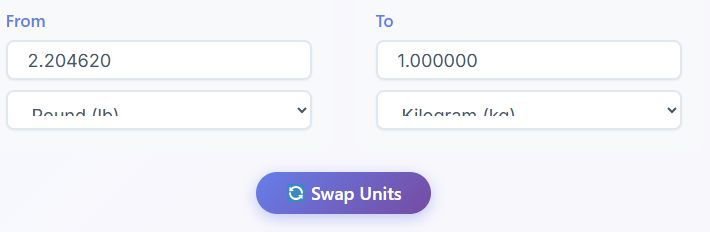
Efficiency is key when dealing with large datasets or repetitive tasks. To facilitate this, our tool includes a dedicated “Swap” feature, typically represented by two arrows pointing in opposite directions between the unit selection menus. This feature is a game-changer for users who need to perform bidirectional weight converting. Instead of manually re-selecting “Pounds” in the “From” menu and “Kilograms” in the “To” menu after finishing a calculation, a single click on the Swap icon instantly reverses the unit configuration.
This functionality is particularly useful during conversations or negotiations where units are being thrown back and forth. For example, if you are discussing shipping rates with an agent who switches between quoting per kg and per lb, you can keep up with the conversation in real-time.
You simply enter the value, check the result, hit swap, enter the new counter-offer value, and see the equivalent immediately. This reduces the time spent clicking through dropdown menus and significantly speeds up the workflow of weight converting. It is a subtle piece of User Experience (UX) design that has a massive impact on the usability of the tool for power users.
Understanding Quick Reference Results
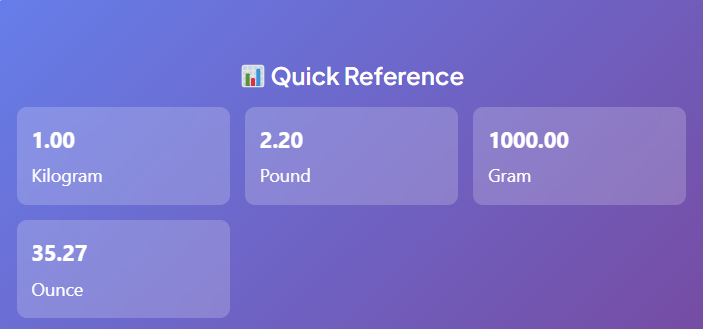
Beyond the primary conversion result, our tool often displays Quick Reference Results or a conversion table. This feature is designed to provide context at a glance. When you perform a specific conversion, say 50 kg to lbs, the tool may also show you nearby values, such as 40kg, 60kg, or 100kg converted into the same target unit. This peripheral data helps users understand the scale and progression of the numbers without needing to type in every single increment manually.
These quick references are incredibly valuable for estimation and planning. If you are weight converting for a range of products—for example, t-shirts that come in boxes weighing roughly 10, 12, and 15 kilograms—seeing a quick reference list allows you to mentally approximate the values for the intermediate weights. It aids in pattern recognition, helping users become more familiar with the relationship between units over time. Eventually, regular users of the tool find they develop an intuitive sense for the conversions, all thanks to the consistent exposure provided by these quick reference data points.
Mandatory Internal Links
While this tool is powerful, weight is rarely the only measurement that matters in complex projects. For instance, in the shipping and logistics industry, knowing the weight is only half the battle. You must also understand how much space that weight occupies. This is where you would integrate our Volume Converter. Understanding the interplay between mass and volume is critical; accurate weight converting is essential, but if you don’t account for density using the Volume Converter, you might underestimate the shipping container size needed for liquids or loose materials.
Similarly, in physics and dietary science, weight is a precursor to calculating energy. If you are tracking weight loss or the fuel efficiency of a vehicle carrying a heavy load, simply knowing the mass isn’t enough. You would use our Energy Converter to translate that mass data into calories burned or joules of energy required to move the object. The process of weight converting provides the raw data, but the Energy Converter turns that data into actionable insights regarding power, consumption, and metabolic rates.
Construction and land management also rely heavily on weight data, but it usually starts with the land itself. Before you can order tons of gravel or soil, you need to measure the site. Using our Area Converter allows you to determine the square footage or acreage of the project site. Once the area is defined, you can calculate the volume of material needed and subsequently use weight converting to order the correct tonnage of raw materials. The Area Converter ensures your base measurements are correct so that your weight orders are precise and cost-effective.
Weight Converting for Fitness & Health Tracking
For the fitness community, the scale is a source of truth, but that truth can look very different depending on the unit setting. Many health apps and smart scales default to the metric system, while users in the US or UK might prefer pounds or stones. Weight converting becomes a daily ritual for those tracking weight loss or muscle gain. Seeing a drop of 2 kilograms might not register emotionally for someone used to pounds until they convert it and realize they have lost nearly 4.5 pounds. This psychological component is crucial for motivation and adherence to fitness programs.
Furthermore, international fitness challenges and online coaching often bridge the gap between units. A coach based in Australia will write plans based on kilogram lifts, while a client in Texas is using pound plates. Accurate weight converting ensures that the client is lifting the intended intensity. If a lifter approximates incorrectly, they risk injury by lifting too heavy or wasting time by lifting too light. The precision offered by our tool ensures that training loads are exact, progressive overload is tracked correctly, and safety is maintained across all exercises regardless of the origin of the programming.
Weight Converting for Shipping, Logistics & Trade
The backbone of the global economy is logistics, and logistics runs on weight. Freight costs are calculated based on weight and volume, often with strict breakpoints where prices jump significantly. A discrepancy in weight converting on a shipping manifest can lead to expensive audits, customs delays, and rejected shipments. When goods move from a metric country to an imperial country, every single document must be accurate. A shipment declared as 1000 lbs but actually weighing 1000 kg (2204 lbs) would be dangerously overweight for certain trucks or aircraft, posing severe safety risks.
Logistics professionals use our tool to audit these manifests and ensure compliance with local road safety laws. The ability to instantly verify that the weight declared on an invoice matches the physical limits of the transport vehicle is invaluable. Weight converting in this context is not just about math; it is about risk management. By ensuring that tons, kilograms, and pounds are perfectly aligned, trade flows smoothly, and unexpected costs are avoided. This level of accuracy builds trust between international partners who can rely on the fact that the agreed-upon quantities are exactly what is being delivered.
Common Mistakes People Make During Weight Conversion
Despite the availability of digital tools, human error remains a significant factor. One of the most common mistakes is confusing the “From” and “To” fields. A user might intend to convert kg to lbs but accidentally sets it to convert lbs to kg, resulting in a number that is drastically off. Because the tool works instantly, if the user isn’t paying attention, they might record this erroneous figure. This underscores the importance of a sanity check—does the result of your weight converting look logical? (e.g., kilograms should result in a higher number when converted to pounds).
Another frequent error is rounding too early. In precise scenarios like chemistry or precious metal trading, decimals matter. Users sometimes mentally round a conversion result like 2.20462 down to 2.2 before they are finished with their calculations. Over thousands of units, this tiny fraction creates a massive discrepancy. Our tool provides high-precision decimals to prevent this, but users must be diligent in using the full number provided. Finally, mixing up similar-sounding units, such as “long tons” (UK) versus “short tons” (US), is a classic pitfall in heavy industry weight converting that can lead to shortages in raw material orders.
Who Uses Weight Converter Tools the Most
The user base for weight conversion tools is incredibly diverse, reflecting the universal nature of mass measurement. Culinary professionals and home cooks make up a large segment, constantly weight converting ingredients to salvage recipes from different continents. They rely on the tool to ensure the texture and flavor of their dishes remain authentic. Science students and researchers are another key demographic. They frequently need to translate data reported in legacy studies or from equipment calibrated in different units, ensuring their current experiments align with historical data.
Additionally, the travel and tourism sector sees heavy usage. Travelers anxiously weight converting their luggage allowance the night before a flight is a common scenario. They need to know if their suitcase meets the strict kilogram limits of budget airlines. Lastly, parents monitoring the growth of their newborns often use these tools. Medical reports might be in grams, but grandparents want to know the weight in pounds and ounces. The tool helps bridge this generational and professional gap, making it an essential utility for a wide array of people.
Final Conclusion
In conclusion, the ability to accurately translate weight measurements is a skill that facilitates better cooking, safer training, efficient trade, and smoother travel. Our Weight Converter Tool stands as a reliable, user-friendly solution to the complex problem of varying global standards. By removing the need for manual math and providing instant, precise results, it empowers users to focus on their tasks rather than the calculations. Whether you are dealing with micrograms or tons, the underlying need for accuracy remains the same.
We have explored the history of units, the practical applications in daily life, and the specific features that make our tool indispensable. From the “Swap” function to the handling of various unit types, every aspect is designed to make weight converting as effortless as possible. As we continue to operate in a globalized world, the friction between metric and imperial systems will persist, making tools like this not just convenient, but necessary. Trust in the
FAQs
Why is converting between kilograms (kg) and pounds (lbs) so common?
Converting between kilograms and pounds is extremely common because these two units represent the primary standards for weight measurement in different parts of the world. The vast majority of countries use the metric system, where the kilogram (kg) is the standard unit for measuring everything from body weight to groceries. However, the United States continues to use the imperial system, where the pound (lb) is the standard. This difference means that international trade, travel, online content, and personal communication frequently require translation between the two. For example, a traveler might need to convert their luggage weight from pounds to kilograms to meet airline limits, or a cook might need to change a recipe’s ingredient measurements from one unit to the other.
How can I be sure the Weight Converter Tool is accurate?
Our Weight Converter Tool ensures accuracy by using the official, internationally recognized conversion factors for all calculations. Unlike mental math or using rounded-off numbers (like estimating 1 kg as 2.2 lbs), the tool applies the precise mathematical relationship between the units down to several decimal places. This precision is critical for professional applications like shipping logistics, scientific measurement, and culinary arts, where even small errors can lead to significant issues. By automating the process, the tool eliminates the risk of human error, providing you with a reliable and exact result every time you perform a conversion.
Besides kg and lbs, what other units can I convert for practical use?
While kilograms and pounds are the most frequently converted units, many other measurements are essential for specific tasks. Our tool also allows you to convert between:
Grams (g): Crucial for precise cooking, baking, and scientific measurements where small quantities matter.
Ounces (oz): Often used for food portions, postal mail, and measuring precious metals.
Stones (st): A common unit for measuring body weight, particularly in the United Kingdom.
Tons: Used for measuring extremely heavy items in industries like shipping, construction, and freight.
Having access to these additional units makes the tool versatile enough to handle a wide range of practical situations, from preparing a recipe to calculating industrial shipping loads.