
Tons to Cubic Yards Calculator
Convert between tons and cubic yards for construction materials. Calculate material volume instantly with accurate densities.
Tons to Cubic Yards: Divide the number of tons by the material density (tons per cubic yard) to get the volume in cubic yards.
Cubic Yards to Tons: Multiply the cubic yards by the material density (tons per cubic yard) to get the total weight in tons.
Material densities vary based on composition, moisture content, and compaction. Use custom density for precise calculations specific to your materials.
Tons in Cubic Yard: The Ultimate Expert Conversion Guide
Understanding the relationship between weight and volume is fundamental for countless projects, from major construction builds to simple weekend landscaping. A common point of confusion that arises on job sites and in planning stages is converting between weight, measured in tons, and volume, measured in cubic yards. The core issue is that there isn’t a single, universal answer. The number of tons in a cubic yard depends entirely on the material you are working with. This guide provides a clear, practical solution, explaining the conversion and introducing a powerful calculator designed to give you accurate results every time. Our goal is to eliminate the guesswork, prevent costly errors, and empower you to plan your projects with confidence.
This article breaks down the concept of tons in a cubic yard from the ground up. We’ll explore why material density is the key to a correct conversion, walk through how our specialized calculator works, and provide real-world examples to make the process tangible. Whether you’re a seasoned contractor ordering gravel or a DIY enthusiast buying soil for your garden, this is the definitive resource for understanding how to convert tons in a cubic yard accurately.
What “Tons in Cubic Yard” Means in Real Life
On paper, “tons in cubic yard” is a ratio of weight to volume. In practice, it’s the critical piece of information you need to order the right amount of material, stay on budget, and ensure your project runs smoothly. Imagine you need to fill a specific area, like a driveway foundation or a raised garden bed. You can easily measure the volume of that space in cubic yards (length x width x depth). However, suppliers of materials like gravel, sand, or concrete often sell them by weight, specifically in tons.
This is where the conversion becomes essential. Knowing how many tons in a cubic yard for your specific material allows you to translate your volume requirement (cubic yards) into a weight order (tons). Getting this wrong has significant real-world consequences. Ordering too little means a second delivery, causing delays and adding extra costs. Ordering too much results in wasted material and the logistical headache of disposing of the excess. Therefore, a precise understanding of tons in a cubic yard is not just an academic exercise; it’s a practical necessity for efficient and cost-effective project management. This conversion factor directly impacts your budget, timeline, and material logistics.
Who Needs This Tool
The need to accurately calculate tons in a cubic yard spans a wide range of professions and activities. The common thread is the need to move, purchase, or place bulk materials where both volume and weight are critical metrics.
- Construction Professionals & General Contractors: This group relies on precise material calculations daily. When pouring a concrete slab, laying an asphalt driveway, or preparing a foundation with crushed stone, the project’s structural integrity and budget depend on getting the quantities right. A contractor needs to know exactly how many tons of concrete corresponds to the cubic yard volume of their forms. This is where understanding the specific tons in a cubic yard for ready-mix concrete is non-negotiable.
- Landscaping Companies: For landscapers, projects often involve large quantities of soil, mulch, sand, and decorative stone. When designing a garden, creating a gravel path, or leveling a lawn with topsoil, they measure the required volume in cubic yards. Suppliers, however, usually price these materials by the ton. An accurate conversion is vital for providing clients with a correct quote and for ensuring the delivered material perfectly matches the project’s scope. The question of tons in a cubic yard is a constant in their daily operations.
- Civil Engineers and Project Managers: In large-scale infrastructure projects like road building, dam construction, or site development, the quantities of earth, aggregate, and other materials are immense. Engineers must perform precise calculations for earthwork (cut and fill), and knowing the density—the tons in acubic yard—of different soil and rock types is fundamental for structural analysis and logistical planning.
- DIY Homeowners: Even for smaller home projects, the same principles apply. If you’re building a small patio, creating a gravel area for a shed, or filling a new vegetable garden, you’ll need to buy materials. Renting a truck or having materials delivered means you need to know the weight. An over-order can leave you with a pile of unused gravel in your driveway for months. Our tool helps homeowners confidently determine how many tons in a cubic yard of their chosen material they need, making the project simpler and more affordable. Answering how many tons is in a yard of dirt becomes a simple task.
How the Tool Works
Our Tons ↔ Cubic Yards calculator is designed to be a straightforward and powerful bridge between weight and volume. It replaces complex manual formulas with an intuitive interface, but its simplicity is backed by sound mathematical logic. Here’s a plain-English explanation of what happens behind the scenes.
The core of the conversion lies in a single, crucial variable: material density. Density is the measure of how much mass (or weight) is packed into a given volume. The tool operates on the fundamental formula:
Weight = Volume × Density
When you use the calculator, you are simply providing two of these variables to find the third.
1. Two-Way Conversion Logic:
The tool is built for flexibility, allowing you to convert in either direction seamlessly.
- Cubic Yards to Tons: This is the most common use case. You know the volume you need to fill (e.g., 5 cubic yards of a trench) and you need to find out how many tons of material to order. When you input the volume and select a material, the tool looks up the preset density for that material (e.g., gravel, ~1.2 tons in a cubic yard). It then performs the calculation:
Tons = 5 cubic yards × 1.2 tons/cubic yardto give you the answer in tons. This is the essence of finding the tons in a cubic yard. - Tons to Cubic Yards: This direction is useful when you have a set amount of material by weight and need to know how much space it will fill. For example, if you buy a 10-ton pile of sand, you can use the tool to determine how many cubic yards it will cover. You input the weight (10 tons) and select “Sand.” The tool retrieves sand’s density and rearranges the formula to solve for volume:
Volume = Weight / Density. The calculation would beCubic Yards = 10 tons / (~1.4 tons/cubic yard), telling you the volume the sand will occupy. This answers the query how many cubic yards in a ton.
2. The Role of Material Density and Presets:
The calculator’s accuracy comes from its built-in library of material densities. We’ve pre-loaded common materials like gravel, sand, topsoil, dirt, asphalt, and concrete. Each has a different density because their composition and particle packing vary. For instance, gravel has large particles with significant air gaps, making it less dense than fine-grained sand. Solid concrete is heavier still. The tool removes the need for you to memorize or look up these values. Selecting “Gravel” automatically applies the correct density for converting tons in a cubic yard for that specific material.
3. The Custom Density Feature:
We recognize that standard presets don’t cover every possible material. You might be working with a unique aggregate mix, specialized soil, or a non-standard construction material. The “Custom Density” input is for these exact scenarios. If you know the density of your material (often provided by the supplier on a technical data sheet), you can enter it directly. This gives you complete control and ensures the highest level of accuracy for your specific project. This feature makes the tool infinitely adaptable. Understanding the correct tons in a cubic yard is essential for this custom input.
By handling the density data and calculations, the tool translates the technical relationship between weight and volume into a practical, error-free answer you can use immediately.
Step-by-Step: How to Use the Calculator
We designed the calculator to be intuitive, ensuring you can get the answers you need in just a few seconds. Follow these simple steps to perform your conversion.
Step 1: Choose Your Conversion Direction
First, decide what you are trying to find. The tool is set up for two-way calculations. You will see input fields for both “Tons” and “Cubic Yards.” Simply decide which value you know and which one you need to calculate.

- To convert from volume to weight, you will enter a number in the “Cubic Yards” field.
- To convert from weight to volume, you will enter a number in the “Tons” field.
Step 2: Enter Your Known Value

Click on the appropriate input box and type in your number. For example, if you have measured a space for a new gravel driveway and found it to be 15 cubic yards, you would type “15” into the “Cubic Yards” box.
Step 3: Select Your Material

This is the most important step for an accurate conversion. Below the input fields, you’ll find a dropdown menu or a list of preset materials. Click on it and select the material you are working with (e.g., Gravel, Sand, Dirt, Soil, Asphalt, Concrete).
As soon as you select a material, the calculator automatically applies its specific density to the formula. This is how it determines the correct number of tons in a cubic yard for your calculation.
Step 4: Use Custom Density (If Needed)
If the material you’re using isn’t on the preset list, but you know its density, you can use the “Custom Density” field. Simply select this option and enter the density value in tons in a cubic yard. This is a powerful feature for professionals working with specialized materials. For instance, if your supplier tells you their specific gravel blend has a density of 1.25 tons in a cubic yard, you would enter “1.25” here for a perfect calculation.
Step 5: Read the Result
The moment you enter a value and select a material, the result instantly appears in the other field. There is no “calculate” button to press. For our example, after entering “15” cubic yards and selecting “Gravel,” the “Tons” field would automatically populate with the calculated weight.
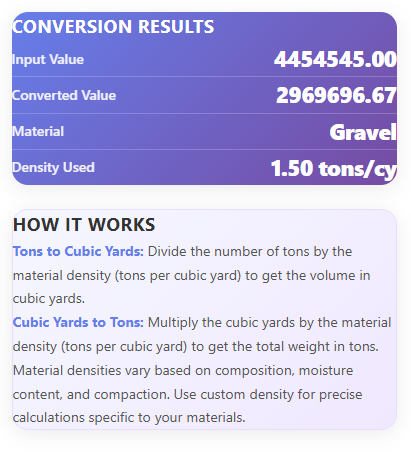
The calculator provides a seamless experience, removing the need for manual lookups and calculations, and delivering a precise result based on the specific tons in a cubic yard of your chosen material.
Material Density Explained Simply
Density is the single most important factor in converting between tons and cubic yards. In simple terms, density is a measure of how “heavy for its size” a material is. It tells you how much weight is packed into a specific amount of space. For our purposes, we measure density in tons in a cubic yard.
Think of it this way: imagine you have two identical one-cubic-yard boxes. You fill one box with feathers and the other with rocks. Both boxes have the same volume (one cubic yard), but the box of rocks will be drastically heavier. This is because rocks have a much higher density than feathers.
The same principle applies to construction and landscaping materials.
- Topsoil: Topsoil contains a lot of organic matter and air. It is relatively light and fluffy. A cubic yard of topsoil might weigh around 0.8 to 1.1 tons. Therefore, its density is about 1 ton to cy.
- Gravel: Gravel consists of small-to-medium-sized rocks with air pockets between them. It’s heavier than soil. A typical value is around 1.2 to 1.3 tons in a cubic yard.
- Sand: Sand particles are fine and pack together more tightly than gravel, leaving less room for air. This makes it denser. A cubic yard of dry sand can weigh about 1.4 to 1.5 tons.
- Concrete: Solid, cured concrete is very dense. It is a composite of cement, sand, and aggregate (stone), with very little air space. A cubic yard of concrete typically weighs around 2 tons, meaning its density is 2 tons in a cubic yard.
Why Does Density Vary?
Two main factors affect a material’s density:
- Composition: The inherent weight of the molecules that make up the material. Iron is naturally denser than wood.
- Compaction & Air Voids: How tightly the material is packed. Loose, uncompacted dirt has a lot of air in it and is less dense. The same dirt, when compacted by heavy machinery, will have less air and a higher density. Moisture content also plays a role, as wet sand is heavier than dry sand.
Our calculator simplifies this by using average, industry-accepted density values for common materials. When you select “Sand,” the tool doesn’t need you to know its exact density; it uses a reliable standard to calculate the tons in a cubic yard for you. Understanding this concept is key to appreciating why a one-size-fits-all conversion factor doesn’t exist.
Real-World Examples & Scenarios
To truly grasp the practical application of converting tons in a cubic yard, let’s walk through some common scenarios where our calculator is an indispensable tool.
Scenario 1: Building a Gravel Driveway
A homeowner wants to create a new gravel driveway. The planned area is 40 feet long, 10 feet wide, and they want the gravel to be 4 inches deep.
- Calculate the Volume in Cubic Yards: First, they must convert all measurements to the same unit (feet). The depth is 4 inches, which is 4/12 = 0.333 feet.
- Volume in cubic feet = Length × Width × Depth
- Volume = 40 ft × 10 ft × 0.333 ft = 133.2 cubic feet.
- Since there are 27 cubic feet in a cubic yard, the volume in cubic yards is 133.2 / 27 = 4.93 cubic yards. Let’s round up to 5 cubic yards to be safe.
- Use the Calculator to Find the Weight: The homeowner needs 5 cubic yards of gravel. The supplier sells it by the ton. They use the calculator:
Now they can confidently order 6.25 tons of gravel, knowing it will be the right amount for their project. They successfully converted from cubic yards to tons.- Enter “5” in the “Cubic Yards” field.
- Select “Gravel” from the material list.
- The tool instantly calculates the weight. Assuming a density of 1.25 tons in a cubic yard for gravel, the result would be 6.25 tons.
Scenario 2: Ordering Topsoil for Garden Beds
A landscaper is building three raised garden beds for a client. Each bed is 8 feet long, 4 feet wide, and 1.5 feet deep.
- Calculate Total Volume: First, find the volume of one bed.
- Volume = 8 ft × 4 ft × 1.5 ft = 48 cubic feet.
- Total volume for three beds = 48 × 3 = 144 cubic feet.
- Convert to cubic yards: 144 / 27 = 5.33 cubic yards.
- Convert to Tons for Ordering: The landscaper needs to order topsoil, which is sold by the ton. They use the calculator to determine the required weight.
The landscaper can now provide an accurate quote to the client and order the correct amount of material. This shows how crucial knowing the number of tons in a cubic yard is for business operations.- Enter “5.33” in the “Cubic Yards” field.
- Select “Topsoil” from the list.
- Using a typical density of 0.9 tons in a cubic yard for topsoil, the tool would show approximately 4.8 tons.
Scenario 3: Pouring a Small Concrete Slab
A DIYer is pouring a concrete slab for a shed. The slab needs to be 10 feet by 10 feet and 6 inches thick.
- Calculate Concrete Volume: Convert thickness to feet: 6 inches = 0.5 feet.
- Volume = 10 ft × 10 ft × 0.5 ft = 50 cubic feet.
- Convert to cubic yards: 50 / 27 = 1.85 cubic yards.
- Find the Weight: Concrete is extremely heavy, and knowing the weight is critical for delivery and handling.
This information helps the DIYer understand the scale of the material they’re dealing with. The question of how many tons is in a yard of concrete is easily answered.- Enter “1.85” in the “Cubic Yards” field.
- Select “Concrete.”
- With concrete’s density around 2.0 tons in a cubic yard, the calculator will show a weight of 3.7 tons.
In each scenario, the calculator removes ambiguity, enabling precise planning and preventing costly mistakes. The conversion of tons in a cubic yard is the central element that makes this possible.
Accuracy, Reliability & Trust Factors
When your project’s budget and timeline are on the line, you need a tool you can trust. We built this calculator with accuracy and reliability as our top priorities. Here’s why you can depend on our conversion tool.
1. Based on Industry-Standard Data: The preset density values in our calculator are not arbitrary numbers. They are based on industry-accepted averages for common construction and landscaping materials. These values are consistent with what material suppliers, engineers, and contractors use in their daily work. While the density of a natural material like gravel can vary slightly from one quarry to another, our presets represent a reliable median that is accurate for most planning and ordering purposes. The value for tons in a cubic yard for each material is carefully chosen.
2. Transparent Calculation Logic: Our tool doesn’t hide its methods. As explained earlier, it operates on the clear and universally accepted formula: Weight = Volume × Density. There are no hidden variables or complex algorithms. This transparency means you can be confident that the results are mathematically sound. The tool is simply automating the exact calculation you would perform by hand, but without the risk of human error. This is a crucial aspect of providing helpful content that users can verify.
3. The Power of the Custom Density Input: We understand that professionals sometimes require a higher level of precision. The inclusion of the custom density field is a key trust factor. It shows that we recognize the potential for material variation and provides a way for expert users to input their own precise data. If your supplier provides a technical spec sheet with a specific density for their product (e.g., 1.38 tons in a cubic yard for a particular aggregate), you can use that exact number. This empowers you to achieve the highest possible accuracy, tailored to your specific materials.
4. Error Handling and Validation: The tool’s code is designed to handle inputs correctly and prevent illogical calculations. It expects numerical inputs and operates within the clear framework of the conversion formula. This robust design minimizes the chance of glitches or erroneous outputs, providing a stable and reliable user experience every time you need to determine the number of tons in a cubic yard. Our commitment extends to related calculations, and you can find similarly reliable tools like our comprehensive Volume Converter for other measurement needs.
By combining standard data, transparent methods, and expert-level customization, our calculator establishes itself as a trustworthy resource for anyone needing to convert tons in a cubic yard.
Why This Tool Is Better Than Manual Calculation
While it’s possible to calculate tons in a cubic yard manually, using our dedicated tool offers significant advantages in speed, accuracy, and convenience. Here’s a breakdown of why our calculator is the superior method.
1. Eliminates Human Error: Manual calculation involves multiple steps: finding the volume, looking up the correct material density, and then performing the multiplication or division. There are several points where errors can occur. You might misremember a density value, make a typo on your calculator, or misplace a decimal point. A simple mistake, such as using the density for dirt when you meant to use the one for gravel, can throw off your entire order. Our tool automates this process, linking the material directly to its correct density, thereby eliminating the risk of human error in calculation and data lookup.
2. Speed and Efficiency: Time is a valuable resource, both on the job site and during the planning phase. Manually calculating your material needs requires finding a reliable source for density values, which can mean searching through websites, spec sheets, or old notes. This takes time. With our tool, the entire process takes seconds. You input your known value, select the material, and the answer appears instantly. This efficiency allows you to make quick decisions, adjust plans on the fly, and get back to the more important aspects of your project.
3. Centralized and Reliable Density Data: Finding accurate density values for various materials can be challenging. Different online sources may provide conflicting information, leaving you uncertain which value to trust. Our calculator acts as a centralized database of pre-vetted, industry-standard densities. You don’t have to second-guess the data. We’ve done the research for you, ensuring the values used for converting tons in a cubic yard are reliable for practical application.
4. Convenience and Accessibility: Our tool is accessible from any device with an internet connection, whether you’re in the office creating a bid or on-site with your smartphone needing to confirm an order. There’s no need to carry around conversion charts or remember complex formulas. It provides the answer to “how many cubic yards in a ton” right when you need it. This on-demand convenience makes it a far more practical solution than pen and paper.
In short, while manual calculation is the basis for the conversion, our tool refines the process into an error-proof, instant, and highly convenient solution. It takes the guesswork and labor out of converting tons in a cubic yard, allowing you to focus on your project.
Common Mistakes Users Avoid Using This Tool
Planning projects with bulk materials can be tricky, and several common mistakes can lead to wasted money, time, and effort. Our calculator is specifically designed to help you avoid these pitfalls.
1. Using a Single “Average” Conversion Factor for All Materials: A frequent and costly error is assuming a single, universal factor for converting tons in a cubic yard. A novice might learn that “a yard of gravel is about 1.2 tons” and then incorrectly apply that same factor to topsoil or sand. As we’ve discussed, material densities vary widely. A yard of soil weighs significantly less than a yard of concrete. Our tool prevents this mistake by forcing a material selection, ensuring the calculation uses a density specific to that material every single time. You get an accurate tons in a cubic yard figure for your specific use case.
2. Errors in Volume Calculation: Before you can even convert to tons, you need the correct volume in cubic yards. Many errors happen here, often from mixing up units (e.g., using inches instead of converting to feet) or from simple arithmetic mistakes. While our tool doesn’t calculate your initial volume, its ease of use encourages a more careful process. Moreover, for other complex calculations beyond simple rectangular volumes, you might find our Area Converter useful in the planning stages. By handling the difficult part of the conversion, our tool lets you focus on getting the initial volume measurement right.
3. Confusion Between Tons and Cubic Yards: It sounds basic, but on a busy job site or during a hurried ordering process, it’s possible to mix up the units. You might calculate you need 10 cubic yards but accidentally order 10 tons of a light material like mulch, resulting in a massive over-delivery. The tool’s clear interface, with distinct fields for “Tons” and “Cubic Yards,” provides a visual separation that reinforces the difference between the two units, reducing the chance of such a mix-up. It makes the relationship between tons in a cubic yard explicit.
4. Ordering Based on “Guesstimates”: Without a reliable tool, many people resort to guesswork. They might eyeball a space and estimate they need “about 5 tons” of sand. This often leads to being significantly short or having a large, wasteful surplus. The calculator replaces guesswork with precision. By taking a few moments to measure your space and use the tool, you can order with confidence. This is especially true when asking “how many tons in a yard,” as the tool provides a definitive answer based on the material. Using a precise tool for determining tons in a cubic yard is the mark of a professional.
By guiding you through a structured and accurate conversion process, the tool acts as a safeguard against these common and expensive mistakes. It promotes a more methodical and precise approach to material purchasing.
Expert Tips for Correct Conversions
Even with a great tool, best practices can enhance your accuracy and ensure your projects go off without a hitch. Here are some expert tips from years of on-site experience with material conversions.
1. Always Measure Twice: The most accurate calculator in the world can’t fix a bad initial measurement. Before you even think about converting tons in a cubic yard, double-check your length, width, and depth measurements. For irregular shapes, break them down into simpler rectangles and triangles to calculate the volume of each part before summing them up. A small error in your initial volume measurement will be magnified after the conversion.
2. Account for Compaction: This is a pro-level tip. Some materials, particularly soil and dirt, will compact after being placed and settled. Uncompacted, loose topsoil will occupy a larger volume than after it has been spread, watered, and settled. As a general rule, it’s wise to order about 5-10% extra of these materials to account for compaction. If your calculation suggests you need 10 cubic yards of soil, consider ordering 10.5 or 11. Our tool gives you the precise base number; this tip helps you adjust for real-world conditions. The number of tons in a cubic yard is often given for a compacted state, so adding extra ensures you have enough loose material to start with.
3. Communicate with Your Supplier: When possible, talk to your material supplier. They are experts on their own products. You can ask them for the specific density or “weight per yard” of the exact gravel or sand you are buying. You can then use this number in our tool’s “Custom Density” field for a perfect match. This also helps you understand if their stated tons in a cubic yard is for loose or compacted material.
4. Consider Moisture Content: Natural materials like sand and soil are heavier when they are wet. While most standard density values account for typical moisture levels, be aware that if you are buying material that has been stored outdoors in heavy rain, it may weigh more than the dry equivalent. This won’t change the volume it fills, but it can affect the total tonnage you are billed for if you’re loading a truck at a quarry by weight. For most delivery orders, this is less of an issue, but it’s good knowledge to have. This is why the standard for tons in a cubic yard is so important.
5. Think Beyond Volume and Weight: Remember that converting tons in a cubic yard is just one part of your project’s logistics. Consider other factors like energy consumption for transport and machinery. For related calculations, our Energy Converter can be a helpful resource for broader project planning.
By combining the precision of our tool with these practical tips, you can master the art of material estimation, ensuring every project is both efficient and cost-effective. The goal is to make the process of converting tons in a cubic yard foolproof.
Final Conclusion
Navigating the conversion between volume and weight is a critical skill in countless projects, and the question of tons in a cubic yard lies at the heart of this challenge. As we have seen, there is no single answer; the key is always the density of the specific material being used. Relying on guesswork or flawed averages can lead to significant and expensive errors, disrupting budgets and project timelines.
This guide was created to provide a definitive, experience-driven resource for understanding this vital conversion. We’ve demystified the role of material density and provided a clear, step-by-step process for accurate calculation. The Tons ↔ Cubic Yards calculator is the practical embodiment of this expertise—a reliable, transparent, and user-focused tool designed to eliminate human error and provide instant, trustworthy answers. It helps you accurately convert cubic yards to tons and back again with ease.
By using this tool, you are replacing uncertainty with precision. You can confidently plan your projects, order the exact amount of material required, and avoid the common pitfalls that plague material purchasing. Whether you are a contractor managing a large build or a homeowner tackling a weekend project, mastering the conversion of tons in a cubic yard is a fundamental step toward success. We are confident that this tool will become an indispensable part of your planning toolkit.
FAQs
Is a cubic yard always heavier than a ton?
Not necessarily. A cubic yard is a measure of volume (space), while a ton is a measure of weight. Whether a cubic yard weighs more than a ton depends entirely on the density of the material filling that space.
For example:
Yes: A cubic yard of concrete or gravel is much denser and typically weighs significantly more than one ton (often 1.5 to 2+ tons).
No: A cubic yard of mulch or wood chips is very light and usually weighs much less than a ton (often 0.3 to 0.4 tons).
It depends: Some materials, like loose topsoil, can hover right around the 1-ton mark depending on moisture content.
How does rain affect the tons in a cubic yard calculation?
Rain and moisture content can drastically change the weight of absorbent materials like soil, sand, and mulch, even though the volume (cubic yards) remains the same. This is crucial for budgeting because many suppliers weigh the delivery truck to determine the bill.
Dry Sand: Weighs approx. 1.3–1.4 tons per cubic yard.
Wet Sand: Can weigh up to 1.6–1.7 tons per cubic yard because water fills the gaps between particles.
Tip: If it has rained heavily recently, ask your supplier if their material is covered. If not, budget for 10-20% extra weight in your order to account for the water weight.
Why do different suppliers give me different tonnage quotes for the same cubic yardage?
This is a common frustration that usually comes down to the source of the material. A “cubic yard” is a standard measure of space, but the rock or soil itself varies geologically by quarry.
Mineral Composition: Granite gravel from one quarry is naturally denser (heavier) than limestone gravel from another.
Crush Size: A mix with more “fines” (dust/small particles) packs tighter and weighs more per cubic yard than “clean” stone with lots of air gaps.
Always ask the supplier for the specific conversion factor or “density” of their product before placing the final order to ensure your quote is accurate.