Perceived Stress Scale (PSS)
In the last month, how often have you felt or thought a certain way?
Your Guide to the Normal Stress Calculator Experience
It sits there, a quiet invitation on the screen. A gentle hum of purple and a simple promise: clarity. We all carry it—a silent, invisible weight that shapes our days. For some, it’s a low-grade static, the constant background noise of deadlines and responsibilities. For others, it’s a sudden, heavy pressure, like the weight of the world descending on their shoulders. This is stress, and understanding it is the first step toward managing it. A digital tool like a normal stress calculator offers a private space to do just that—to pause, reflect, and translate that fuzzy, overwhelming feeling into something tangible and understandable.
1. The First Look: Your Digital Moment of Calm
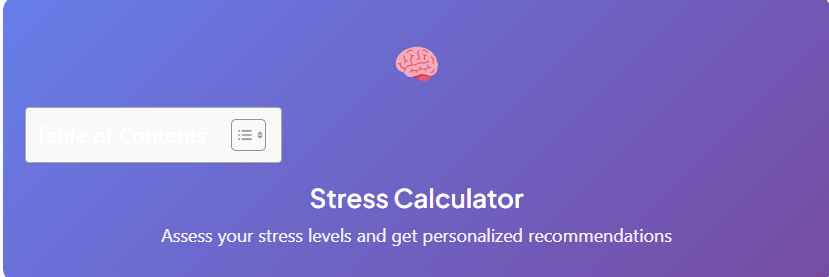
Imagine you’ve been running on fumes for weeks. You’re a parent juggling remote work and your child’s virtual schooling, and the line between office hours and family time has completely blurred. The days feel like one long, continuous task. You stumble upon a webpage, and the first thing you see is a soft, inviting banner. It’s a beautiful gradient of deep purples and gentle lavenders, colors often associated with peace and introspection.
At its center is a large, friendly brain emoji: 🧠. It’s not clinical or intimidating; it’s almost playful, a modern symbol for the mind. Below it, the title is clear and direct: “Stress Calculator.” This isn’t about diagnosing a problem; it’s about understanding a feeling. The subtitle offers a gentle hand: “Assess your stress levels and get personalized recommendations.”
This initial view is designed to disarm you. It feels less like a test and more like a wellness journal. You think of Sarah, a university student buried under textbooks, her heart racing before every final exam. She uses a normal stress calculator not for a score, but for a moment of validation. She needs to see her feelings acknowledged, to put a name to the pressure building inside.
Or consider David, a manager who prides himself on his resilience. Lately, though, he’s felt a deep sense of burnout. The passion for his work has faded, replaced by exhaustion. He feels disconnected from his team and his purpose. For him, a normal stress calculator is a private, non-judgmental first step. He isn’t ready to talk to HR or even his partner, but he can interact with this tool.
It’s a personal mirror, reflecting the internal state he’s been trying to ignore. The simple, clean design of this hero section tells him, “It’s safe to look.” It is a modern wellness tool, an approachable normal stress calculator designed for everyday people.
2. The Heart of Reflection: The Perceived Stress Scale (PSS)
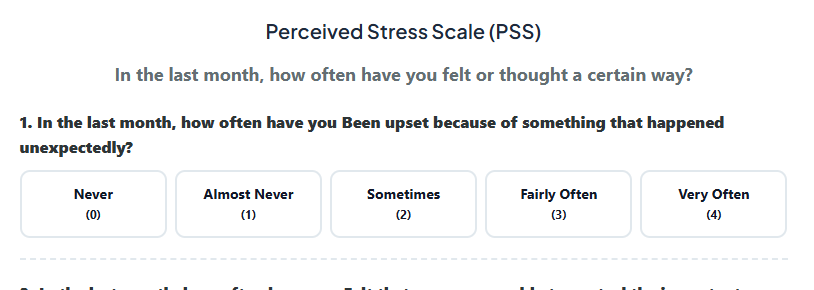
Once you move past the welcoming banner, you arrive at the core of the experience. A clean, organized card appears with the bold title, “Perceived Stress Scale (PSS).” This is a widely respected method for measuring how we view stress. The tool isn’t guessing; it’s using a framework grounded in understanding human perception.
Beneath the title, a soft grey subtitle gently poses a question that sets the stage for self-reflection: “In the last month, how often have you felt or thought a certain way?” This one-month timeframe is crucial. It’s long enough to capture meaningful patterns but short enough to recall with some accuracy. It stops you from focusing only on the bad day you just had or an unusually good week. It asks for a balanced, honest look at your recent life. This normal stress calculator prompts a thoughtful review of the past few weeks.
Below this, a vertical list of 10 questions unfolds. Each question is neatly separated by a dashed border, creating a sense of order and space. The layout is uncluttered, preventing the feeling of being interrogated. It’s more like a guided conversation with yourself. The questions are personal and relatable:
- “In the last month, how often have you been upset because of something that happened unexpectedly?”
- “In the last month, how often have you felt that you were unable to control the important things in your life?”
- “In the last month, how often have you felt difficulties were piling up so high that you could not overcome them?”
These questions don’t ask why. They simply ask how often. This is a key distinction that makes the normal stress calculator so powerful. It removes the need for justification and allows for pure, honest reflection.
Next to each question, a grid of five selectable tiles waits for your input. The options are simple and intuitive: Never, Almost Never, Sometimes, Fairly Often, Very Often. The boxes themselves are a soft white, blending into the clean background. As you consider a question and click on a response, the tile transforms, filling with the same calming purple from the banner. This small visual feedback is surprisingly satisfying.
It’s a physical action that corresponds to your internal thought process, making your feelings feel seen and recorded. The UI is expertly designed to make using this normal stress calculator a smooth and reflective process.
Many of us misunderstand our own stress. We might think we’re just “busy” or “tired.” This interactive process forces a more nuanced look. As you click “Fairly Often” for feeling nervous and stressed, you can’t help but acknowledge a pattern. The interface of the normal stress calculator helps you connect the dots between your feelings and your daily life.
It’s like an engineer analyzing the calculation of bending stress in a structure; they need to understand the internal pressures that aren’t visible on the surface. Similarly, this tool helps you see the invisible load you’ve been carrying. The simple act of selecting these boxes becomes a quiet act of self-awareness. This is a primary function of a good normal stress calculator.
3. The Moment of Truth: Assess, Reset, Print
After thoughtfully answering the 10 questions, your eyes land on a set of three distinct buttons at the bottom of the card. This is the control panel for your journey, the point where you decide what happens next.
The most prominent button, sitting confidently in the center, is the “Assess My Stress” button. It’s filled with a solid, vibrant purple, drawing your attention and encouraging action. It feels like the main event. Clicking this button holds a sense of anticipation, a mix of nervousness and relief.
It’s the moment you’ve been building toward—the moment the abstract feelings you’ve just quantified will be translated into a clear result. You might be a recent graduate, anxiously navigating the job market. Each rejection email adds to a growing sense of dread. Using a normal stress calculator and clicking this button feels like a way to finally face that anxiety head-on.
To its left is the “Reset” button. It’s a subtle, soft grey, designed to be helpful but not distracting. This button offers a beautiful, pressure-free escape hatch. Perhaps you rushed through the questions and want to start over with more intention. Or maybe you answered and then realized you weren’t being completely honest with yourself. The Reset button says, “It’s okay. Take your time. Start again when you’re ready.
” There’s no penalty, no judgment. It’s a quiet acknowledgment that self-reflection is a process, not a one-shot task. For anyone tracking their progress, having a reliable normal stress calculator with a simple reset function is essential.
Finally, on the right, is the “Print” button. Its purpose is practical and forward-thinking. Clicking it suggests a desire to take this insight beyond the screen. You might be preparing for a doctor’s appointment or a session with a therapist. Having a printed copy of your normal stress calculator results provides a concrete starting point for a deeper conversation. It can also be for personal tracking.
Imagine taping it into a physical journal, creating a tangible record of your mental well-being over time. A student could track their stress levels throughout a semester, noticing the peaks before midterms and finals. An employee could monitor their stress during a high-pressure project, using the data to advocate for better support. Each button serves a unique emotional need, making this normal stress calculator a truly user-centric tool.
4. Your Results: A Visual Language for Your Feelings

You take a breath and click “Assess My Stress.” The page doesn’t just flash a number at you. Instead, it presents your results in a way that is both visually intuitive and emotionally supportive.
The first thing you see is your score, displayed in a large, bold font, perhaps as “26 / 40.” This numerical value gives you a concrete metric, grounding your feelings in something measurable. But the number isn’t left to stand alone, which could feel cold or clinical. Right below it, a horizontal scale bar comes to life. A sliding animation gracefully fills the bar from left to right, finally resting at a point that corresponds to your score.
This bar is color-coded, a universal language for intensity. The left side is a calming green, labeled “Low.” The middle section shifts into a cautionary yellow for “Moderate.” The right end glows with a warm but urgent red for “High.” Seeing the indicator land in the yellow or red zone is an instant “aha” moment. It validates your feelings in a way words sometimes can’t. This visual feedback is a core feature of an effective normal stress calculator. It transforms a number into a story.
Beneath the bar, a clear text label confirms your category: “Moderate Stress.” This is followed by a short, supportive message. If your score is low, it might say something like, “You seem to be handling life’s pressures well. Keep up your healthy coping strategies!” If the score is high, the message is gentle and encouraging, perhaps: “It looks like you’re dealing with a significant amount of stress right now.
Remember to be kind to yourself and consider seeking support.” The normal stress calculator is careful not to be alarming. It frames the result as an observation, a snapshot in time, and immediately offers a sense of compassion. The final line is a crucial disclaimer, reminding you that this is a tool for self-understanding, not a medical diagnosis.
This is where analogies can help contextualize the feeling. The internal load you’re feeling is much like the unseen forces within a physical object. The pressure you feel from deadlines and expectations is similar to how bending stress in a beam increases when a heavy load is placed upon it. The structure might look fine from the outside, but internally, the tension is immense. Your mental resilience is also a factor, much like a material’s strength is considered in engineering.
A high score on the normal stress calculator might suggest your emotional structure is under significant strain. It’s a quiet signal that the internal pressure is reaching a critical point, a concept similar to applying a bending stress formula to predict when a material might falter. This is why a normal stress calculator is more than a quiz; it’s a reflection of your inner state.
5. Your Compass Forward: Tips & Recommendations
A good normal stress calculator doesn’t just show you where you are; it offers a map for where you could go next. After revealing your score and category, the tool presents a dedicated section titled “Tips.” This isn’t a generic, one-size-fits-all list. The recommendations are often tailored to your specific stress level, providing relevant and actionable guidance.
The section is beautifully organized into sub-categories, each with its own heading, such as “Maintain Healthy Habits,” “Stress Management,” and “Professional Help.” Each tip within these categories is presented with a positive, green check icon next to it, creating a visual sense of proactive, positive steps you can take.
For someone with a “Moderate Stress” score, the tips might focus on reinforcing positive behaviors. Under “Maintain Healthy Habits,” you might see suggestions like:
- Get Regular Exercise: Even a 20-minute walk can significantly improve your mood. Physical activity is a powerful way to manage the mental load.
- Prioritize Sleep: Aim for 7-9 hours of quality sleep per night. Your mind and body need this time to recover and process the day’s events.
- Eat a Balanced Diet: Nourishing your body can have a profound impact on your mental resilience. Good nutrition fuels a healthy mind.
These aren’t just empty words. For that burnt-out manager, David, seeing the exercise tip might remind him how much he used to enjoy his morning runs before work took over. The normal stress calculator result gives him the push to finally dust off his sneakers. For a parent, the tip on nutrition is a gentle nudge toward healthier family meals. It connects directly to other aspects of wellness.
Speaking of wellness, managing your physical health is a key component of managing stress. Tools can help you track different parts of your lifestyle. For example, understanding your physical exertion can be just as insightful as understanding your mental load.
🚴
Calories Burned Calculator
Calculate calories burned during various activities
If your score is in the “High Stress” category, the “Stress Management” section becomes more prominent. It might include tips like:
- Practice Mindfulness or Meditation: Apps and guided sessions can teach you to ground yourself in the present moment, reducing the feeling of being overwhelmed.
- Set Boundaries: Learn to say “no” to extra commitments when your plate is already full. Protecting your time and energy is not selfish; it’s necessary.
- Connect with Loved Ones: Share what you’re feeling with a trusted friend or family member. A listening ear can make a world of difference.
The young student, Sarah, sees the tip about connecting with loved ones and realizes she’s been isolating herself in the library. The result from the normal stress calculator encourages her to call her parents, and just hearing their voices brings a wave of relief. The tips offered by the normal stress calculator are practical and human-centered.
Finally, the “Professional Help” section offers a vital, destigmatized pathway to further support, suggesting that it’s a sign of strength to seek guidance from therapists, counselors, or doctors. This makes the normal stress calculator a responsible and ethical tool, acting as a bridge rather than a final destination.
6. The Rhythm of Self-Awareness: How You Interact with the Tool
The true power of the normal stress calculator isn’t in a single use, but in how you integrate it into your life. The interaction is simple by design. You read a question, you reflect on your life over the past month, and you make a selection. The clean interface removes any friction, allowing you to focus entirely on the internal process of reflection. The visualization of your results—the color-coded bar and the clear category—provides immediate clarity that can be difficult to achieve on your own. When you’re in the thick of it, stress just feels like a big, messy cloud. The normal stress calculator helps give that cloud a shape and a name.
Imagine using the tool weekly, every Sunday evening. The first week, your score is high. You implement some of the suggested tips: you start taking short walks during your lunch break and make a point to disconnect from work emails after 6 p.m. The next Sunday, you take the assessment again. Your score is still in the moderate zone, but it’s a few points lower. The bar on the screen doesn’t reach quite as far into the yellow. This is powerful feedback. It shows you that your small, intentional actions are making a measurable difference. This repetitive use of the normal stress calculator creates a rhythm of self-awareness. It turns reflection into a habit.
This process is what leads to true clarity in emotional decision-making. When you have data—even personal, subjective data—you can make more informed choices. You might notice that your stress peaks after meetings with a certain client and use that insight to change how you prepare for those calls. You might see a link between poor sleep and high stress, motivating you to finally commit to a better bedtime routine. The normal stress calculator empowers you to become an active participant in your own well-being. Knowing your body’s needs and tendencies can further enhance this.
📊
Body Type Calculator
Determine your body type (ectomorph, mesomorph, endomorph)
In a way, this tool serves a purpose similar to certain engineering calculators. An engineer uses a youngs modulus calculator to understand a material’s elasticity—its ability to deform under stress and return to its original shape. Our minds have a similar elasticity. A normal stress calculator helps us gauge our own mental and emotional “stiffness.” Are we feeling brittle and close to a breaking point, or are we flexible and resilient?
This is not a technical measurement, of course, but a human one. The calculation of bending stress helps determine where a physical structure is most vulnerable. A normal stress calculator helps you find where you are emotionally vulnerable. Are you feeling overwhelmed by unexpected events? Are you struggling with a perceived lack of control? The tool guides you to these specific pressure points.
Ultimately, the goal is to understand the hidden forces at play. Whether it’s the bending stress in a beam or the emotional stress in a human being, making the invisible visible is the first step toward ensuring strength and stability. Similarly, the bending stress formula in engineering provides a predictive framework. While there’s no formula for human emotion, a normal stress calculator offers a reflective framework. It gives you a language and a visual to understand the load you carry, helping you manage it before it becomes overwhelming. And managing your inputs, like diet, is a foundational part of this.
🍎
Nutrition Calculator
Calculate nutritional values and daily requirements
Using a normal stress calculator is an act of profound self-care. It’s a quiet moment to check in, to be honest with yourself, and to get the guidance you need to navigate the pressures of life with greater awareness and grace. It is an essential tool for anyone looking to build a healthier relationship with their own mind. A good normal stress calculator is a friend to your mental wellness journey. Take the time to use a normal stress calculator today.
FAQs
Is the normal stress calculator a medical diagnosis?
No, not at all. Think of the normal stress calculator as a personal wellness tool, much like a journal or a mood tracker. It’s designed to help you pause and reflect on your feelings over the past month, offering a private space for self-awareness. The results provide a snapshot of your perceived stress level to help you understand your emotional state better. It is not a substitute for professional medical advice, diagnosis, or treatment. If you have serious concerns about your stress or mental health, it is always best to speak with a doctor or mental health professional.
How often should I use the stress calculator?
There’s no strict rule, but using the normal stress calculator consistently can be very insightful. Many people find it helpful to check in on a weekly or bi-weekly basis. This rhythm allows you to see patterns over time and notice how changes in your life—or the new coping strategies you’re trying—might be affecting your stress levels. Using it regularly can turn it into a positive habit of self-reflection.
My score was high. Should I be worried?
Seeing a high score isn’t a reason to worry, but it is a gentle signal to be extra kind to yourself. A high result simply acknowledges that you’re likely navigating a significant amount of pressure right now. Use this information as a prompt to focus on self-care. Review the personalized tips provided by the tool, such as practicing mindfulness, setting boundaries, or connecting with loved ones. It’s an opportunity to prioritize your well-being and consider what support you might need.