Enter Your Details
Pregnancy Due Date Calculator for IVF
The moment you see that positive test result, time seems to shift. Suddenly, your calendar isn’t just about work meetings or birthdays; it becomes a countdown to the most significant appointment of your life. Whether you conceived naturally or went through the rigorous journey of fertility treatments, knowing exactly where you stand in your pregnancy timeline provides an immense sense of control and connection. This is especially true for parents who have navigated the complexities of In Vitro Fertilization. For you, precision matters. That’s why using a specialized pregnancy due date calculator ivf tool is more than just checking a date—it’s about visualizing the miracle growing inside you.
Navigating pregnancy math can be confusing. Doctors talk in weeks, apps talk in fruit sizes, and family members just want to know “the date.” If you have gone through fertility treatments, standard calculations based on the last menstrual period (LMP) might not be accurate enough. You need a method that accounts for transfer dates or specific conception timing. Our goal is to walk you through how to use a pregnancy due date calculator ivf effectively, explaining every feature of our tool so you can feel confident and prepared for every step of this beautiful journey.
We designed this guide to be your companion. We will explore how to calculate baby’s due date, understand the nuances of IVF dating, and use our interactive tool to track your baby’s development week by week.
Why Precision Matters in Pregnancy Dating
When you visit your obstetrician for that first confirmation scan, one of the first things they establish is your Estimated Due Date (EDD). This date is the anchor for your entire prenatal care plan. It determines when you should schedule screenings, when you can expect to feel movement, and ultimately, when you might meet your little one.
For natural conceptions, doctors typically use the first day of your last period. But bodies aren’t clocks. Ovulation can happen early or late. However, if you are looking for a pregnancy due date calculator ivf solution, you likely have an exact date of conception or transfer. This precision allows for incredibly accurate dating. Knowing when am i due isn’t just about circling a day on the calendar; it helps you track growth against expected norms. If a baby measures small or large, the accuracy of your due date is critical for medical decisions.
Using a robust pregnancy due date calculator ivf helps bridge the gap between medical jargon and your daily reality. It transforms abstract weeks into tangible milestones. Let’s dive into how our tool works and how it simplifies this complex timeline for you.
Understanding the Hero Section: Your Starting Point
When you first load our pregnancy due date calculator ivf tool, you are greeted by a calming, purple gradient hero box. We designed this intentionally. Pregnancy can be overwhelming, and we wanted the visual experience to be soothing yet professional.
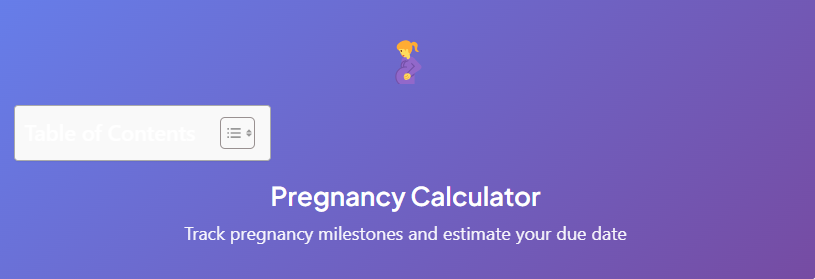
At the top, you will see a simple 🤰 icon alongside the title “Pregnancy Calculator.” Below this is a short, welcoming description. This isn’t just filler text; it sets the stage for what you are about to do. It explains that this tool is designed for tracking pregnancy milestones and estimating your due date with ease.
Think of this hero section as the reception desk at a supportive clinic. It confirms you are in the right place. Whether you are here to double-check a doctor’s date or you are just five minutes past your positive home test and eager to know more, this section welcomes you. It reassures you that whether you need a standard calculator or a specific pregnancy due date calculator ivf setting, you have the right resources at your fingertips.
Mastering the Input Section: Tailoring Your Timeline
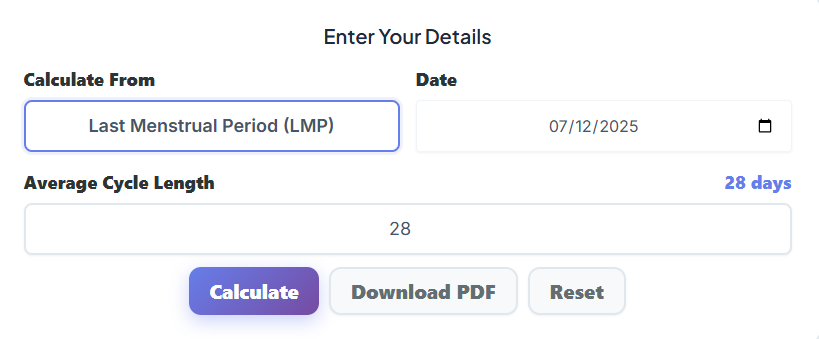
The heart of any calculator is the data you feed it. Our tool’s input section is designed for flexibility because no two pregnancies are identical. Here is how you can use the User Details Form to get the most accurate results.
choosing Your Calculation Method
The first thing you will notice is the “Calculate From” dropdown. This is crucial. Most generic calculators only offer “Last Menstrual Period” (LMP). While useful for many, it doesn’t always serve the IVF community well. In our tool, you can select between:
- LMP (Last Menstrual Period): Ideal if you have regular cycles and conceived naturally.
- Conception Date: This is the gold standard for accuracy if you are using this as a pregnancy due date calculator ivf tool. If you know the exact date of egg retrieval or insemination, this option bypasses the guesswork of ovulation timing.
The Date Picker
Once you have selected your method, you use the simple date picker to input your specific date. If you selected “Conception Date,” you would enter the date of your transfer or retrieval here. This precision is what makes a pregnancy due date calculator ivf so valuable—it aligns your timeline with the biological reality of your pregnancy, rather than a statistical average based on a period you might not have even had if you were on suppression medications.
Cycle Length Adjustments
If you choose to calculate baby’s due date using the LMP method, you will see an option to adjust “Average Cycle Length.” The standard medical assumption is a 28-day cycle, but many women have cycles that range from 24 to 35 days.
The tool features a live preview of this cycle length. By default, it shows “28 days.” As you adjust this number, the preview updates instantly. Why does this matter? If you have a 35-day cycle, you likely ovulated later than the standard calculation assumes. Adjusting this ensures that your pregnancy due date calculator ivf or natural estimation isn’t off by a week, which could cause unnecessary worry about the baby “measuring behind” later on.
Action Buttons
We have kept the interface clean with three distinct buttons:
- Calculate: This is the magic button. One click processing your data to generate your timeline.
- Download PDF: We will discuss this more later, but this button allows you to save your results instantly.
- Reset: If you made a mistake or want to compare dates for a friend, this clears the inputs so you can start fresh.
The Output Section: visualizing Your Journey
Once you hit “Calculate,” the tool transforms your data into a comprehensive pregnancy dashboard. This isn’t just a single date; it’s a roadmap. If you are using this as a pregnancy due date calculator ivf resource, this detailed breakdown helps you synchronize with your fertility clinic’s schedule.
Your Estimated Due Date

The most prominent result is, of course, the Estimated Due Date. It is displayed in a large, readable format. This is the date you will likely memorize and repeat to everyone who asks, “So, when am i due?”
The Countdown
Next to the date, you will see “Days Left.” There is something incredibly grounding about seeing that number count down. Whether it says 200 days or 20 days, it quantifies the waiting game. It turns “months away” into a tangible, shrinking number.
Pregnancy Progress Bar
Visual learners love this feature. The progress bar shows exactly where you sit in the grand scheme of 40 weeks. Watching this bar fill up week by week is a satisfying ritual for many expectant parents. It provides a quick visual check-in: “Am I halfway yet?” or “Wow, I’m almost to the third trimester!”
Detailed Metrics
Below the visuals, we provide specific data points:
- Current Gestational Age: displayed in weeks and days (e.g., “14 Weeks, 3 Days”). This is the language your doctors will use.
- Conception Date: If you entered your LMP, the tool estimates when conception occurred. If you used the pregnancy due date calculator ivf method (entering conception date directly), this confirms your input.
- Fetal Age: This is different from gestational age. Fetal age refers to the actual age of the embryo/fetus, usually two weeks less than gestational age. This distinction is fascinating for understanding development.
Trimester Timeline
Pregnancy is a marathon divided into three distinct laps. The tool outlines the exact start and end dates for your 1st, 2nd, and 3rd trimesters. Knowing when you enter the second trimester (often the “honeymoon phase” of pregnancy) can give you a milestone to look forward to if you are struggling with morning sickness.
Weekly Milestones & Fetal Size
Perhaps the most beloved feature is the Weekly Milestones section. Here, we break down the pregnancy week by week. You will see a cute emoji representing the baby’s size relative to a fruit or object.
Reading that your baby is the size of a blueberry, then a lime, then an avocado helps you bond with the life growing inside you. For IVF parents, who may have seen their baby as a cluster of cells on a screen, these tangible comparisons provided by the pregnancy due date calculator ivf results are deeply emotional and validating.
Support Your Health During Pregnancy
Tracking your dates is essential, but supporting your body through those dates is vital. Pregnancy increases your metabolic demands significantly. You are building a whole new person, after all!
To ensure you are fueling this marathon correctly, you might find our BMR Calculator useful. It can help you understand your baseline energy needs, which you can then discuss with your nutritionist to adjust for pregnancy.
Hydration is another critical aspect. Amniotic fluid is replenished frequently, and your blood volume increases by up to 50%. Staying hydrated helps with everything from swelling to energy levels. Check out our Water Intake Calculator to see if you are drinking enough for two.
Lastly, you will notice your heart working harder. It’s normal for your resting heart rate to increase during pregnancy. You can monitor what is normal for you using our Heart Rate Calculator, but always consult your doctor if you feel palpitations or extreme fatigue.
The PDF Export Feature: Keeping Your Records
One of the standout features of our pregnancy due date calculator ivf tool is the ability to “Download PDF.”
Pregnancy brain is real. You might calculate your milestones today and forget them by tomorrow. Or perhaps you want to share the timeline with your partner, your mother, or your doula. By clicking this button, you get a neatly formatted document containing all the data we just discussed.
You can print this out and stick it on the fridge. You can bring it to your first midwife appointment to save time on “dating math.” It serves as a lovely keepsake for your baby book, documenting the day you officially checked your dates. This feature transforms a momentary web search into a permanent part of your pregnancy story.
Usability and Live Updates: Designed for You
We know that when you are searching for a pregnancy date calculator, you want answers fast. You don’t want to reload pages or deal with clunky interfaces.
That is why our tool features live updates. If you realize you entered the wrong year or want to see how a 30-day cycle changes the result compared to a 28-day cycle, the preview labels update instantly. The switch between LMP and Conception methods is seamless.
This responsiveness is key for the pregnancy due date calculator ivf user. You might want to run a few scenarios: “What if the transfer was a day later?” or “Does the clinic’s date match the standard calculation?” The tool is robust enough to handle these curiosities immediately, designed entirely for clarity and ease of tracking.
The Nuance of IVF Dating vs. Natural Conception
It is worth diving a little deeper into why a specific pregnancy due date calculator ivf is different from a standard due date calculator.
In a natural pregnancy, the exact moment of ovulation and fertilization is rarely known. Sperm can survive for up to five days inside the female reproductive tract, meaning “sex on Saturday” doesn’t necessarily mean “conception on Saturday.” This is why doctors rely on the LMP—it is a concrete date they can put in a chart.
However, IVF eliminates this ambiguity. We know exactly when the eggs were retrieved. We know exactly when fertilization happened in the lab. We know whether a 3-day or 5-day embryo was transferred.
Using a pregnancy due date calculator ivf allows you to input the “Conception Date.” For a fresh transfer, this is effectively the date of retrieval. For a frozen transfer, calculations are adjusted based on the age of the embryo at transfer.
How to use our tool for IVF:
- Select “Calculate From: Conception Date.”
- For Fresh Transfers: Enter the date of your egg retrieval.
- For Frozen Transfers: This is slightly trickier. You essentially need to calculate the “theoretical” ovulation date. Usually, you subtract 2 weeks and 5 days (for a Day 5 transfer) or 2 weeks and 3 days (for a Day 3 transfer) from your transfer date to find the LMP equivalent. However, simply entering the transfer date as the conception date in our tool often aligns perfectly with standard medical charts.
This precision prevents the frustration of being told your baby is “measuring ahead” or “measuring behind” simply because a standard pregnancy date calculator assumed you ovulated on day 14 when your transfer protocol followed a different timeline.
Common Questions About Pregnancy Timelines
While we won’t do a standard FAQ, addressing common curiosities through the lens of using our pregnancy due date calculator ivf can be helpful.
“Can my due date change?”
Yes, but usually only early on. If you calculate baby’s due date based on LMP, an early ultrasound might shift the date if the baby measures significantly larger or smaller. However, for IVF patients using a pregnancy due date calculator ivf, the date is rarely changed because the conception timing is irrefutable. The baby’s size is compared against the known date, rather than moving the date to match the size.
“Why is pregnancy 40 weeks?”
It seems long, doesn’t it? The 40-week count includes the two weeks before you even conceived (if counting from LMP). So, when you miss your period and get a positive test, you are already considered 4 weeks pregnant! Our pregnancy due date calculator ivf accounts for this mathematical quirk, showing you the correct gestational age immediately.
“What is the most accurate way to date a pregnancy?”
A first-trimester ultrasound is clinically considered the most accurate method for natural conceptions. However, a pregnancy due date calculator ivf based on transfer dates is equally, if not more, accurate because the biology was monitored so closely.
Looking Ahead: Your Trimester Journey
Once you have used the pregnancy due date calculator ivf, you will see your trimester breakdown. Let’s look at what those dates actually mean for you.
The First Trimester (Weeks 1-12)
This is a time of rapid change and often, secrecy. You might be dealing with fatigue and nausea. The tool will show you exactly when this period ends. Many parents feel a huge sense of relief passing the 12-week mark, as the risk of miscarriage drops significantly.
The Second Trimester (Weeks 13-26)
Often called the “golden period.” Our tool will highlight when this begins. This is typically when you will schedule your anatomy scan (around week 20). Knowing this date in advance helps you plan. You might start to feel flutters of movement. Checking the pregnancy due date calculator ivf results can remind you that “Yes, week 18 is prime time for feeling kicks!”
The Third Trimester (Weeks 27-40)
The home stretch. The countdown in the “Days Left” section becomes very real. You are preparing the nursery, packing bags, and seeing the doctor more frequently. The milestones in the tool will show rapid weight gain for the baby, explaining why you might be feeling more physically tired.
The Emotional Side of Tracking
Using a pregnancy due date calculator ivf is about more than logistics. For many, it is a way to bond.
After a journey that might have involved disappointment, negative tests, and medical procedures, typing your successful date into a calculator is a triumphant act. Seeing the “Estimated Due Date” pop up validates your success. It serves as a permission slip to start dreaming.
Every time you log in to check when am i due or to see how many days are left, you are reaffirming the reality of this pregnancy. You are acknowledging the life that is developing. The “Weekly Milestones” with their fruit comparisons give you a way to talk to your partner or family about the baby. “The baby is the size of a lemon today!” is much more fun to say than “I am 13 weeks and 4 days.”
Accuracy of Due Date Calculators
You might wonder, can I trust this pregnancy due date calculator ivf?
Online calculators are mathematical tools. They apply standard medical formulas to the dates you provide. They are highly accurate in terms of the math. However, biology is variable. Only about 4-5% of babies are born on their exact due date.
Think of the date provided by the pregnancy due date calculator ivf as a target window. Most babies arrive within two weeks before or after this date. Even if the baby doesn’t arrive on the exact day, the milestones and developmental tracking remain accurate guides for what is happening inside the womb.
Whether you are looking to calculate baby’s due date for a shower invitation or just for your own peace of mind, our tool provides the industry-standard estimation used by healthcare providers.
How Our Tool Supports High-Risk Pregnancies
IVF pregnancies are sometimes monitored more closely and considered “precious” or higher risk simply due to the effort taken to achieve them. Having a reliable pregnancy due date calculator ivf helps you advocate for yourself.
If you know you are exactly 24 weeks based on your transfer date, and a provider suggests you are 23 weeks based on a quick measurement, you can confidently discuss your dates. Understanding your exact gestation via a due date based on ovulation or transfer helps you participate actively in your medical care.
Conclusion
Your pregnancy is a unique, life-altering journey. While the destination—holding your baby—is the goal, the months leading up to it are precious. We created this pregnancy due date calculator ivf to be a reliable companion through those months.
By offering features like specific conception dating, PDF exports, and visual progress bars, we hope to make the abstract concept of “40 weeks” clear, exciting, and personal. Whether you are here to calculate baby’s due date for the first time or the fiftieth time (we know, it’s exciting to check!), we are honored to be a small part of your story.
Remember to take care of yourself. Drink your water, check your heart rate, and rest when you need to. Watch that progress bar fill up. Before you know it, the “Days Left” will hit zero, and a new adventure will begin.
Try the calculator above, download your milestone PDF, and start planning for the incredible days ahead.
FAQs
How is a pregnancy due date calculator for IVF different from a regular one?
A regular due date calculator typically uses the first day of your last menstrual period (LMP) to estimate your due date. However, this assumes a standard 28-day cycle with ovulation on day 14, which isn’t always accurate. A pregnancy due date calculator ivf is more precise because it allows you to use your exact conception date—such as the date of your egg retrieval or embryo transfer—to calculate your timeline. This eliminates the guesswork and provides a due date that aligns perfectly with your specific fertility treatment schedule.
Can my due date change after using the calculator?
For IVF pregnancies, the due date calculated from your transfer or retrieval date is highly accurate and rarely changes. Unlike natural conceptions where an early ultrasound might adjust the date based on the baby’s size, your date is fixed from the start. Any variations in fetal measurement during scans will be assessed against this known, accurate timeline, rather than used to change the due date itself.
What is the most accurate date to enter for an IVF pregnancy?
For the highest accuracy, you should select the “Conception Date” option in the calculator.
For a fresh embryo transfer: Use the date of your egg retrieval.
For a frozen embryo transfer (FET): The most accurate method is to enter the date of your embryo transfer and also know the age of the embryo (e.g., a 5-day embryo). However, for simplicity and strong accuracy, many fertility clinics calculate your due date based on the transfer date plus the standard gestational period. Our tool uses your provided conception or transfer date to create a reliable timeline for your entire pregnancy journey.