Moon Phase Calculator: See the Moon Tonight
Have you ever looked up at the night sky and wondered about the Moon's current appearance? The lunar cycle is a beautiful and predictable celestial event, and our Moon Phase Calculator makes it easy to track. Whether you're a student, an amateur astronomer, or just curious about what the Moon will look like tonight, this tool provides instant and detailed information.
Understanding the lunar schedule helps you connect with the natural rhythms of our solar system. This guide will walk you through how to use the calculator to find out what phase the moon is in, its visibility, and its position in the current cycle.
How to Use the Moon Phase Calculator
Our calculator is designed for simplicity and clarity. With just a few clicks, you can get a complete picture of the Moon for any given date.
Step 1: Select Your Date

The first step is to choose the date you want to investigate. The calculator defaults to today’s date, instantly showing you the moon cycle today. However, you can easily look into the past or future. Simply click on the date field and a calendar will appear. Select any day, month, and year to explore the lunar phase for that specific time. This is perfect for planning activities like stargazing or night photography.
Step 2: Get Your Results Instantly
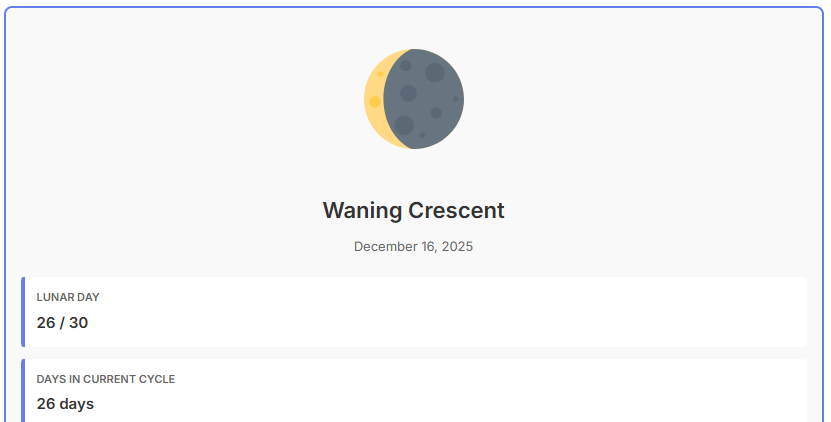
There's no "calculate" button to press. The tool updates automatically as soon as you select a date. All the information you need appears right away, giving you a quick and accurate snapshot of the lunar state.
Understanding Your Results
Once you've selected a date, the calculator presents several key pieces of information to help you understand the Moon's phase and characteristics.
Moon Phase Name and Visualization
The most prominent result is the name of the moon phase, such as "First Quarter," "Waning Gibbous," or "Full Moon." Next to the name, you'll see a clear emoji-style visual of the Moon. This graphic shows you exactly how the Moon appears in the sky, making it simple to identify what you're seeing. It’s a great way to answer the question, "what will the moon look like tonight?"
Detailed Lunar Data
Beneath the phase name, you’ll find more specific details:
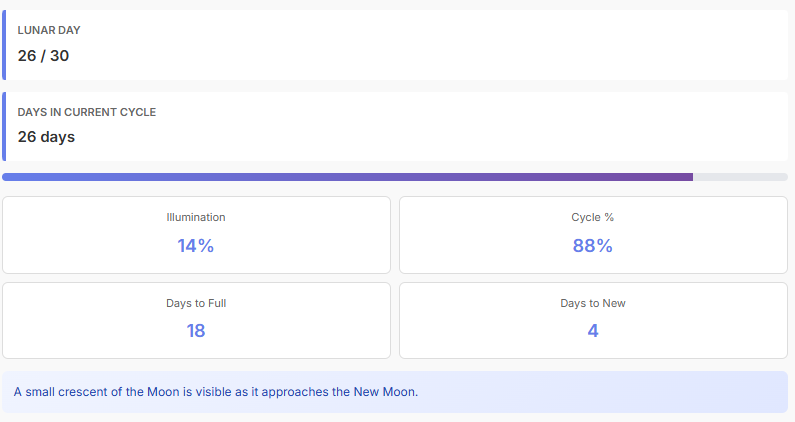
- Illumination: This percentage tells you how much of the Moon's surface is lit by the Sun from our perspective on Earth. A New Moon will have 0% illumination, while a Full Moon is at 100%.
- Lunar Day: This number indicates where we are in the 29.53-day moon cycle. Day 1 is the New Moon, and the cycle progresses from there.
- Cycle Percentage: Similar to illumination, this shows how far along the Moon is in its complete cycle. For example, a First Quarter moon occurs at roughly 25% through the cycle.
Countdown to Major Phases
The tool also includes a handy countdown feature. It shows you the number of days remaining until the next New Moon and the next Full Moon. This is particularly useful for those who track the lunar schedule for gardening, fishing, or personal planning. Knowing the time until the next major phase helps you anticipate celestial events. If you need to calculate the exact time between two lunar events, our Duration Calculator can help you measure the hours and minutes precisely.
The Eight Phases of the Moon
The Moon's appearance changes based on its position relative to the Earth and Sun. Our calculator provides a brief description for each phase, helping you learn more about the lunar cycle. Here are the eight primary phases:
- New Moon: The Moon is between the Earth and the Sun, making it invisible to us.
- Waxing Crescent: A small sliver of the Moon becomes visible, and this sliver grows each day.
- First Quarter: The Moon has completed one-quarter of its orbit and appears as a half-moon.
- Waxing Gibbous: More than half of the Moon is illuminated, and the visible portion continues to grow.
- Full Moon: The Earth is between the Sun and Moon, and the entire face of the Moon is illuminated.
- Waning Gibbous: After the Full Moon, the illuminated portion begins to shrink.
- Third Quarter: The Moon has completed three-quarters of its orbit and appears as a half-moon again, but with the opposite side lit.
- Waning Crescent: The visible sliver continues to shrink until the Moon becomes invisible again, starting a new cycle.
Planning events around specific dates can be complex, especially when coordinating across different time zones. Some organizations find it useful to schedule meetings using a 24-hour clock. If you need to align schedules, the Military Time Converter can be a great asset. Similarly, if you're aligning your plans with public holidays, our Holiday Calculator is a valuable resource for seeing upcoming observances.
Read about : holiday-calculator
Explore the Sky
Now you have everything you need to determine what moon phase we are in on any given night. Use our Moon Phase Calculator to stay connected with the cosmos, plan your outdoor adventures, or simply satisfy your curiosity. The predictable and graceful dance of the Moon is always just a click away.
FAQs
Who can benefit from using the Moon Phase Calculator?
The calculator is useful for a wide range of people. This includes students learning about astronomy, photographers planning night shoots, gardeners who follow lunar planting schedules, and anyone curious about what the moon will look like on a particular night. It’s a great tool for both educational and practical purposes.
How can I use the moon phase information for activities like fishing or hunting?
Many outdoor enthusiasts believe that animal and fish activity is influenced by the lunar cycle. For example, the bright light of a Full Moon might affect animal movement, while the tides influenced by the moon can impact fish behavior. You can use the calculator to check moon phases in advance and plan your trips accordingly.
Can this tool help me with stargazing?
Absolutely. For optimal stargazing, you typically want the darkest sky possible. You can use the calculator to find dates near the New Moon, when the moon’s illumination is at its lowest. This will reduce natural light pollution and make it easier to see stars, planets, and meteor showers.