IVF Due Date Calculator: A Caring Guide to Your Pregnancy Timeline
The journey to pregnancy is rarely a straight line. For many, it is a winding path filled with hope, patience, science, and resilience. If you are reading this, you are likely at a pivotal moment in that journey. Perhaps you have just received positive news, or maybe you are in the planning stages of In Vitro Fertilization. Regardless of where you stand, having clarity about the future is incredibly comforting. That is exactly why we designed our ivf due date calculator.
This tool is more than just a digital calendar; it is a way to visualize the future you have been working so hard toward. Unlike a standard pregnancy calculator that relies solely on a “last period” date, an IVF pregnancy requires specific inputs to be accurate. The precision matters because the timing of conception in IVF is known with exact certainty. When you use an ivf due date calculator, you aren’t guessing. You are using the specific dates of your procedure to look forward to the moment you finally meet your little one.
We built this interface to be simple, calming, and easy to read. You don’t need to be a medical expert or tech wizard to use it. In this guide, we will walk you through exactly how to use the tool, what every button does, and how to interpret the detailed results it provides. We want you to feel empowered and informed every step of the way.
Choosing Your Calculation Method
When you first look at the ivf due date calculator, the first thing you will notice is the clean, user-friendly layout. At the very top of the tool, there are two distinct buttons that allow you to choose how you want to measure your pregnancy. This is the starting point for your calculation.
These buttons represent the “Method” selection. You will see two options side-by-side:
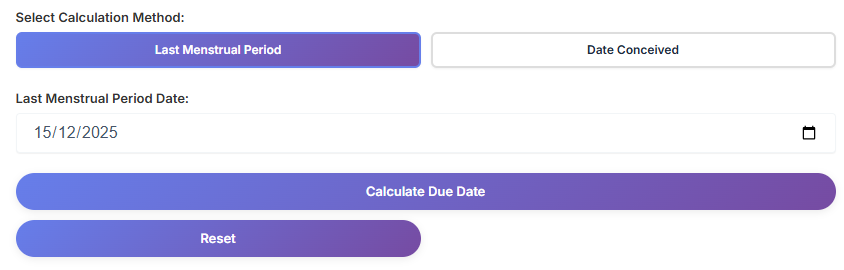
- Last Menstrual Period (LMP)
- Date Conceived
The tool is designed so that you can switch between these methods instantly. When you click on one, you will see a visual change—the active button highlights or changes color to indicate it is selected, while the inactive one fades slightly into the background. This visual cue is important because it confirms exactly which mode the ivf due date calculator is currently in.
For many IVF patients, the “Date Conceived” option is the most relevant. In a natural pregnancy, the date of conception is often an estimate. However, in IVF, you know the exact date of the transfer or retrieval. By selecting “Date Conceived,” you tell the tool to base its math on that precise medical event. However, some clinics still track timelines based on the “Last Menstrual Period” for consistency with standard obstetric charts. We provide both options so you can match the calculator to the information your fertility specialist has given you.
How to Enter Your Dates in ivf due date calculator

Once you have selected your method, your eyes will naturally move down to the input section. This is where you personalize the data. The ivf due date calculator features clear, labeled input fields corresponding to the method you chose.
If you selected “Last Menstrual Period,” you will see a field labeled “LMP Date.” If you selected “Date Conceived,” the label updates to reflect that. Next to or inside this field, there is a small calendar icon.
When you click on this input field to calculate baby’s due date, a date picker interface appears. This interactive calendar allows you to navigate easily through months and years. You don’t have to type the date manually, which reduces the chance of typos. You simply scroll to the correct month and click on the specific day.
The behavior of the date picker is smooth and responsive. As soon as you click a date, the calendar closes, and your chosen date is displayed clearly in the input box. This confirms that the ivf due date calculator has registered your information and is ready for the next step. It is a small interaction, but seeing your significant date locked into the system can feel like a big step towards reality.
Initiating the Calculation
Below the date inputs, you will find the primary action area. This consists of two prominent buttons:

- Calculate Due Date
- Reset
The “Calculate Due Date” button is usually the most visually striking element in this section. It is designed to draw your attention. When you have entered your date and are ready to see the future, you click this button. Visually, you might notice a subtle press effect or a color shift indicating the click has been registered. This is the trigger that tells the ivf due date calculator to process your input.
Next to it is the “Reset” button. This is essential for those times when you want to start over. Maybe you clicked the wrong date by accident, or perhaps you want to compare different scenarios. Clicking “Reset” instantly clears all the fields, returning the tool to its initial state so you can begin again with a fresh slate. It ensures you never get stuck with old data on the screen.
Sometimes, life involves managing multiple timelines, not just pregnancy ones. Whether you are tracking medication schedules or work projects before maternity leave, staying organized is key.
🎯 Deadline Calculator
Track project deadlines and milestones
Open Calculator →
Understanding Your Results
After you click “Calculate,” the ivf due date calculator reveals the results section. This is the heart of the tool. The transition is often accompanied by a smooth animation—the result box might slide down or fade in, drawing your eye gently to the information you have been waiting for.
The result box is designed with a clear hierarchy to make reading easy. It doesn’t just dump numbers on you; it organizes them into a story about your pregnancy.
The Big Reveal: Estimated Due Date
The most prominent feature in the result box is your Estimated Due Date. This is displayed in a large, highlighted box, often using a font size or color that stands out from the rest of the text. It is the focal point. This date represents the 40-week mark, the target you are aiming for. Seeing this date in the ivf due date calculator is often an emotional moment, as it puts a specific timeframe on when you might hold your baby.
Comprehensive Breakdown
Below the main due date, the tool provides a rich detailed summary. It breaks down the information into specific data points that help you understand exactly where you are in the timeline right now.
Day of Week:
The tool calculates the specific day of the week your due date falls on. Knowing your baby might arrive on a Tuesday or a Saturday adds a layer of reality to the date.
Input Date Summary:
To ensure accuracy, the result box restates the date you entered (LMP or Conception). This serves as a quick check for you to verify that the calculation is based on the correct starting point.
Weeks and Days Pregnant:
This is one of the most frequently checked metrics on any ivf due date calculator. It tells you exactly how far along you are, expressed as “X Weeks, Y Days.” This matches the language your doctor uses during check-ups. Instead of doing mental math every day, you can see it clearly displayed here.
Days Until Due:
This field acts like a countdown. It shows the total number of days remaining until your estimated due date. Watching this number decrease over time can be incredibly exciting.
Trimester:
The pregnancy journey is divided into three trimesters, and the tool identifies which one you are currently in. This helps you understand what changes your body might be going through and what medical milestones to expect.
Estimated Conception Date:
Even if you used your Last Menstrual Period to calculate, the tool will reverse-engineer the math to show you the estimated date of conception. This is particularly interesting for verifying timelines.
The layout uses contrasting colors or bold text to separate labels from values, ensuring you can scan the results quickly. It is all about providing clarity and reducing anxiety. When you ask yourself “how far along am I?” or “when am i due,” this result box answers everything in one glance.
As you watch the days tick by and your pregnancy progresses, you might find yourself becoming more attuned to the natural rhythms of time and nature.
🌙 Moon Phase Calculator
Calculate moon phases for any date
Open Calculator →
The Medical Disclaimer Box
At the bottom of the results or near the main interface, you will see a distinct section often outlined or shaded differently. This is the Info / Disclaimer Box.
An ethical ivf due date calculator always includes this. It contains a medical notice explaining that while the calculator provides a mathematical estimate based on standard medical algorithms, it is not a substitute for professional medical advice. It reminds you that every pregnancy is unique and that actual delivery dates can vary.
This box usually explicitly states that the tool is for informational purposes only. It is a responsible inclusion that ensures you understand the data is a guide, not a guarantee. It reinforces trust by being transparent about the limitations of digital tools compared to a doctor’s personalized care.
Real-Life Scenarios
To better understand how this tool fits into real lives, let’s look at a few examples of how people utilize the ivf due date calculator.
Scenario 1: The Fresh Transfer
Sarah and her partner just underwent a fresh embryo transfer three days ago. The waiting period before the pregnancy test is often the hardest part. To stay positive, Sarah opens the ivf due date calculator. She selects “Date Conceived” and inputs the date of her transfer. Seeing a potential due date next spring gives her a concrete goal to visualize during the difficult “two-week wait.” It shifts her focus from anxiety to hope.
Scenario 2: The Frozen Transfer (FET)
Elena had a frozen embryo transfer. The timing for FET can be different from fresh cycles regarding medication and uterine preparation. Her clinic gave her a lot of dates, and she feels a bit overwhelmed. She uses the ivf due date calculator to clarify her timeline. By inputting her transfer date, she instantly sees her “Weeks Pregnant” count. This helps her synchronize with the apps she wants to download and the books she wants to read. It aligns her mental state with her biological reality.
Scenario 3: The Doctor’s Visit Prep
Mark and Lisa are preparing for their first ultrasound after a successful IVF cycle. They want to walk into the appointment informed. They use the ivf due date calculator to verify their current week count so they can ask intelligent questions about the baby’s development. Knowing they are exactly 7 weeks and 2 days allows them to research what the ultrasound should look like before they even step into the clinic.
Just as you track the days of your pregnancy, observing the passage of days in the wider world can be a grounding practice during this transformational time.
☀️ Sunrise Sunset Calculator
Find sunrise and sunset times
Open Calculator →
Use Cases for the Calculator
This tool serves a wide variety of users, all of whom share a need for precision and ease of use.
For IVF Patients:
The primary users are, of course, the patients. The ivf due date calculator is a daily companion. It provides reassurance. In a process where so much control is given over to doctors and biologists, having a tool that lets you check your own stats restores a sense of agency. It helps patients plan maternity leave, prepare nurseries, and mentally adjust to the idea of parenthood.
For Expecting Parents:
Partners and family members also find value here. It helps them understand the timeline. If a partner wants to know “when am i due” to plan a surprise or arrange work schedules, this tool gives them the answer without needing to ask the pregnant partner constantly. It fosters a shared experience of the pregnancy.
For Doctors and Clinics:
While doctors have their own medical software, a quick, web-based ivf due date calculator is handy for quick visuals during patient consultations. It can also be a recommended resource for patients who call the front desk asking frequently about their dates. It reduces the administrative load by empowering patients to find these answers themselves.
For Planning and Preparation:
Beyond the emotion, there is logistics. You need to know when the first trimester ends to plan travel safely. You need to know when the third trimester begins to have your hospital bag ready. The ivf due date calculator provides the “Trimester” breakdown specifically for this type of high-level planning. It helps users pace their preparations so they aren’t rushing at the last minute.
Why Accuracy Matters
You might wonder why you can’t just use a standard pregnancy date calculator. The difference lies in the inputs. Standard calculators assume conception occurred 14 days after the last period. In IVF, the embryo might be 3 days old or 5 days old at the time of transfer. A standard tool doesn’t account for embryo age, which can throw the date off by several days.
An ivf due date calculator is specifically programmed to handle these nuances. When you use the “Date Conceived” method, it is calculating based on the biological reality of assisted reproductive technology. This accuracy is vital for monitoring fetal growth. If a baby measures small or large on an ultrasound, doctors use the due date as a benchmark. Having the correct date from the start ensures that growth tracking is accurate and prevents unnecessary worry about the baby’s size.
Furthermore, a specialized ivf due date calculator acknowledges the unique nature of your pregnancy. It validates the different path you took to get here. It isn’t just about math; it is about recognition.
Common Questions About Timing
While we aren’t providing a FAQ section, it is worth noting that users often look for a due date based on ovulation or egg retrieval. In the context of the calculator’s UI, “Date Conceived” is the setting that covers these biological events. For an IVF patient, the day of fertilization (or retrieval) effectively functions as the date of ovulation/conception. By simplifying the UI to “Date Conceived,” the ivf due date calculator captures these various technical milestones under one easy-to-understand umbrella.
Whether you are looking to calculate baby’s due date for a registry or just for your own peace of mind, the interface handles the complexity in the background so you only see the simple, clear result.
Conclusion of IVF Due Date Calculator
The path of IVF is one of profound dedication. It involves schedules, medications, appointments, and a lot of waiting. When you finally reach the stage where you need an ivf due date calculator, it is a victory in itself. It means you are moving from the phase of trying to the phase of expecting.
Our ivf due date calculator is designed to honor that transition. By providing a clear, visually soothing, and accurate interface, we hope to give you a moment of clarity amidst the excitement. From the simple toggle of the method buttons to the detailed breakdown in the results box, every element is there to support you.
We invite you to visit https://swiftcalcu.com/ to explore this tool and others that might assist you in organizing your life. Whether you are counting down the days or just checking your current week, we are here to help you keep track of the
FAQs IVF Due Date Calculator
Why is an IVF due date calculator different from a regular pregnancy calculator?
A regular pregnancy calculator typically estimates your due date based on the first day of your last menstrual period (LMP), assuming conception occurred about 14 days later. An IVF due date calculator is more precise because it uses the exact date of your embryo transfer or conception, which is known in an IVF cycle. This provides a more accurate timeline tailored to the specifics of your fertility treatment.
Can I use this calculator for both fresh and frozen embryo transfers (FET)?
Yes, you can. The calculator is designed for all types of IVF cycles. For either a fresh or frozen transfer, you would select the “Date Conceived” method and input the date of your embryo transfer. The tool will then calculate your estimated due date and other pregnancy milestones accurately based on that specific date.
Is the due date from the calculator a guarantee of my delivery date?
No, the date provided is an estimated due date. It is calculated based on a standard 40-week gestation period from your conception date. While it provides a very accurate forecast for planning, only a small percentage of babies are born on their exact due date. This tool is for informational purposes and should not replace guidance from your healthcare provider, who will monitor your unique pregnancy journey.