
BMI Calculator
Calculate your Body Mass Index and see your weight status, risks, and ideal range
Enter Your Details
Your BMI
—
Ideal Weight Range
—
Height (m)
—
Current Weight
—
Personalized Health Recommendations
Understanding Your Health: A Guide to Using a BMI Calculator for Amputation
Navigating health metrics can often feel like learning a new language, filled with acronyms and numbers that are hard to interpret. For individuals with limb loss, this can be even more complex. Standard health tools may not accurately reflect your body’s unique composition. This is where a specialized tool becomes not just helpful, but essential. A dedicated bmi calculator for amputation is designed to provide a more accurate picture of your health, moving beyond generic formulas to offer personalized insights.
I’ve seen firsthand how the right information can transform uncertainty into empowerment. Staring at health data that doesn’t account for your specific circumstances can be disheartening. It can make you feel like an outlier, and the results can be misleading. A standard BMI calculation, for instance, doesn’t know that a limb is missing, which can skew the results and provide an inaccurate assessment of your weight status. This is why a proper bmi calculator for amputation is such a critical resource.
My goal here is to walk you through my experience using one of these thoughtfully designed tools. We will explore it together, step-by-step, just as you would on your own screen. I want to show you how each section is built to guide you, not confuse you. We won’t get bogged down in complex math or code. Instead, we’ll focus on what you see, what you do, and how it feels to get clear, relevant answers about your health. This is a journey from data confusion to personal clarity, using a tool made for you. Using a bmi calculator for amputation should feel empowering, and I’m here to show you how.
First Impressions: A Welcoming and Clear Hero Section

When the page for the bmi calculator for amputation first loads, the initial view is designed to create a sense of calm and clarity. The top of the page, often called the hero section, sets the tone for the entire experience. The best tools I’ve used feel clean, professional, and reassuring from the very first glance.
You are greeted by a prominent title, likely “BMI Calculator,” accompanied by a simple, friendly icon like a scale. This immediately confirms you’re in the right place. The color scheme is often a soothing gradient of blues and purples, which feels modern and trustworthy without being cold or clinical. Below the main title, a short, encouraging description explains the tool’s purpose: to help you calculate your Body Mass Index and understand your weight status, risks, and ideal range.
This introduction is crucial. It makes the bmi calculator for amputation feel less like a medical examination and more like a supportive guide. It’s an invitation to engage with your health in a positive, proactive way. The clean layout and welcoming design elements work together to build your confidence before you even begin entering your data.
Entering Your Details: The Heart of the Calculator
Just below the hero section, you’ll find the main input card. This is where you’ll provide the information the tool needs to give you an accurate result. A well-designed bmi calculator for amputation makes this process intuitive and conversational.
Setting Your Preferences: Units and Sex
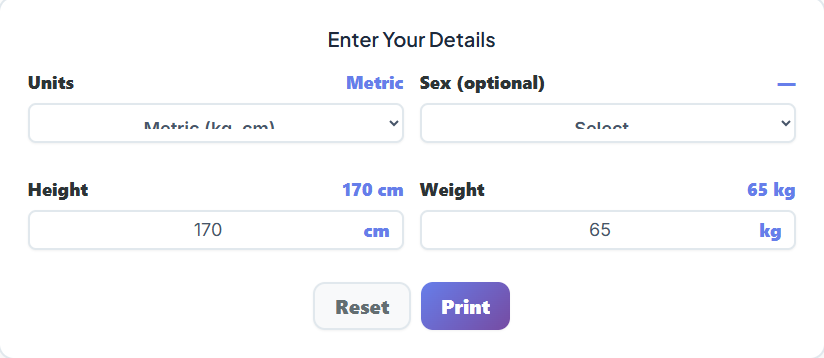
The first thing you’ll see is a row with two drop-down menus: “Units” and “Sex (optional).”
The “Units” selector lets you choose between Metric (kilograms and centimeters) and Imperial (pounds, feet, and inches). What I love about this feature is the small, live-updating label right above the selector. If you choose “Metric,” the label instantly confirms your choice. This immediate feedback makes the tool feel responsive and alive. It’s a small detail that enhances the user experience significantly.
Next to it is the “Sex” selector. It’s clearly marked as optional, which is an important, inclusive touch. Selecting “Female” or “Male” can help the tool provide more personalized health recommendations later on. Just like the units, a live label updates to show your selection, or a simple dash if you choose to leave it blank.
Inputting Your Measurements: Height and Weight
Once your units are set, the calculator presents the fields for your height and weight. The interface is dynamic. If you selected “Metric,” you’ll see boxes for centimeters (cm) and kilograms (kg). If you chose “Imperial,” these will cleverly switch to fields for feet (ft), inches (in), and pounds (lb).
The design here is exceptional. Each input box has a label above it that shows the current value in real-time. As you type your height—say, 170 cm—the label “170 cm” appears instantly. This confirms your input and makes the experience feel interactive. The input fields themselves are clean, with the unit (like “cm” or “kg”) displayed subtly inside the box to the right. This prevents any confusion about what number you should be entering. This thoughtful design is what makes a great bmi calculator for amputation.
For many, using a bmi calculator for amputation is a new experience. The clarity of these input fields helps demystify the process. It feels less like filling out a form and more like having a conversation with a very attentive assistant. This is where an effective bmi calculator for amputation truly shines.
After entering your details, you will also notice a “Reset” and “Print” button. The reset button is perfect for starting over or trying different scenarios, while the print button allows you to keep a physical copy of your results, a feature many find useful for tracking progress or sharing with a healthcare provider. A quality bmi calculator for amputation always includes these user-friendly options.
Your Results Explained: Understanding Your BMI
After you’ve entered your details, the results appear instantly in a series of clean, easy-to-read cards. This is the moment of truth, and a good bmi calculator for amputation presents the information in a way that is both clear and compassionate. It’s not just about giving you a number; it’s about giving you context.
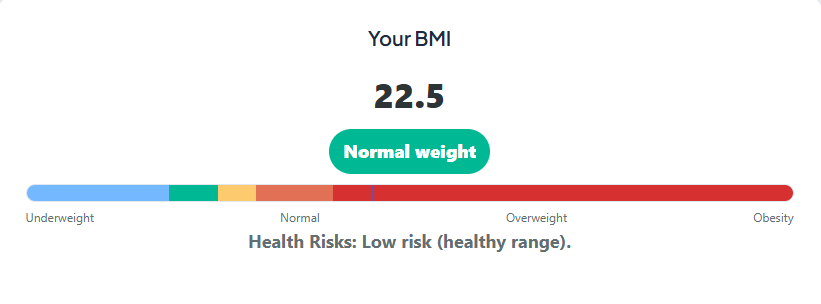
The Main Result: Your BMI Score
The most prominent part of the results is your BMI value, displayed in a large, bold font. You can’t miss it. Below this number, a colorful “pill” or tag immediately tells you what category your BMI falls into—such as “Underweight,” “Normal weight,” “Overweight,” or “Obesity.”
The color of the pill provides a quick visual cue: green for normal, blue for underweight, and warmer shades like yellow or orange for overweight and obesity. This visual system is incredibly effective at conveying your status at a single glance.
Below this, you’ll find a visual scale—a colored bar that represents the entire BMI spectrum, from underweight to obesity. A small marker appears on this bar, showing exactly where your specific BMI falls. This helps you see your result not as an isolated number, but as a point on a continuum. It’s a powerful way to visualize your current standing. The tool also provides a brief explanation of the health risks associated with your BMI category, offering valuable context. This comprehensive feedback is a hallmark of a superior bmi calculator for amputation.
Understanding Adjusted Body Weight and Ideal Weight
Calculating body mass after a limb is removed requires a specific approach. This is where the concept of adjusted body weight (adj body weight) comes into play. A sophisticated bmi calculator for amputation performs these calculations behind the scenes to provide a more accurate BMI. It estimates what your weight would be if the limb were not missing, allowing for a more comparable and fair assessment. The tool uses established percentages for different parts of the body to make this adjustment. For example, a full leg accounts for a certain percentage of total body weight, while a foot accounts for a smaller percentage.
This process is critical for determining a realistic amputation ideal body weight. A standard chart might suggest a weight that is unachievable or unhealthy for an amputee. By using an adjusted formula, the bmi calculator for amputation can provide a healthy weight range that is tailored to your body. This personalized range is often displayed in a dedicated card, showing you the minimum and maximum weight considered healthy for your height and circumstances. It might show the range in both kilograms and pounds for easy reference. This is a crucial feature for anyone looking to manage their weight post-amputation. This focus on amputation ideal body weight is vital.
Another important metric you might see is the percent ibw (percent of ideal body weight). This figure tells you where your current adjusted weight falls in relation to your ideal weight. For example, a percent ibw of 110% would indicate you are 10% above your ideal body weight. This provides a clear, quantifiable measure of how close you are to your goal, which is incredibly motivating for tracking progress. Calculating the percent ibw helps contextualize your weight management journey. This makes the bmi calculator for amputation an indispensable tool. A bmi amputation requires this level of detail.
A Deeper Dive: The Key Performance Indicator (KPI) Cards
Below the main BMI result, you’ll typically find a grid of smaller cards, each highlighting a key piece of information. This is where the tool breaks down the numbers into digestible insights. You’ll usually see:
- Ideal Weight Range: As discussed, this card shows the healthy weight range for your height, often providing values in both metric and imperial units. Seeing your amputation ideal body weight presented so clearly is incredibly helpful for goal-setting.
- Height in Meters: This card simply displays your height converted to meters, which is the standard unit used in the BMI formula. It’s a small but transparent detail that shows you the data being used.
- Current Weight: This displays your current weight, converted to a single unit (like kg or lb), making it easy to compare against your ideal weight range.
These cards are designed to be scanned quickly. They take the core components of your BMI calculation and present them as standalone facts. This layout prevents information overload and helps you focus on one concept at a time. This detailed approach makes the bmi calculator for amputation more than just a calculator; it’s a comprehensive health dashboard. The bmi calculator for amputation is designed for this clarity. It is why the bmi calculator for amputation is so effective.
This is a much better approach than a generic tool. A general bmi calculator for amputation might not offer this. The nuance of a bmi amputation calculator is in these details. Understanding your adj body weight is key. A good bmi calculator for amputation will always clarify this.
Personalized Health Recommendations: Actionable Tips
Perhaps the most valuable feature of a top-tier bmi calculator for amputation is the personalized recommendations section. A great tool doesn’t just give you data; it tells you what you can do with it.
Based on your BMI category, the calculator generates a list of actionable health tips. This section is usually found in its own card near the bottom of the page. The advice is tailored to your specific situation.
- If your BMI is in the underweight range, the tips might focus on nutrient-dense foods and strength training to build lean mass.
- If you’re in the normal range, the advice will center on maintenance, suggesting a balanced diet and regular exercise to stay healthy.
- If your result is in the overweight or obesity categories, the recommendations will focus on sustainable strategies for weight management, such as creating a modest calorie deficit, increasing physical activity, and prioritizing protein and fiber.
The tips are written in simple, encouraging language. They feel like advice from a knowledgeable and caring health coach, not a robot. Phrases like “Consider,” “Aim for,” and “Prioritize” are used to make the suggestions feel manageable. This section transforms the bmi calculator for amputation from a diagnostic tool into a proactive health partner. The experience of using a bmi calculator for amputation should feel supportive. The insights from a bmi amputation calculator are invaluable for health planning.
For individuals with limb loss, finding safe and effective exercise can be a challenge. While the tool provides general guidance, this is where consulting with a healthcare provider or a physical therapist who specializes in working with amputees is crucial. They can help adapt these recommendations to your specific abilities and needs, ensuring you have a safe and effective plan. The bmi calculator for amputation is your starting point. It provides the “what,” and your healthcare team can help with the “how.” This makes the journey feel collaborative.
Read More About: https://swiftcalcu.com/calorie-calculator/
The right bmi calculator for amputation will always put your health first. When you need a reliable tool, a specialized bmi calculator for amputation is the best choice. This journey is made easier with a bmi calculator for amputation. This tool is more than a simple calculator; a high-quality bmi calculator for amputation is a health companion. Every feature of the bmi calculator for amputation is designed with the user in mind.
In the context of a bmi amputation, this guidance is even more critical. A standard calculator wouldn’t understand the nuances. That’s why a specific bmi calculator for amputation is so necessary. It respects the user’s unique situation. The bmi calculator for amputation empowers you with knowledge. It is essential to use a bmi calculator for amputation that is built on accurate data.
Why a Specialized Calculator Matters
Living with an amputation brings unique challenges, and managing your health shouldn’t be one of them. Using a generic BMI calculator can be frustrating and misleading. It doesn’t account for the change in your body composition, and the results can lead to incorrect conclusions about your health status. You might be told you are at a healthy weight when you are not, or vice versa.
A dedicated bmi calculator for amputation is built to address this specific need. By incorporating formulas that adjust for the weight of the missing limb, it provides a much more accurate and meaningful BMI score. This allows for a proper assessment of your health and helps in setting realistic and safe weight management goals. Calculating an accurate adj body weight is the first step toward this clarity.
This is not just about a number. It’s about having access to tools that see you and are designed for you. It’s about feeling understood and supported in your health journey. The confidence that comes from using a tool that truly fits your needs is immense. It replaces doubt with data and anxiety with a clear plan.
The journey to health is personal. For amputees, it requires tools that are as resilient and adaptable as they are. A bmi calculator for amputation is one such tool. It’s a resource that provides the clarity needed to move forward with confidence, to set achievable goals, and to take control of your well-being. Finding the right bmi calculator for amputation is a significant step toward a healthier future.
So, when you are ready, find a bmi calculator for amputation and begin your journey. The detailed feedback from a bmi amputation calculator can guide your next steps with your doctor. Remember that a bmi calculator for amputation is a starting point, a powerful first step in a larger conversation about your lifelong health and wellness. Your health journey deserves the precision and care that a specialized bmi calculator for amputation provides.
FAQs
What is a BMI calculator for amputation, and why is it important?
A BMI calculator for amputation is a specialized tool designed to provide accurate Body Mass Index (BMI) calculations for individuals with limb loss. Unlike standard BMI calculators, it adjusts for the weight of the missing limb, ensuring the results reflect your unique body composition. This is crucial for setting realistic health goals, understanding your weight status, and planning effective weight management strategies.
How does a BMI calculator for amputation differ from a regular BMI calculator?
A regular BMI calculator uses a standard formula that doesn’t account for limb loss, which can lead to inaccurate results for amputees. A BMI calculator for amputation adjusts the calculation by factoring in the percentage of body weight represented by the missing limb. This ensures the BMI score is more accurate and relevant, helping you better understand your health and set appropriate goals.
Can a BMI calculator for amputation help with weight management?
Yes, a BMI calculator for amputation is an excellent tool for weight management. By providing an accurate BMI score and adjusted body weight, it helps you understand your current health status and identify a healthy weight range. Many calculators also offer insights like ideal body weight and percent IBW, which can guide you in creating a personalized weight management plan in collaboration with your healthcare provider.