The Ultimate Guide to Finding the Best Calculator for Calculus
Calculus is often the hurdle that separates casual math enthusiasts from serious STEM students. It is the language of change, motion, and complex systems. But mastering it requires more than just memorizing formulas; it requires the right tools. Whether you are navigating your first derivatives or tackling complex series expansions, having the best calculator for calculus by your side can transform confusion into clarity.
In the past, this meant carrying around a bulky device with a monochrome screen. Today, the landscape has shifted. While physical graphing calculators still hold their ground in exam halls, the modern student often turns to a powerful web-based advanced calculator for homework, study sessions, and deep comprehension.
This guide explores what makes a tool the best calculator for calculus, diving deep into the features of a modern interface designed to make calculus accessible, while comparing these digital solutions to traditional hardware.
The Evolution of the Calculus Tool
For decades, the gold standard was a handheld device. Students would debate the merits of the ti 83 vs ti 84, arguing over processor speed and screen resolution. These devices were revolutionary for their time, allowing users to graph functions and find intersections without plotting points by hand. However, they came with a steep learning curve. You had to learn a specific syntax, navigate nested menus, and squint at pixelated graphs.
Enter the era of the calculadora online. The digital revolution has brought us tools that are not just replicas of physical calculators but enhancements of them. The best calculator for calculus today isn’t necessarily a piece of hardware you buy at an office supply store; it is often a sophisticated software interface accessible from your laptop or tablet.
A modern sci calculator (scientific calculator) offers an intuitive user experience that physical buttons simply cannot match. We are going to explore a specific tool that exemplifies this shift—a comprehensive calculus suite featuring derivative, integral, limit, and series calculators.
A Tour of the Modern Interface
When looking for the best calculator for calculus, user experience is paramount. You don’t want to fight the tool; you want the tool to fight the math for you. Let’s break down the front-end features of a top-tier calculus tool designed for usability.
The Unified Dashboard
Upon loading the tool, you are greeted not by a blank, intimidating command line, but by a clean, modern dashboard. The design philosophy here centers on accessibility. The layout typically uses a soft, gradient background—perhaps blending soothing blues or purples—to reduce eye strain during late-night study sessions.
Central to the design is a card-based layout. This is a hallmark of modern web design, distinct from the rigid grids of a traditional sci calculator. The main card houses the calculator itself, floating elegantly against the background. This visual hierarchy guides your eye immediately to where the action happens.
Intuitive Navigation Tabs
The best calculator for calculus understands that calculus isn’t just one thing. It’s a collection of related disciplines. To manage this, the interface uses a sleek tabbed navigation system at the top of the main card.
You will typically find four distinct tabs:
- Derivatives
- Integrals
- Limits
- Series
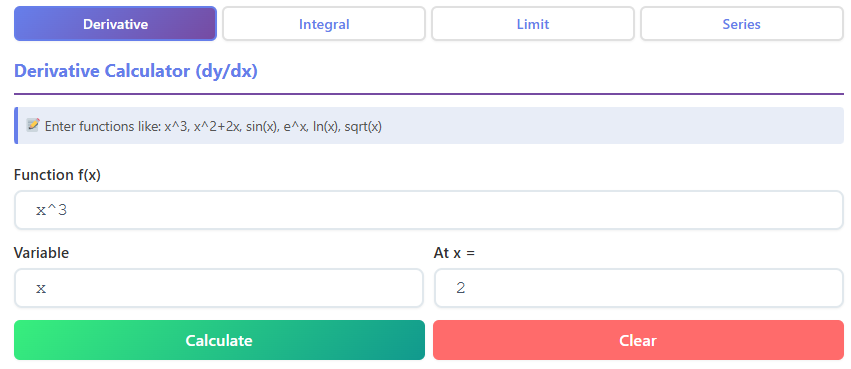
Clicking a tab instantly swaps the active view without reloading the page. This responsiveness is key. Unlike the ti 83 vs ti 84 debate, where upgrading meant buying new hardware for faster processing, web tools switch contexts instantly. The active tab is usually highlighted with a vibrant color (like a primary blue) and white text, while inactive tabs remain subtle, ensuring you always know exactly which mode you are in.
The Derivative Calculator: Analyzing Change
Let’s dive into the first tab. When you select the Derivative Calculator, the input area changes to reflect the needs of differential calculus.
Input Fields and Labels

The best calculator for calculus eliminates ambiguity. You will see a clearly labeled input box, often with a placeholder example like “x^2 + sin(x)” to show you the expected syntax. This is a subtle but crucial design choice. It teaches you how to use the tool without a manual.
Below the function input, you might find a “Variable” input field, defaulting to ‘x’. This flexibility allows you to differentiate with respect to ‘t’, ‘y’, or any variable required by your physics or engineering problems—a feature often buried deep in the menus of a standard advanced calculator.
The “Order” Selector
Calculus often requires finding the second or third derivative. A high-quality tool handles this with a simple numerical input for “Order”. Instead of typing d/dx(d/dx(...)), you simply input ‘2’ for the second derivative. This streamlines the workflow significantly.
Action Buttons and Results
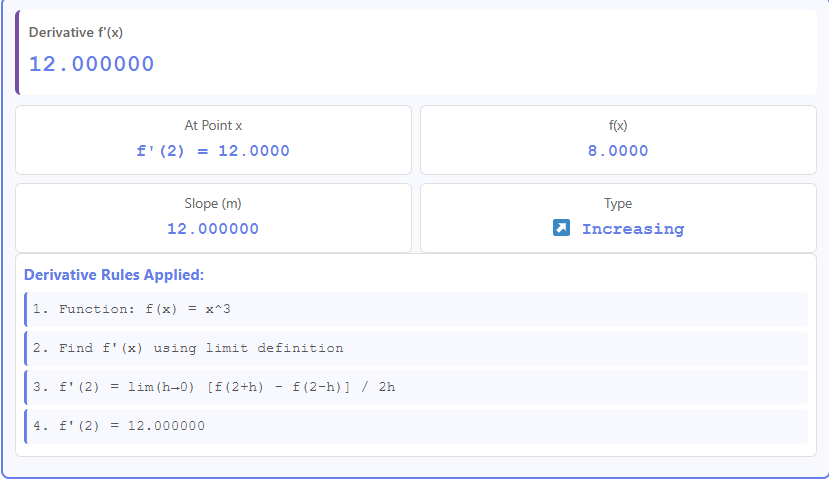
Once your data is in, a prominent “Calculate Derivative” button awaits. It’s usually styled with a gradient or a solid primary color to stand out as the primary call to action.
Upon clicking, the result doesn’t just pop up as raw text. The best calculator for calculus presents the answer in a dedicated “Result” card. This card might feature a light background to contrast with the main interface. Inside, the mathematical result is rendered beautifully, often using standard mathematical notation (like LaTeX rendering) so it looks exactly like it does in your textbook.
Crucially, a “Steps” box often appears below the result. This is where the tool acts as a tutor. It breaks down the process, explaining the rules applied (like the Power Rule or Chain Rule). This explanatory feature is the main reason students search for a calculadora online over using a physical device that only gives the final answer.
The Integral Calculator: Accumulating Area
Switching tabs to the Integral Calculator shifts the context to anti-derivatives and areas.
Definite vs. Indefinite Integration
The best calculator for calculus must handle both definite and indefinite integrals effortlessly. The interface accommodates this with optional fields. You have your main function input, but also fields for “Lower Bound” and “Upper Bound”.
A smart UI design will allow you to leave these bounds empty for indefinite integrals. If you fill them in, the tool understands you are looking for a numerical area. This flexibility is far superior to the rigid syntax of older handhelds.
Visual Cues and Feedback
When you hit “Calculate Integral”, the feedback loop is instantaneous. If there is a syntax error—perhaps you forgot a closing parenthesis—a modern tool will display a helpful error message in red text, guiding you to fix the typo. A physical sci calculator might just say “SYNTAX ERROR”, leaving you guessing.
The results area for integrals is particularly robust. For indefinite integrals, it automatically adds the constant of integration “+ C”, a detail students often forget but the best calculator for calculus never does.
The Limit Calculator: Approaching the Edge
Limits are the foundation of calculus, yet they are often the most abstract concept for students. The Limit Calculator tab demystifies them.
Defining the Approach
The input section here is unique. You have the function input, but also a specific “Approach Value” field (approaching x -> a).
Furthermore, a true advanced calculator for limits includes a “Direction” selector. You can choose to approach from the “Left”, “Right”, or “Both” sides. This is visualized clearly in the UI, often with a dropdown menu. This granular control is essential for analyzing continuity and finding vertical asymptotes.
Handling Infinity
The best calculator for calculus handles inputs of “infinity” or “-infinity” gracefully. You don’t need to hunt for a special symbol; typing “inf” is usually recognized immediately. The result card will clearly state if the limit converges to a value or diverges, often accompanied by a brief explanation in the steps box.
The Series Calculator: Expansions and Sums
The final tab is for Series, a topic that usually appears in Calculus II. This section distinguishes a basic tool from the best calculator for calculus.
Taylor and Maclaurin Series
The interface here asks for a function and a “Center Point”. If you leave the center point at 0, it calculates a Maclaurin series; change it to any other number for a Taylor series.
You also get a “Terms” input to specify the order of the expansion. Want the first 5 terms? Just type ‘5’. The result card displays the expanded polynomial clearly. Seeing the terms laid out sequentially helps students understand how the series approximates the original function.
User Experience Details
Across all these tabs, the overall design plays a huge role.
- Metrics Grid: You might see a small grid showing computation time or precision settings. This transparency builds trust in the tool’s accuracy.
- Helpful Notes: Small snippets of text under input boxes (e.g., “Enter ‘sin(x)’ for sine”) act as micro-tutorials.
- Responsive Layout: The best calculator for calculus works on your phone. The cards stack vertically on mobile screens, ensuring you can calculate limits on the bus just as easily as on your desktop.
Physical vs. Digital: The TI-83 vs TI-84 Debate in a Web Era
No discussion on this topic is complete without addressing the hardware giants. The comparison of the ti 83 vs ti 84 has dominated classroom discussions for twenty years. The TI-84 Plus, with its faster processor and USB connectivity, was a significant upgrade over the TI-83. It introduced “MathPrint,” which allowed fractions to look like fractions rather than division lines.
However, even the TI-84 pales in comparison to a modern web-based advanced calculator in terms of pure user interface.
- Screen Real Estate: A calculator screen is roughly 320×240 pixels. A web tool uses your high-definition monitor.
- Input Method: Typing on a QWERTY keyboard is infinitely faster than alpha-keying on a handheld.
- Cost: A TI-84 can cost upwards of $100. A calculadora online is often free or a fraction of the cost.
While you need a physical calculator for the SAT or AP exams, for the actual process of learning and doing homework, the best calculator for calculus is the one that provides the most context and ease of use. That is almost always the web-based tool.
Why the “Calculadora Online” Wins for Learning
The shift to online tools is about more than just convenience; it’s about pedagogy. When you use a calculadora online, you aren’t just getting an answer key. You are interacting with a dynamic interface that guides you.
A physical sci calculator is a black box. You put numbers in, and numbers come out. If the answer is wrong, you don’t know why. The best calculator for calculus on the web breaks down the barrier between the problem and the solution.
- Readability: The difference between reading
int(x^2, x, 0, 5)on a small screen and seeing a properly formatted integral symbol on a web page is night and day. - Copy/Paste Functionality: You can copy your result from the web tool and paste it directly into your digital notes or lab report.
- Updates: The ti 83 vs ti 84 firmware updates are cumbersome. Web tools update silently in the background. You always have the latest features.
Navigating the “Advanced Calculator” Landscape
The term advanced calculator can mean many things. It can refer to financial calculators, graphing utilities, or matrix solvers. But in the context of calculus, “advanced” means the ability to handle symbolic math.
The tool we described—with its dedicated sections for series and limits—fits this description perfectly. It abstracts the complexity of symbolic computation behind a user-friendly front end. The use of gradients, shadows, and rounded corners isn’t just aesthetic; it lowers the cognitive load. When the tool looks friendly, the math feels less scary.
Usability Features that Define the Best Calculator for Calculus
What truly cements a tool’s status as the best calculator for calculus are the small details in the UI.
The Steps Box
We mentioned this earlier, but it deserves a deeper look. A “Steps” box that appears after calculation is the bridge between confusion and understanding. It transforms the tool from a cheater’s aid into a teacher’s aid. Seeing the intermediate steps of a difficult integral helps you spot where your own manual calculation went wrong.
Metric Grids and Performance
An advanced calculator often displays metrics like “Execution Time” or “Precision”. While seemingly technical, this reassures the user that the tool is performing complex logic efficiently. It gives the interface a professional, scientific feel, akin to a high-end dashboard.
Clear Error Handling
Nothing is more frustrating than a vague error. The best calculator for calculus uses its interface to communicate clearly. If you try to divide by zero in the Limit calculator, the result card shouldn’t crash; it should say “Undefined” or “Infinity” depending on the context. If you type a letter in a number-only field, the input box might glow red or display a “Invalid Input” tooltip. This responsiveness is what makes a calculadora online superior for beginners.
Integrating the Tool into Your Study Routine
To get the most out of the best calculator for calculus, you should use it alongside your textbook, not just to finish homework.
When studying derivatives, predict the answer yourself first. Then, type the function into the tool. If your answer matches the Result Card, great. If not, look at the Steps box. Did you miss a Chain Rule application?
When comparing the ti 83 vs ti 84 for exam prep, use the web tool to verify the graphs you see on your handheld screen. The high-resolution rendering on the web can help you understand the nuances of the curve that might be lost on the lower-resolution LCD screen of a physical sci calculator.
Accessibility and Design
A key factor in being the best calculator for calculus is accessibility. The interface described—with clear labels, high contrast text (white on blue buttons), and logical tab order—ensures that the tool is usable by everyone.
The “Result Card” design separates the answer from the input, preventing visual clutter. This is a common failure point in older software where inputs and outputs would mix in a scrolling log. By keeping the current state clean and isolated, the tool helps the user focus.
Conclusion: The Future of Calculus Calculation
The search for the best calculator for calculus ultimately depends on your needs. For the exam room, you are bound by the regulations that keep the ti 83 vs ti 84 relevant. But for understanding the soul of calculus—the rates of change, the accumulation of areas, the infinite sums—the modern calculadora online is the clear winner.
Tools that offer a dedicated front-end for derivatives, integrals, limits, and series, wrapped in a beautiful, responsive design, represent the future of education. They remove the friction of computation, allowing students to focus on the concepts.
Whether you call it a sci calculator, a web app, or an advanced calculator, the value lies in the interface. A tool that invites you to experiment, guides you through errors, and presents results with crystal clarity is, without a doubt, the best calculator for calculus.
By embracing these digital advancements, you aren’t just getting the right answer faster; you are building a deeper, more intuitive relationship with mathematics itself. So, open that tab, input your function, and let the best calculator for calculus show you the beauty of the math behind the curtain.
Understanding the “Best Calculator for Calculus” Workflow
Let’s walk through a final workflow scenario to illustrate why this specific UI design works so well. Imagine you are working on a problem involving the Taylor Series of cos(x) at x=0.
- Selection: You open the tool and immediately click the “Series” tab. The UI shifts instantly. The best calculator for calculus anticipates your needs by hiding the unrelated integral bounds or limit directions.
- Input: You type
cos(x)into the function box. You see a note “Center Point (default 0)”. You leave it as is. You enter ‘4’ into the “Terms” box. - Action: You click the primary button. It provides tactile visual feedback (a subtle depression or color shift).
- Result: The Result Card slides into view. You see
1 - x^2/2! + x^4/4!. - Verification: You are confused about the factorials. You look at the “Steps” section (if available) or the “Notes” section which explains the formula used.
This seamless flow is what defines the best calculator for calculus. It is frictionless. It feels less like operating a machine and more like having a conversation with a math expert.
Final Thoughts on Choosing Your Tool
As you progress through your mathematical journey, remember that the tool you choose shapes your thinking. A clumsy interface can make calculus feel disjointed and difficult. A sleek, well-designed advanced calculator makes it feel logical and elegant.
While the physical buttons of a sci calculator have their place, the screen of your computer offers a canvas for learning that is unmatched. The ability to toggle between a derivative calculator and an integral calculator with a single click, viewing high-fidelity results in a clean card layout, is a game-changer.
So, when you next sit down to tackle a problem set, ensure you have the best calculator for calculus open in your browser. It’s the smart, modern way to master the mathematics of change.
Summary of Key Features
To recap, here is what makes the specific tool we analyzed the best calculator for calculus:
- Tabbed Interface: distinct workspaces for Derivatives, Integrals, Limits, and Series prevents confusion.
- Card-Based Results: isolates the answer for clarity.
- Natural Inputs: accepts standard math notation without requiring complex syntax learning.
- Helpful Micro-copy: guides the user through inputs and potential errors.
- Visual Appeal: uses gradients and spacing to create a professional, low-stress environment.
This combination of aesthetics and functionality is why students are moving away from the hardware limitations of the ti 83 vs ti 84 era and embracing the limitless potential of the calculadora online. Choosing the best calculator for calculus is the first step toward conquering the subject.
FAQs
What makes an online calculus calculator better than a physical one?
An online calculus calculator, or calculadora online, offers a more intuitive and user-friendly experience compared to physical calculators like the TI-83 or TI-84. With features like step-by-step solutions, high-resolution results, and a clean, modern interface, online tools make learning and solving calculus problems easier. Plus, they’re often free or more affordable than traditional sci calculators.
Can an online calculator handle advanced calculus problems?
Absolutely! Modern online tools are designed as advanced calculators capable of solving derivatives, integrals, limits, and series with precision. They also provide detailed explanations, making them ideal for both beginners and advanced users who want to understand the process behind the solution.
Are online calculators allowed in exams?
While online calculators are excellent for learning and homework, most exams require physical calculators like the TI-83 or TI-84 due to strict regulations. However, using an online tool for practice ensures you’re well-prepared and confident when using a physical sci calculator during the test.