
A Deep Dive into the Square Root Curve Calculator
Mathematics often involves concepts that are easier to understand when you can see them. One such concept is the root of a number, which can be visualized beautifully on a graph. The square root curve calculator is a powerful digital tool designed to make the process of finding roots and powers not just simple, but also visually intuitive. This guide will walk you through every feature of this calculator, explaining how to use its interface to solve problems and understand the underlying mathematical concepts. From basic square roots to more complex nth roots, you’ll see how this tool can transform your approach to calculations.
We will explore the entire user interface, from the main header to the detailed results cards. This is more than just a calculation engine; it’s an educational platform that helps you see the math in action. Whether you’re a student trying to grasp these ideas for the first time or a professional needing a quick and reliable tool, this square root curve calculator provides a seamless experience.
Navigating the Header Section
When you first load the square root curve calculator, your eyes are drawn to the clean and organized header section at the top of the page. This area serves as the main navigation hub, providing a clear title and easy access to other essential tools. The title, prominently displayed, confirms you are in the right place to work with roots and powers. It’s designed to be simple and direct, ensuring there’s no confusion about the tool’s purpose.
The header isn’t just for show; it’s a functional part of the user experience. It often contains links or a menu that can lead you to other calculators, tutorials, or resources. This thoughtful design means you can easily switch between different mathematical tools without having to leave the site. The layout is intentionally uncluttered, focusing your attention on the task at hand: using the square root curve calculator to solve your problem. The minimal design helps reduce cognitive load, making the entire process feel smooth and efficient.
Understanding the Tab-Based Interface
Below the header, the core functionality of the square root curve calculator is organized into a series of tabs. This tab-based system is incredibly intuitive, allowing you to switch between different types of calculations with a single click. Each tab represents a specific mathematical operation, keeping the interface clean and preventing the screen from becoming cluttered with too many options at once. Let’s explore each tab in detail.
This design choice is crucial for a tool that handles multiple functions. Instead of presenting all options simultaneously, which could be overwhelming, the tabs guide you naturally toward the operation you need. It segments the calculator into logical sections: Square Root, Cube Root, Nth Root, and Power. This segmentation is key to the user-friendly nature of the square root curve calculator, making complex operations accessible to everyone.
The Square Root Tab
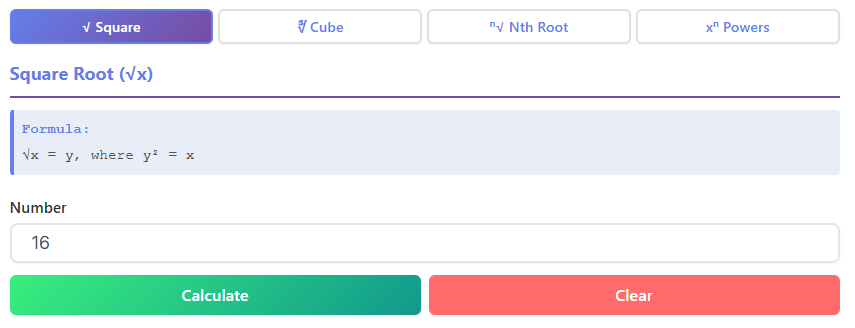
The default tab, and often the most used, is the “Square Root” tab. This is your go-to section for finding the square root of any non-negative number. The interface here is streamlined for this specific task. You’ll find a single input field where you can enter the number you want to find the root of. For example, if you wanted to find the 82 square root, you would simply type “82” into this box.
Once you enter a number and perform the calculation, the tool provides a comprehensive breakdown of the result. It doesn’t just give you a decimal approximation; it also shows you the steps involved in simplifying the radical, if possible. This educational component is a standout feature of the square root curve calculator. You’re not just getting an answer; you’re learning the process behind it. The visual representation of the root curve also helps solidify your understanding of how the function behaves.
The Cube Root Tab
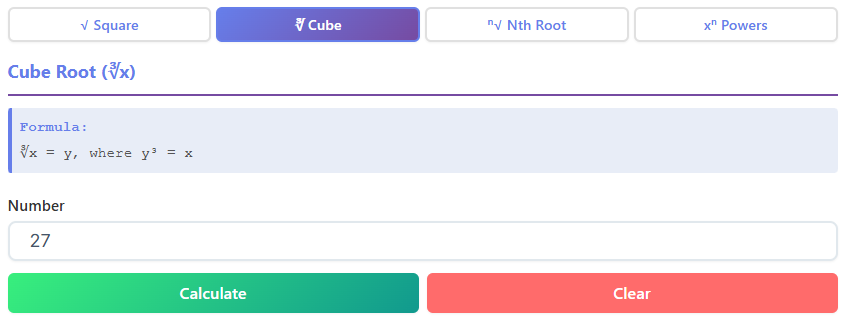
Adjacent to the Square Root tab is the “Cube Root” tab. As the name suggests, this section is dedicated to finding the cube root of a number, which is the value that, when multiplied by itself three times, gives the original number. Unlike square roots, you can take the cube root of a negative number, and this calculator handles that perfectly.
The layout is consistent with the Square Root tab, featuring a clear input field. You can enter positive or negative integers or decimals. The results are displayed with the same level of detail, including a step-by-step simplification and a final decimal value. The visual graph will adjust to show the characteristic shape of the cube root function. Using this tab is just as straightforward as the others, maintaining the user-friendly experience of the overall square root curve calculator.
The Nth Root Tab
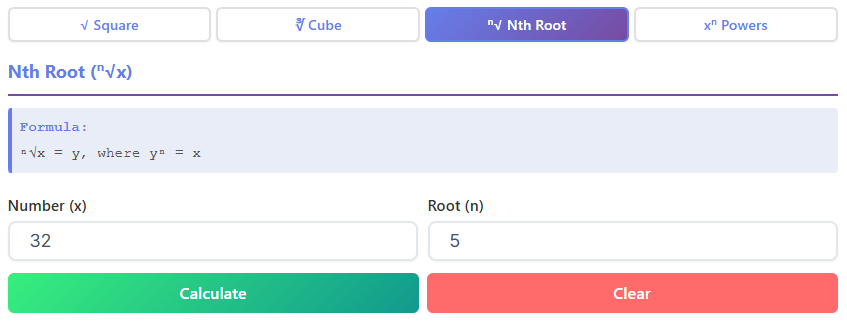
For calculations that go beyond squares and cubes, the “Nth Root” tab provides ultimate flexibility. This powerful feature allows you to calculate any root of a number. Here, you’ll find two input fields: one for the number (the radicand) and another for the root index (n). This is where you can explore a wide range of mathematical problems.
Do you need to find the 4th root of 256 or the 7th root of -128? This is the place to do it. The square root curve calculator excels here by making a potentially confusing operation incredibly simple. The interface guides you to enter both values correctly. After calculation, you receive the same detailed results, including a decimal answer and a simplified radical form. This tab truly expands the capabilities of the tool, making it a comprehensive solution for root-related calculations. It’s a core component of what makes this a versatile square root curve calculator.
The Power Tab
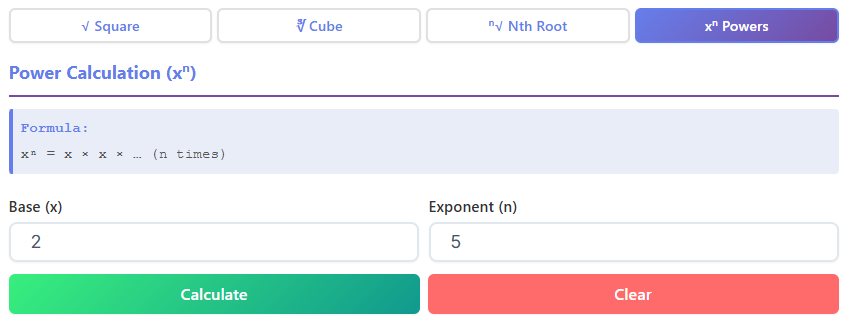
The final tab, “Power,” is the inverse of the root tabs. Instead of finding a root, it allows you to raise a number to a specific power. This is useful for checking your root calculations or for any situation where you need to perform exponentiation. For instance, if you found the square root of 9 is 3, you could use the Power tab to calculate 3 squared (3^2) to confirm it equals 9.
This tab also features two input fields: one for the base number and another for the exponent. You can use integers, fractions, or decimals for the exponent, giving you a wide range of calculation possibilities. The inclusion of the Power tab makes the square root curve calculator a more complete mathematical tool. It creates a closed loop where you can explore the relationship between roots and powers within the same interface, deepening your understanding of these fundamental concepts.
∫ Calculus Calculator
Derivatives, integrals, and limits calculator
Open Calculator →
📈 Graphing Calculator
Plot and analyze mathematical functions
Open Calculator →
🎲 Probability Calculator
Calculate probabilities and combinations
Open Calculator →
Interacting with Inputs and Buttons
The usability of any digital tool often comes down to its inputs and buttons. The square root curve calculator is designed with simplicity and clarity in mind. The input fields are large, clearly labeled, and easy to click into. They accept a wide range of numerical entries, including integers and decimals. Placeholder text within the fields often provides examples, guiding you on the type of number to enter. For instance, in the Square Root tab, the input box might say “Enter a number,” leaving no room for confusion.
Once you’ve entered your numbers, the action buttons are impossible to miss. Typically, you’ll see a prominent “Calculate” button. Its size, color, and placement are all chosen to draw your attention and make the next step obvious. Some versions of the tool might also include a “Clear” or “Reset” button, allowing you to quickly erase the inputs and start a new calculation without having to manually delete the previous numbers. This thoughtful design ensures a frustration-free experience, which is essential when you’re focused on solving a math problem. This careful attention to user interaction makes this a top-tier square root curve calculator.
Deciphering the Result Cards
After you hit the “Calculate” button, the results are presented in a clean, organized format known as result cards. This is where the square root curve calculator truly shines, as it provides much more than a single numerical answer. The result is typically broken down into several sections for maximum clarity.
First, you’ll see the final answer displayed prominently, often in a larger font. This could be a simple integer if the number is a perfect square (like the square root of 49 being 7) or a decimal approximation for other numbers. For a problem like the 59 square root, the card would show the long decimal value.
Below this main answer, you often get additional valuable information. The card might show the answer in simplified radical form. For example, the square root of 50 would be displayed as 5√2. This is incredibly helpful for students learning to simplify radicals. The result cards are a key educational component, turning the square root curve calculator from a simple answer-finder into a genuine learning tool. They present information in a layered way, allowing you to take in as much or as little detail as you need.
The Power of Visual Outputs
One of the most compelling features of the square root curve calculator is its visual output. Alongside the numerical results, the tool generates a graph that plots the function and highlights the point corresponding to your calculation. This visual representation is invaluable for understanding the concept of a root curve.
When you calculate a square root, for instance, you’ll see the characteristic parabolic shape of the square root function, which starts at the origin and curves upward and to the right. A point will be marked on this curve that corresponds to your input and its root. For example, if you calculate the square root of 16, a dot will appear at the coordinates (16, 4). This helps you visualize that as the input number increases, its square root also increases, but at a decreasing rate. It makes questions like “how does a square root curve work?” instantly understandable.
This visual feedback reinforces the connection between the abstract numbers and a concrete geometric shape. Seeing the root curve helps you develop an intuition for how roots behave. For cube roots, the graph will show the S-shaped curve that extends into the negative quadrants, visually explaining why you can take the cube root of a negative number. This graphical element elevates the square root curve calculator beyond a mere computational device.
Understanding the Steps Box
To further its educational mission, the square root curve calculator often includes a “Steps” box. This feature provides a detailed, step-by-step explanation of how the calculator arrived at the simplified radical form of the answer. It’s like having a tutor built directly into the tool.
For instance, if you were to calculate the square root of 72, the answer is not a clean integer. The Steps box would break down the process:
- Find the prime factorization of 72 (2 x 2 x 2 x 3 x 3).
- Look for pairs of prime factors (a pair of 2s and a pair of 3s).
- For each pair, take one factor out of the square root sign.
- Multiply the factors outside the root (2 x 3 = 6).
- Leave the remaining unpaired factors inside the root (the single 2).
- The simplified result is 6√2.
This breakdown is incredibly useful for students who are trying to master the technique of simplifying radicals. It demystifies the process and shows the logic behind the answer. Even for a less straightforward calculation like the 59 square root, which cannot be simplified because 59 is a prime number, the box might explain that no perfect square factors exist. This feature turns a simple query into a learning opportunity, making the square root curve calculator an indispensable educational aid. It’s another example of how the tool helps you understand how a square root curve work.
Perfect Square and Cube Indicators
A subtle but brilliant feature of the square root curve calculator is its use of indicators for perfect squares and perfect cubes. When you enter a number that has an integer root, such as 25 for a square root or 27 for a cube root, the tool often provides a visual cue to let you know.
This might be a small badge, a checkmark, or a simple text notification that says “Perfect Square!” or “Perfect Cube!” next to your result. This immediate feedback is highly rewarding and helps reinforce the concept of perfect roots. It helps you quickly identify these special numbers without having to think too hard about it. For example, when you input ’64’ in the Square Root tab, the indicator will pop up, confirming it is a perfect square (8×8). If you then switch to the Cube Root tab and input ’64’, the indicator will appear again, confirming it is also a perfect cube (4x4x4).
This feature is especially helpful for learners who are memorizing perfect squares and cubes. It provides instant validation and can make the learning process more engaging. For numbers that are not perfect roots, like when finding the 82 square root or 59 square root, the absence of this indicator clearly communicates that the answer will be a decimal approximation. It’s a small detail, but it significantly enhances the clarity and educational value of this excellent square root curve calculator. You see the answer, the graph, and a confirmation, all in one place. This is how a square root curve work within this tool to provide a complete picture.
FAQs
What is the square root curve calculator used for?
The square root curve calculator is a user-friendly tool designed to calculate square roots, cube roots, nth roots, and powers. It provides detailed results, visual graphs, and step-by-step explanations, making it ideal for students, educators, and professionals who want to understand mathematical concepts visually and interactively.
Can the calculator handle decimals and negative numbers?
Yes! The calculator supports both decimals and negative numbers. For square roots, it calculates the principal root for non-negative numbers. For cube roots and nth roots, it can handle negative inputs, providing accurate results and visualizing them on the graph.
How does the visual graph enhance learning?
The visual graph plots the root curve or power function based on your input, helping you see how the function behaves. For example, when calculating the square root of 16, the graph highlights the point (16, 4) on the curve, making it easier to understand the relationship between the input and output.