⛽ Fuel Economy Converter
Convert MPG to L/100km and more. Essential for comparing car fuel efficiency across different standards.
📊 Quick Reference
📜 Recent Conversions
Fuel Economy Converter: The Ultimate Guide for Drivers
Understanding your vehicle’s fuel efficiency is more important than ever. Whether you are a daily commuter, a road trip enthusiast, or in the market for a new car, knowing how to interpret and compare fuel economy ratings can save you a significant amount of money and help you make more informed decisions. However, with different measurement standards used across the globe, comparing vehicle efficiency isn’t always straightforward. This is where a reliable fuel economy converter becomes an indispensable tool.
This comprehensive guide will walk you through everything you need to know about using a fuel economy converter. We will explore why these comparisons matter, break down the different global standards like MPG and L/100km, and provide a step-by-step tutorial on how to use a modern, feature-rich online fuel economy converter.
From its basic functions to advanced features, you will learn how this simple yet powerful tool can demystify fuel consumption figures, making you a smarter and more efficient driver. Understanding these metrics is crucial in today’s automotive landscape, and having a go-to fuel economy converter simplifies the entire process.
Understanding the Tool: Header and Visual Overview
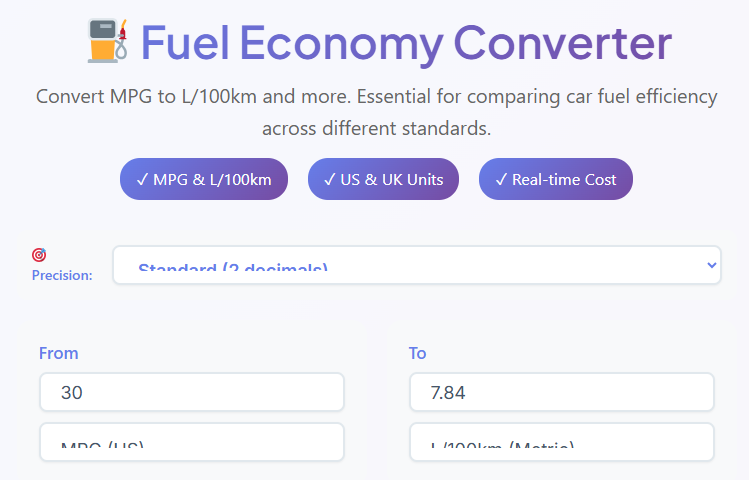
The first thing you will notice when you open a high-quality fuel economy converter is its clean and intuitive design. The user interface is crafted to be straightforward, ensuring that anyone can perform conversions without a steep learning curve. The goal is to provide immediate value without overwhelming the user with unnecessary clutter.
At the very top, you will find the main title, clearly stating the tool’s purpose: Fuel Economy Converter. Directly beneath the title, a short descriptive text offers a concise summary of what the tool does. It might say something like, “Instantly convert between different fuel economy units like MPG, L/100km, and km/L.” This immediate clarification sets the right expectation for the user.
A key part of the visual overview is the feature badges. These small, icon-driven highlights provide a quick snapshot of the tool’s capabilities. You can expect to see badges such as:
- MPG & L/100km: This indicates that the tool supports the most common units, covering both imperial/US customary and metric systems.
- US & UK Units: This is a crucial distinction. The tool can differentiate between a US gallon and an imperial (UK) gallon, which are different in volume. This ensures accuracy when you need to convert from mpg to l/100km for vehicles from different regions.
- Real-time Cost: A more advanced feature, this badge signifies that the tool can help you calculate the potential cost of fuel, adding a practical financial dimension to your conversions.
The overall UI design is typically modern and responsive, meaning it works flawlessly on desktops, tablets, and mobile phones. This accessibility ensures you can use the fuel economy converter whether you are at home researching cars or at a dealership comparing models on the spot.
Setting Your Accuracy: The Precision Selector

When dealing with fuel economy figures, precision can be surprisingly important. Small differences in efficiency add up over thousands of miles, translating into real-world cost savings or expenses. A well-designed fuel economy converter gives you control over the level of detail in your results through a precision selector.
Typically presented as a dropdown menu, the precision selector allows you to choose the number of decimal places displayed in the converted result. Common options include:
- 2 Decimal Places (e.g., 7.15)
- 4 Decimal Places (e.g., 7.1523)
- 6 Decimal Places (e.g., 7.152389)
Why does this matter? For everyday driving comparisons, two decimal places are usually sufficient. If you are a car enthusiast, an engineer, or conducting a detailed analysis for a vehicle import or a technical report, higher precision is vital. It allows for a more granular comparison and ensures that no data is lost due to rounding.
Using the fuel economy converter with adjustable precision means you can tailor the output to your specific needs, whether for a quick check or a deep dive. To use it, simply click the dropdown and select your desired level of accuracy before or after performing a conversion; the result will update instantly.
The Starting Point: The “From” Input Section
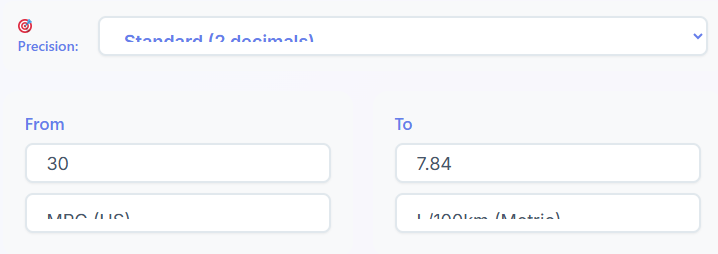
This section is the heart of the fuel economy converter. It is where you provide the initial value you want to convert. The design is intentionally simple to facilitate a quick and error-free process. Let’s break it down step-by-step.
Step 1: Entering the Value
The first element is a clear input field, often labeled “Value” or “Amount.” This is where you type the numerical fuel economy figure you already have. For example, if your car’s specification sheet says it gets 35 MPG, you would enter “35” into this box. The field is designed to accept numerical input, ensuring you can get started without any confusion.
Step 2: Selecting the “From” Unit
Next to the value field is a crucial dropdown menu labeled “From.” This is where you tell the fuel economy converter what unit your initial value represents. Clicking on this dropdown reveals a list of supported fuel economy standards from around the world. A comprehensive fuel economy converter will include:
- MPG (US): Miles per Gallon (using the US gallon). This is the standard in the United States.
- MPG (UK): Miles per Gallon (using the Imperial gallon). The UK gallon is about 20% larger than the US gallon, so this distinction is critical for accurate conversions. A car rated at 30 MPG (UK) is more efficient than one rated at 30 MPG (US).
- L/100km: Liters per 100 kilometers. This is the standard across Europe, Canada, Australia, and much of the world. Unlike MPG, a lower number here means better efficiency.
- km/L: Kilometers per Liter. This metric is popular in many parts of Asia and South America. Like MPG, a higher number indicates better fuel economy.
- Miles/L: Miles per Liter. A less common but still useful unit, it helps bridge the gap between metric volume and imperial distance measurements.
Correctly selecting the “From” unit is the most important step to ensure your conversion is accurate. A good fuel economy converter makes this selection process seamless.
The Result: The “To” Output Section
Once you have entered your value and selected the “From” unit, the “To” section instantly provides the answer. This part of the fuel economy converter is designed for clarity and ease of use.
The primary element is a read-only result field. It is “read-only” because the tool calculates the value for you; you do not need to type anything here. This field prominently displays the converted fuel economy figure.
Alongside the result, you will find another dropdown menu labeled “To.” This selector allows you to choose the unit you want to convert your original value into. For instance, if you entered 35 MPG (US), you could use the “To” dropdown to see the equivalent in L/100km, km/L, or even MPG (UK).
One of the standout features of a modern fuel economy converter is the instant, real-time update. You do not need to click a “Convert” or “Submit” button. The moment you type a value or change a unit in either the “From” or “To” dropdowns, the result field updates automatically.
This dynamic calculation allows for rapid experimentation and comparison. You can quickly cycle through different units to get a complete picture of a vehicle’s efficiency across all major global standards. This makes the fuel economy converter an incredibly efficient tool for anyone needing fast and reliable answers.
A Simple Switch: The Swap Units Button
Efficiency in a tool is not just about calculation speed; it is also about user convenience. The “Swap Units” button is a perfect example of a small feature that dramatically improves the user experience of a fuel economy converter.
Located between the “From” and “To” sections, this button is usually represented by an icon with two arrows pointing in opposite directions. Its function is simple yet powerful: with a single click, it swaps the units and values between the “From” and “To” sections.
For example, imagine you just converted 35 MPG (US) to 6.72 L/100km. Now, you want to know what 7 L/100km is in MPG (US). Instead of re-selecting all the units manually, you can just click the swap button. The “To” section’s 6.72 L/100km will move to the “From” section, and you can simply change the number to 7. The result in MPG (US) will appear instantly in the “To” field.
This feature is incredibly useful for quick back-and-forth comparisons, such as when you are trying to understand the relationship between two units like miles per gallon to km/l. It eliminates repetitive clicks and makes the workflow much smoother. The swap button embodies the design philosophy of a great fuel economy converter: to make the complex task of unit conversion as effortless as possible.
At-a-Glance Information: The Quick Reference Section
While the main function of the fuel economy converter is to perform specific conversions, a “Quick Reference” section adds another layer of utility. This area typically displays a set of pre-calculated conversion cards, providing common equivalents without requiring any input from the user.
These cards act as a handy cheat sheet. For instance, you might see cards showing:
- 20 MPG (US) is approximately 11.76 L/100km.
- 5 L/100km is approximately 47.04 MPG (US).
- 40 MPG (UK) is approximately 33.31 MPG (US).
The primary benefit of this section is multi-unit comparison. It allows car buyers and drivers to quickly contextualize fuel economy figures they encounter. If a European car is advertised at 6 L/100km, a quick glance at the reference cards can give an American buyer an immediate sense of its efficiency in the more familiar MPG format. This is especially helpful in the early stages of research when you are trying to narrow down vehicle options.
For drivers planning international travel or considering an imported vehicle, this section of the fuel economy converter provides instant clarity. It reinforces your understanding of how different units relate to one another, making you more confident when evaluating performance data.
It is another example of how a thoughtful fuel economy converter goes beyond basic calculations to offer truly helpful resources. Sometimes, even when dealing with vehicle specifications, you may need to convert other physical measurements. For example, tire pressure is a key factor in fuel economy. If you have a reading in PSI and need to understand it in bar, a dedicated tool is necessary.
For tasks that go beyond simple distance or volume, like checking tire pressure specifications from different regions, a reliable Pressure Converter is invaluable.
Open Converter →
Decoding the Numbers: The Fuel Economy Info Box
One of the most confusing aspects of fuel economy for many people is the inverse relationship between MPG (Miles per Gallon) and L/100km (Liters per 100 kilometers). A good fuel economy converter will include an informational box to explain this concept clearly and conceptually, without resorting to complex formulas.
This info box breaks down the two core ideas:
- Higher MPG is Better: MPG measures distance per fixed unit of fuel (one gallon). Therefore, a higher number means the car can travel farther on the same amount of fuel, indicating better efficiency.
- Lower L/100km is Better: L/100km measures fuel consumed per fixed unit of distance (100 kilometers). In this case, a lower number means the car uses less fuel to cover that same distance, also indicating better efficiency.
The key takeaway, which the info box emphasizes, is that they are inverse measurements. One measures “distance per fuel,” while the other measures “fuel per distance.” A helpful analogy is thinking about “pizzas per person” versus “minutes per pizza eaten.” If you can eat more pizzas per hour, you are a faster eater.
If it takes you fewer minutes to eat one pizza, you are also a faster eater. The concepts are different, but they describe the same outcome—efficiency.
By explaining this conceptually, the fuel economy converter empowers users to interpret fuel economy data from any region correctly. You will quickly learn to recognize that a low number in a European spec sheet is a good thing, just as a high number is on an American one.
This educational component transforms the fuel economy converter from a simple calculator into a genuine learning tool that helps you understand km/100l to mpg and other related conversions.
Never Lose a Calculation: The Conversion History
When you are deep in research, comparing multiple vehicles or planning a complex trip, you might perform dozens of conversions. A “Conversion History” feature ensures you never lose track of your work. It is a simple yet powerful productivity enhancement for any serious user of a fuel economy converter.
Located below the main conversion interface, this section automatically keeps a running list of your most recent calculations. Each entry in the history typically shows the full conversion, such as “35 MPG (US) → 6.72 L/100km.” This provides a clear, at-a-glance record of your activity.
The benefits are twofold:
- Auto-Saved Results: You do not need to manually write down or screenshot your conversions. The fuel economy converter does the bookkeeping for you, allowing you to focus on your research. If you need to refer back to a previous calculation, it is right there in the list.
- Productivity: When comparing several cars, you can perform all the conversions and then review the history list side-by-side. This makes it much easier to see which vehicle performs best across different metrics.
For privacy and convenience, a “Clear History” button is always included. With one click, you can wipe the entire list and start fresh. This feature turns a simple, one-off fuel economy converter into a persistent workspace, saving you time and effort during any extensive comparison task.
Putting It to Work: Real-Life Use Cases
A fuel economy converter is more than just a tool for satisfying curiosity; it has practical, real-world applications that can save you time and money. Here are three detailed scenarios where a reliable fuel economy converter proves essential.
Scenario 1: Comparing an Imported Vehicle
Imagine you are living in the United States and are interested in purchasing a niche European car, a high-performance wagon that isn’t officially sold in the US market. You find a specialty importer, but all the vehicle’s specifications are metric. The dealer tells you its fuel consumption is “an impressive 8.2 L/100km on the highway.”
To you, that number is abstract. Is it better or worse than your current sedan, which gets 32 MPG? You pull out your phone and open the fuel economy converter.
- In the “From” section, you enter “8.2” and select “L/100km” as the unit.
- In the “To” section, you select “MPG (US).”
- The result instantly appears: 28.69 MPG.
Immediately, you have a clear comparison. The European wagon is slightly less fuel-efficient on the highway than your current car. Now you can factor this into your decision. Is the performance and utility of the wagon worth the extra fuel cost? The fuel economy converter gave you the concrete data needed to make an informed choice, translating a foreign metric into a number that has real meaning for you. This is a perfect example of why a fuel economy converter is a vital tool for global car enthusiasts.
Scenario 2: Planning a Cross-Country Road Trip
You and your friends are planning an epic road trip from Vancouver, Canada, to Los Angeles, California. You will be driving a Canadian vehicle with a fuel economy rating of 9.0 L/100km. Your trip planning app estimates the total distance is 2,050 kilometers. However, once you cross the border, gas stations will be priced in US dollars per US gallon. To budget for fuel, you need to work in MPG.
This is a multi-step problem made easy with a fuel economy converter.
- First, you use the fuel economy converter to understand your car’s efficiency in US terms. You enter “9.0” and “L/100km” and convert it to “MPG (US).” The tool shows you it’s equivalent to 26.13 MPG.
- Next, you need to convert your total trip distance from kilometers to miles. A good online conversion tool can tell you that 2,050 km is about 1,274 miles.
- Now you can calculate the total fuel needed: 1,274 miles / 26.13 MPG = 48.76 US gallons.
- If you estimate the average gas price in the US will be $4.50 per gallon, your total fuel budget will be 48.76 x $4.50 = $219.42.
In this scenario, the fuel economy converter was the critical first step. Without it, you would be unable to bridge the gap between the Canadian (metric) and US (imperial) systems to create an accurate budget. This precise planning prevents financial surprises on the road. The duration of stops on your road trip can also be planned. If you decide to take a 90-minute break, a Time Unit Converter can help you express that in hours or seconds for more detailed itineraries.
Open Converter →
Scenario 3: Making a Smart Car Purchase Decision
You are in the market for a new compact SUV and have narrowed it down to two models.
- Vehicle A (American Brand): Advertised at 28 MPG combined.
- Vehicle B (Japanese Brand, sold globally): Advertised at 8.5 L/100km combined.
To make a true apples-to-apples comparison, you need them in the same unit. You use your trusted fuel economy converter.
You choose to convert Vehicle B’s rating to MPG. You enter “8.5” and “L/100km” into the fuel economy converter. The result is 27.67 MPG. Now the comparison is clear:
- Vehicle A: 28 MPG
- Vehicle B: 27.67 MPG
Vehicle A is marginally more fuel-efficient. While the difference is small, it might be the tiebreaker you need. Over the 10-year lifespan of a car, even a small efficiency gain adds up. You can now weigh this factor alongside other considerations like price, features, and reliability.
The fuel economy converter removed the guesswork and empowered you to make a decision based on hard data. This shows how indispensable a fuel economy converter is for any modern car buyer. The internal systems of a car, like the radio or GPS, operate on specific frequencies. While not directly related to fuel, understanding these units can be helpful for tech-savvy owners. If you ever need to compare electronic specifications, a Frequency Converter can be a useful resource.
Open Converter → This fuel economy converter is a must-have. A good fuel economy converter will always be a handy resource. This simple fuel economy converter is user-friendly.
Conclusion
In a world of global markets and diverse standards, being able to quickly and accurately interpret data is crucial. For any driver, car buyer, or automotive enthusiast, a fuel economy converter is an essential tool that bridges the gap between different measurement systems. It transforms confusing figures like L/100km and MPG into a universal language of efficiency that anyone can understand.
As we have explored, a modern fuel economy converter offers far more than basic calculations. With features like adjustable precision, US and UK gallon differentiation, instant results, and a convenient conversion history, it provides a seamless and powerful user experience. Its intuitive design ensures that whether you are making a quick comparison on your phone or conducting in-depth research at your desk, you can get the answers you need without friction. The educational components, like the info box explaining the inverse nature of MPG and L/100km, empower users to become more knowledgeable.
The real-world applications are clear: from making smarter vehicle purchase decisions and planning cross-border road trips to comparing imported cars, the practical benefits are undeniable. By demystifying fuel economy ratings, a high-quality fuel economy converter helps you save money, make more sustainable choices, and navigate the complexities of the modern automotive world with confidence. Ultimately, the importance of a reliable fuel economy converter cannot be overstated; it is a simple, free tool that delivers immense value to drivers everywhere. This final point underscores why every driver should have a preferred fuel economy converter bookmarked. Having this fuel economy converter ready is always a good idea.
FAQs
What’s the difference between MPG (US) and MPG (UK) in a fuel economy converter?
When using a fuel economy converter, it’s crucial to select the correct MPG unit. The difference comes down to the size of a gallon. A US gallon is smaller than a UK (Imperial) gallon. Specifically, one UK gallon is equivalent to about 1.2 US gallons. This means a car rated at 30 MPG (UK) is more fuel-efficient than a car rated at 30 MPG (US). A reliable tool will always let you choose between the two to ensure your conversions are accurate.
Why does a lower L/100km value mean better fuel economy?
It can seem confusing, but it’s about what is being measured. MPG (Miles Per Gallon) measures the distance you can travel on a fixed amount of fuel. Therefore, a higher number is better. In contrast, L/100km (Liters per 100 kilometers) measures the amount of fuel needed to travel a fixed distance. With this metric, a lower number means your car uses less fuel to cover the same 100 kilometers, indicating better efficiency. A good fuel economy converter helps you easily translate between these two inverse standards.
Can I use a fuel economy converter to calculate my actual fuel costs for a trip?
While a fuel economy converter is primarily designed to translate efficiency ratings between different units (like MPG to L/100km), it’s the essential first step in calculating trip costs. To figure out your expenses, you first need to convert your vehicle’s official fuel economy rating into the same units used for fuel prices and distances in your travel region. Once you have a consistent efficiency figure (e.g., MPG), you can use it with your trip’s total distance (in miles) and the local price of fuel (in dollars per gallon) to estimate your total cost.