Energy Converter: Your Go-To Tool for Instant Unit Conversions
Energy is a fundamental concept that powers our world, from the food we eat to the electricity that lights our homes. It exists in many forms and is measured in numerous units. You might see calories on a food label, kilowatt-hours on an electricity bill, and joules in a physics textbook. While these units all measure the same thing—energy—they are used in different contexts and can be difficult to compare without a reliable tool. This is where a powerful online energy converter becomes an indispensable resource.
Whether you are a student, a professional engineer, a scientist, or just someone curious about how different energy units relate to one another, understanding these conversions is essential. An energy converter simplifies these complex calculations, providing instant and accurate results. This guide will walk you through everything you need to know about using our comprehensive tool, exploring its features, and discovering its practical applications across various fields. We will explore how this tool can streamline your work, enhance your studies, and satisfy your everyday curiosity.
Why Do You Need an Energy Converter?
In our interconnected world, data and measurements are shared globally across different industries and academic disciplines. Each field often has its preferred unit of energy. A nutritionist works with kilocalories (kcal), an electrical engineer deals with kilowatt-hours (kWh), and a physicist frequently uses joules (J) or electronvolts (eV). The need for a universal translation tool is clear. An energy converter bridges this gap, preventing confusion and saving valuable time.
Imagine trying to compare the energy output of a solar panel (measured in kWh) with the energy content of a gallon of gasoline (often measured in British Thermal Units, or BTUs). Without a dedicated energy converter, you would need to find the correct conversion factors and perform manual calculations, which can be prone to errors. This tool automates the entire process, ensuring you get precise results every single time. It is designed for anyone who needs to translate energy values quickly and accurately, making it a crucial utility for both professional and personal use.
Getting Started: A Deep Dive into Our Energy Converter
Our energy converter is designed with user-friendliness and functionality at its core. Its clean interface allows for seamless navigation, enabling you to perform complex conversions in just a few clicks. Let’s break down each component of the tool to understand how you can get the most out of it.
Understanding the Main Conversion Interface
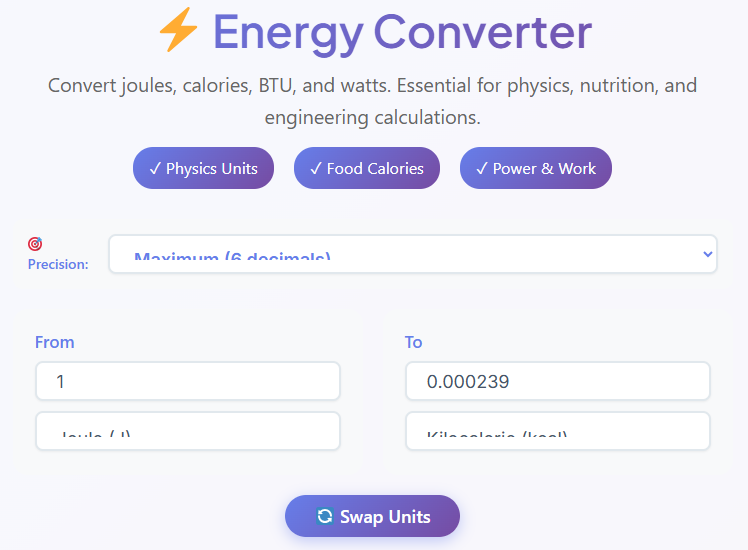
The primary section of the energy converter is where the magic happens. Here, you input your value, select your units, and instantly see the result.
The “From” Field: Inputting Your Value
The first step is always to enter the numerical value you wish to convert. The “From” section contains a simple input box labeled “Value.” Click on this box and type the number you’re starting with. For example, if you want to convert 150 kilocalories, you would type “150” here.

Directly next to the value box is the first dropdown menu. This is where you select the unit of the value you just entered. Our energy converter supports a vast range of energy units, including:
- Joule (J)
- Kilojoule (kJ)
- Gram calorie (cal)
- Kilocalorie (kcal)
- Watt-hour (Wh)
- Kilowatt-hour (kWh)
- Electronvolt (eV)
- British Thermal Unit (BTU)
- Therm (US)
- Foot-pound (ft-lbf)
Select the unit that corresponds to your input value. For our example, you would choose “Kilocalorie (kcal).”
The “To” Field: Choosing Your Target Unit
Once you have entered your starting value and its unit, you need to specify what you want to convert it into. The “To” section mirrors the “From” section, featuring a dropdown menu with the same extensive list of energy units. Simply open this menu and select your desired unit. If you wanted to find out how many kilojoules are in 150 kilocalories, you would select “Kilojoule (kJ)” from this list.
The moment you select the “To” unit, the converted value appears instantly in the corresponding box. There’s no need to click a “calculate” button, making our energy converter exceptionally fast and efficient.
The Swap Units Button

What if you entered your units the wrong way around? Or maybe you’ve just finished a conversion and now want to go in the opposite direction. The “Swap Units” button, typically represented by two arrows pointing in opposite directions, is your best friend. With a single click, it instantly swaps the “From” and “To” units, along with their values. This feature is incredibly useful for quick reverse calculations without re-entering any data. It’s a small detail that makes this online energy converter remarkably intuitive.
Customizing Your Results with the Precision Selector
Accuracy is paramount in scientific and engineering calculations. Our energy converter gives you full control over the level of detail in your results. The “Precision” selector lets you choose the number of decimal places you want to see in the converted value. You can typically choose between 2, 4, 6, or 8 decimal places.
This is particularly important when dealing with very small or very large numbers, where a high degree of precision can be critical. For general use, two decimal places might be sufficient. For a scientific paper or a detailed engineering report, you might need six or eight to ensure complete accuracy. This feature makes the energy converter a versatile tool for all levels of need.
Keeping Track of Your Work: History and Quick Reference
For users performing multiple calculations, keeping track of previous results is essential. Our tool includes features designed specifically for this purpose.
The Conversion History Panel
Every calculation you perform with the energy converter is automatically saved in the “Conversion History” panel. This feature creates a running log of your recent conversions, displaying the input value, the “From” and “To” units, and the result. This is incredibly helpful when you need to refer back to a previous calculation or compare several different conversions. You don’t have to worry about writing down results or trying to remember them.
If your history log gets too cluttered, you can easily manage it. The “Clear History” button, usually located at the top or bottom of the panel, allows you to wipe the entire log with one click, giving you a fresh start. This simple management feature ensures the energy converter remains organized and easy to use, even during long sessions.
The Quick Reference Panel
To further enhance your experience, the tool includes a “Quick Reference” panel. This section provides a handy chart or list of common conversion factors. For instance, it might show that 1 kilocalorie is equal to 4.184 kilojoules or that 1 kWh equals 3.6 million joules. This panel is a great educational resource, helping you learn and remember some of the most frequently used conversions. It serves as a quick check and reinforces your understanding of how different energy units relate, making this energy converter more than just a calculator—it’s a learning tool.
Practical Applications: Who Uses an Energy Converter and Why?
The true value of an energy converter lies in its wide range of applications across numerous fields. From academic settings to industrial operations, the ability to seamlessly convert energy units is a daily necessity for many.
Physics and Science Students
For students studying physics, chemistry, or any natural science, energy is a core concept. Textbooks and research papers often use different units, and being able to switch between them is crucial for solving problems and understanding theories. A student might need to perform a wavelength to ev (electronvolt) conversion when studying the photoelectric effect, or an ev to nm (nanometer) conversion when dealing with photon energies.
Let’s say a physics problem gives the energy of a particle in joules (J), but the follow-up question requires the answer in electronvolts (eV). Instead of manually calculating the conversion (1 eV = 1.602 x 10⁻¹⁹ J), the student can use the energy converter for an instant, error-free answer. This allows them to focus on the underlying physics principles rather than getting bogged down in arithmetic. Similarly, converting j to hz (joules to hertz) via the Planck-Einstein relation (E=hf) becomes simpler when the energy value is readily available in the correct unit. This energy converter is an essential study aid.
Electrical and Mechanical Engineering
Engineers are constantly working with energy calculations. Electrical engineers designing power systems need to convert between watt-hours (Wh), kilowatt-hours (kWh), and joules (J) to measure power generation, consumption, and efficiency. A mechanical engineer might analyze an engine’s performance using foot-pounds (ft-lbf) or British Thermal Units (BTU) and need to translate those figures into a standardized unit like joules for a report.
The energy converter streamlines these tasks. An engineer can quickly determine the energy equivalent of a power source or the efficiency of a machine without resorting to manual calculations or complex spreadsheets. This boosts productivity and reduces the risk of costly errors in design and analysis. The ability to use a reliable energy converter is a mark of an efficient professional.
🚗 Speed Converter
Need to convert speeds for an automotive project? Our Speed Converter handles km/h, mph, m/s, and knots with ease.
Open Converter →
Nutrition and Diet Planning
In the world of health and fitness, energy is measured in calories. Nutrition labels on food products list energy content in kilocalories (kcal), often just called “Calories.” However, scientific literature and international food databases sometimes use kilojoules (kJ). A dietitian or anyone tracking their food intake might need to convert between these units to accurately monitor their energy consumption.
For example, if a meal plan from Europe lists energy values in kJ, a person in the US would need to convert them to kcal to align with local food labels. Our energy converter makes this a trivial task. Simply enter the kilojoule value, select “Kilojoule (kJ)” as the “From” unit and “Kilocalorie (kcal)” as the “To” unit, and get an immediate result. This simple utility helps people make more informed decisions about their diet and health.
The HVAC and Energy Industry
Professionals in the Heating, Ventilation, and Air Conditioning (HVAC) industry rely heavily on energy units like the British Thermal Unit (BTU). The cooling or heating capacity of an air conditioner, for instance, is rated in BTUs per hour. In the broader energy sector, particularly natural gas, you’ll encounter units like cubic feet to btu or even larger-scale conversions such as cfh to mmbtu (cubic feet per hour to million BTU).
An HVAC technician might need to calculate the total energy consumption of a heating system over a month, which is often billed in kilowatt-hours (kWh). They would use an energy converter to translate the system’s BTU rating into kWh to estimate costs. Likewise, an energy analyst comparing natural gas and electricity as heating sources would need a robust energy converter to compare their energy content and cost-effectiveness on an equal footing. This tool is fundamental for planning, analysis, and billing in the energy industry. It’s an essential part of the modern toolkit. An effective energy converter is non-negotiable.
💻 Data Storage Converter
Working with large files or server capacities? Convert bytes, kilobytes, megabytes, gigabytes, and terabytes instantly.
Open Converter →
Academic Research and Scientific Publishing
Researchers across all scientific disciplines must report their findings using standardized units to ensure clarity and reproducibility. However, the experimental data they collect might be in a non-standard unit. Before publishing, they must convert all measurements to the accepted international standard, which is often the joule (J).
An astrophysicist might measure the energy of a cosmic ray in electronvolts (eV) but need to report it in joules for a journal publication. A biochemist might measure the energy released in a chemical reaction in kilocalories per mole but need to convert it to kilojoules per mole. An energy converter ensures these conversions are accurate and consistent, which is critical for the integrity of scientific research. Using a precise energy converter is a standard practice in academic circles.
Everyday Curiosity and Comparisons
Beyond professional and academic use, an online energy converter is a fascinating tool for anyone with a curious mind. Have you ever wondered how the energy in a lightning bolt compares to a day’s worth of a city’s power consumption? Or how many calories you would need to eat to generate the same amount of energy as a gallon of gasoline?
An energy converter empowers you to explore these questions. You can look up the energy content of various phenomena, convert them to a common unit like kWh or joules, and make insightful comparisons. For example, you could compare the energy from a candy bar to the energy needed to power a laptop for an hour. This tool makes abstract energy concepts tangible and relatable to our daily lives. This is why having a flexible energy converter is so useful. It is more than just a calculator; it’s a window into understanding the world around us. A good energy converter can answer countless questions.
⛽ Fuel Economy Converter
Comparing car efficiency? Easily convert between MPG (US and UK), L/100km, and other fuel economy units.
Open Converter →
Mastering the Flow: A Step-by-Step Example
Let’s walk through a complete, practical example to see just how easy it is to use the energy converter.
Scenario: You are an engineering student working on a thermodynamics assignment. A problem asks you to calculate the work done by a piston, which you’ve determined to be 1,200 foot-pounds (ft-lbf). You need to express this result in British Thermal Units (BTU) with a precision of four decimal places.
- Navigate to the Tool: Open the energy converter webpage.
- Enter the “From” Value: In the input box under the “From” section, type “1200”.
- Select the “From” Unit: Click the dropdown menu next to the value you just entered. Scroll through the list and select “Foot-pound (ft-lbf)”.
- Select the “To” Unit: Move to the “To” section. Click its dropdown menu and select “British Thermal Unit (BTU)”.
- Check the Result: The tool will instantly display the converted value. You will see approximately “1.5425 BTU”.
- Adjust Precision: The result might default to two decimal places. Locate the “Precision” selector and change it to “4”. The displayed result will update to “1.5425”.
- Review History: Your calculation, “1200 ft-lbf = 1.5425 BTU”, will now appear at the top of the “Conversion History” panel for future reference.
In just a few seconds, you’ve completed an accurate conversion without needing to look up a formula or use a calculator. This efficiency is precisely why this energy converter is an essential tool. The power of a dedicated energy converter is its ability to deliver speed and accuracy.
Conclusion: Empowering Your Calculations
Energy is a universal constant, but the way we measure it is incredibly diverse. From the food we eat to the fuel that runs our industries, different units are used to quantify this fundamental force. An energy converter serves as the universal translator, breaking down barriers between disciplines and making complex calculations simple and accessible to everyone.
Whether you’re a student tackling a tricky physics problem, an engineer designing the next breakthrough technology, a nutritionist planning a healthy diet, or simply a curious individual, this tool is built for you. With its intuitive interface, comprehensive unit support, and helpful features like precision control and conversion history, our energy converter provides fast, accurate, and reliable results every time. It saves you time, prevents manual errors, and deepens your understanding of how energy works. Make this versatile energy converter your go-to resource for all your energy conversion needs. A powerful energy converter is more than a convenience—it’s a necessity in a data-driven world.
FAQs
How accurate are the results provided by the energy converter?
You can rely on this tool for highly precise calculations suitable for both professional and academic work. Because different projects require different levels of detail, our energy converter features a precision selector that allows you to choose up to 8 decimal places. This ensures that whether you are double-checking a physics problem or calculating engineering tolerances, you get the exact level of accuracy you need.
Which energy units can I convert using this tool?
You can convert a comprehensive list of energy units that covers everything from scientific research to home utility management. The tool supports:
Scientific units: Joules (J), Kilojoules (kJ), and Electronvolts (eV).
Everyday units: Calories (cal), Kilocalories (kcal), and Watt-hours (Wh).
Industrial units: British Thermal Units (BTU), Therms, and Foot-pounds (ft-lbf).
Is this energy converter free to use for unlimited calculations?
Yes, this tool is completely free to use as often as you like. There are no hidden costs, subscription fees, or software downloads required. You can access it directly from your browser on any device, making it a convenient resource for students, professionals, and anyone needing quick, reliable energy conversions on the go.