Convert the Volumes from the Derived Units to Liters: A Guide
Volume is one of those concepts that feels abstract until you’re standing in your kitchen holding a measuring cup that reads “milliliters” while your recipe demands “cups.” Or perhaps you are on a construction site trying to figure out how much concrete to order when the plans list cubic meters but the supplier talks in liters. These moments of confusion highlight why accurate conversion tools are essential. Whether you are baking a cake, managing a chemical experiment, or planning a large-scale engineering project, the need to convert the volumes from the derived units to liters is a common hurdle.
It isn’t just about math; it is about precision and efficiency. In chemistry, a slight miscalculation when you convert the volumes from the derived units to liters can ruin an entire experiment. In the logistics industry, failing to accurately calculate cargo space—often requiring a shift from cubic meters to liters—can lead to wasted space or overloaded trucks. Even in everyday household tasks, understanding how liquid measurements interact saves time and prevents waste.
Most of us don’t memorize conversion factors. We don’t walk around knowing exactly how to change meter 3 to liter in our heads instantly. That is where digital tools bridge the gap. Instead of pulling out a calculator and risking a decimal error, modern converters handle the heavy lifting. They ensure that whenever you need to convert the volumes from the derived units to liters, you get a precise answer immediately. This guide helps you understand volume measurements and master the tools designed to simplify them.
Introducing Your Volume Converter Tool
Let’s look at the solution: a dedicated Volume Converter designed for clarity and ease of use. This tool is built to help anyone, from students to professionals, quickly convert the volumes from the derived units to liters without getting bogged down in complex formulas.
When you first open the tool, you will notice a clean interface prioritizing speed. The goal is simple: take a value in one unit (like cubic meters or gallons) and translate it into another (like liters) instantly. This specific functionality is crucial because liters often serve as the standard bridge between different measuring systems. When you use this liquid converter calculator, you eliminate the guesswork associated with manual math.
Why Focus on Liters?
You might wonder why we emphasize the need to convert the volumes from the derived units to liters so frequently. The liter is a unique unit. It sits comfortably between the metric system’s strict cubic measurements (like cubic centimeters) and the daily volume measurements we use for liquids. Because of this, almost every industry eventually needs to convert the volumes from the derived units to liters to standardize their data.
For example, water usage is often billed in cubic meters, but beverage production is measured in liters. To reconcile these figures, you must convert the volumes from the derived units to liters. Our tool automates this step. By acting as a central hub for conversion, it ensures that whether you are dealing with liters to cbm or gallons to milliliters, the process remains seamless.
How the Tool Simplifies Your Workflow
Imagine you have a derived unit, such as a cubic decimeter or a cubic meter. These are “derived” because they come from measuring length in three dimensions. While scientifically accurate, they aren’t always intuitive for visualizing liquid quantity. This tool allows you to input these geometric volumes and immediately see the liquid equivalent. It is specifically programmed to help you convert the volumes from the derived units to liters with a single click.
Here is how it generally works for the user:
- Input Clarity: You enter your starting figure.
- Unit Selection: You choose from a wide array of derived units (like m³, cm³, ft³).
- Instant Result: The tool processes the request to convert the volumes from the derived units to liters and displays the result.
This simplicity is vital. When you are in the middle of a project, you don’t want to struggle with the tool itself. You want the answer. By focusing on the user experience, we ensure that every time you need to convert the volumes from the derived units to liters, the experience is frictionless.
The interface also handles the reverse seamlessly. If you have a liquid volume and need to know its spatial footprint, you can switch directions. However, the primary strength of this layout remains its ability to help you convert the volumes from the derived units to liters quickly, supporting workflows in science, education, and industry. Whether you are checking a volume conversion for a pool or a beaker, the reliability of the output is guaranteed.
Step-by-Step Guide to Using the Volume Converter
Navigating a new tool should never feel like solving a puzzle. Our Volume Converter is designed with a “what you see is what you get” philosophy. Every button, dropdown, and panel exists to help you convert the volumes from the derived units to liters efficiently. Let’s walk through the interface together so you can master every feature in minutes.
Selecting Your Units: The Starting Point
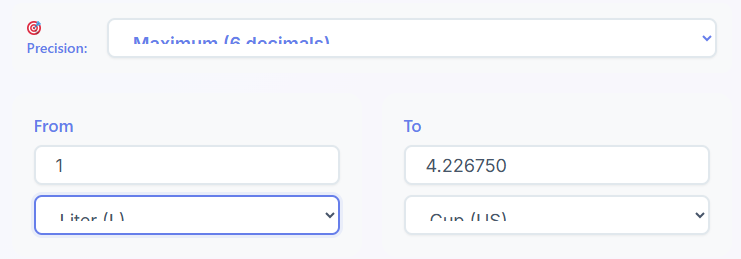
The core of the tool lies in the “From” and “To” dropdown menus. This is where you define the relationship between your measurements. When you open the list, you will see a comprehensive range of units. You aren’t limited to just the basics; the tool supports everything from metric giants like cubic meters to smaller imperial units like fluid ounces.
To begin, click the “From” dropdown. This is where you input your current measurement type. If you are working with a solid volume measurement, like a box or a container with specific dimensions, you might select cubic meters (m³) or cubic centimeters (cm³). Once that is set, move to the “To” dropdown. If your goal is to convert the volumes from the derived units to liters, simply select “Liter” from the list. The tool immediately prepares to translate the spatial volume into a liquid capacity.
This flexibility is key. You might be an engineer looking at a blueprint in cubic meters, or a student with a homework problem in cubic decimeters. Regardless of the starting point, the path to convert the volumes from the derived units to liters remains the same simple process of selection.
Understanding Unit Behavior: m³, cm³, and Liters
It is helpful to understand how different units behave within the tool. When you select a derived unit like cubic meters (m³), you are dealing with a three-dimensional space—imagine a cube that is one meter long, one meter wide, and one meter high. This is a massive amount of volume.
In contrast, a liter is a more manageable unit for liquids. When you use this liquid converter calculator to switch from meter 3 to liter, you will often see the number grow significantly because it takes 1,000 liters to fill just one cubic meter. Conversely, if you are working with cubic centimeters (cm³), the resulting liter value will be much smaller.
The tool handles these scales automatically. You don’t need to move decimal points manually. Whether you are scaling up from tiny milliliters or scaling down from massive cubic kilometers, the calculator adjusts instantly, ensuring that whenever you convert the volumes from the derived units to liters, the scale is mathematically perfect.
Refining Accuracy with the Precision Selector

Sometimes, a rough estimate is enough. Other times, you need exact figures down to the fourth decimal place. This is where the Precision Selector comes in handy. Located near the result display, this feature allows you to control how many decimal places appear in your final answer.
By default, the tool might show two decimal places. However, if you are doing precise chemistry work where every drop counts, you can increase this precision. This ensures that when you convert the volumes from the derived units to liters, you aren’t losing critical data to rounding errors. It gives you control over the granularity of your data, making the tool adaptable for both casual checking and rigorous scientific standards.
The Swap Units Button

We have all been there—you set up your conversion, only to realize you put the units in the wrong order. Instead of re-selecting everything from the dropdowns, simply hit the “Swap” button. This icon, usually represented by two opposing arrows, instantly reverses your “From” and “To” selections. It is a small feature that saves significant time.
If you were set up to convert the volumes from the derived units to liters but actually needed to go from liters back to cubic meters, one click flips the logic. This is particularly useful when checking your work or performing reverse calculations to verify liters to cbm ratios.
Utilizing the Quick Reference Panel
For users who need common values at a glance, the Quick Reference Panel is a lifesaver. This section displays a static list of standard conversions relevant to your current selection. If you frequently need to convert the volumes from the derived units to liters for standard amounts—like 1, 10, or 100 units—this panel shows those answers immediately without you needing to type anything. Think of it as a cheat sheet.
It is perfect for getting a “ballpark” feel for the numbers. If you are converting liters to m 3, seeing a list of 10 liters, 50 liters, and 100 liters converted into cubic meters helps you visualize the relationship between the liquid volume and the physical space it occupies.
Tracking with the Conversion History
In the middle of a complex project, it is easy to forget the result you just calculated five minutes ago. The Conversion History section solves this by keeping a temporary log of your recent actions. Every time you successfully convert the volumes from the derived units to liters, the result is added to this list.
This feature is invaluable for comparing different datasets. You might be calculating the volume for three different tanks. Instead of writing each result down on a scrap of paper, you can simply perform the calculations one after another and then review the History section to see all three figures. It streamlines your workflow, allowing you to focus on the task at hand rather than memorizing numbers.
Practical Applications in Everyday Life and Industry
The ability to convert the volumes from the derived units to liters extends far beyond academic exercises. It has tangible impacts on professional industries and daily tasks. Understanding these real-world scenarios highlights the practicality of a reliable conversion tool.
In the Kitchen: Precision Cooking and Baking
Home cooks and professional chefs alike rely on precise measurements. Many modern recipes, especially those from international sources, use metric units like milliliters. If your measuring tools are in cups or fluid ounces, you need a quick way to translate. A baker, for example, might need to know the liquid volume of a specific-sized pan to avoid overflow. This requires a quick volume conversion. The tool allows them to effortlessly convert the volumes from the derived units to liters, ensuring their cake batter fits perfectly.
On the Construction Site: Managing Materials
Construction and civil engineering projects deal with enormous volumes. Materials like concrete, gravel, and sand are often measured in cubic meters (m³). However, suppliers might price or deliver certain liquid additives in liters. Project managers constantly need to convert the volumes from the derived units to liters to ensure accurate ordering and cost management. For instance, calculating the amount of water needed for a concrete mix based on a meter 3 to liter conversion is a daily task.
🚗 Speed Converter
Need to check velocity for your next project? Instantly convert measurements like km/h, mph, m/s, or knots with precision.
Open Converter →
In the Laboratory: Chemistry and Research
In scientific research, precision is non-negotiable. Chemists work with solutions where concentration is key. They often prepare stock solutions in large volumes (measured in liters) and then take smaller amounts (in milliliters) for experiments. When dealing with gaseous reagents, which occupy a specific volume in cubic centimeters, they must convert the volumes from the derived units to liters to calculate molarity correctly. An error in this step could invalidate an entire study.
In the Household: Everyday Volume Needs
Beyond cooking, you encounter volume conversions all the time. Planning to fill a backyard swimming pool? You will calculate its volume in cubic meters but need to understand the water usage in liters for your utility bill. Similarly, when purchasing a new refrigerator or freezer, the capacity is almost always given in liters. This helps you compare models and understand how much food you can actually store. Even a simple task like dosing liquid fertilizer for your garden requires you to convert the volumes from the derived units to liters to get the dilution right. Our tool makes it easy to convert the volumes from the derived units to liters.
Engineering and Manufacturing: Design and Production
Engineers designing anything from a car engine to a water bottle must consider volume. The fuel tank capacity, engine displacement, and fluid reservoirs are all critical design parameters. During the manufacturing process, quality control may involve checking if a container holds the correct volume. The ability to convert the volumes from the derived units to liters is fundamental. This ensures that a product marketed as holding 2 liters actually does. This process to convert the volumes from the derived units to liters is vital for quality assurance.
💻 Data Storage Converter
Running out of space on your hard drive? Easily translate confusing file sizes between bytes, KB, MB, GB, and TB.
Open Converter →
In all these cases, a reliable liquid converter calculator serves as an indispensable aid. It bridges the communication gap between different systems of measurement. The need to convert the volumes from the derived units to liters is a constant, and having a tool to do so accurately saves time, money, and prevents costly mistakes. Each time you convert the volumes from the derived units to liters, you ensure accuracy. It’s a simple step that helps you convert the volumes from the derived units to liters with confidence.
Mastering Advanced Scenarios and Tips
Once you are comfortable with the basic functions, you can leverage the tool for more complex tasks. A deeper understanding of its capabilities can further streamline your workflow. The goal is to make any volume conversion feel second nature.
Working with Large and Small Numbers
The converter is built to handle both astronomical and microscopic values. Whether you are an astrophysicist calculating the volume of a nebula in cubic kilometers or a nanotechnologist working with microliters, the tool maintains its precision. The key is to select the most appropriate starting unit to avoid dealing with an overwhelming number of zeros. For instance, instead of entering a value in cubic millimeters and asking the tool to convert the volumes from the derived units to liters, start with a more logical unit if possible.
Combining Conversions for Multi-Step Problems
Some problems require more than one conversion. For example, you might need to find out how many gallons of paint are needed to cover a wall, but you only have the wall’s dimensions in feet. First, you would calculate the volume of paint needed (e.g., in cubic inches or feet), then use the tool to convert the volumes from the derived units to liters, and finally convert from liters to gallons. The conversion history feature is perfect for these multi-step scenarios, allowing you to track each stage of the calculation. This makes it easier to convert the volumes from the derived units to liters as an intermediate step.
⛽ Fuel Economy Converter
Planning a road trip? Compare fuel efficiency standards like MPG to L/100km to better estimate your travel costs.
Open Converter →
A Final Word on Precision
While the precision selector offers control, it is important to use it wisely. For most daily tasks, one or two decimal places are sufficient. Over-specifying precision can make numbers harder to read and use. Reserve higher decimal counts for scientific or technical applications where such accuracy is mandated.
The ability to convert the volumes from the derived units to liters accurately is a powerful skill, and this tool is designed to make that process as intuitive as possible. The capacity to convert the volumes from the derived units to liters is at your fingertips. Ultimately, the best way to become proficient is through practice, and this tool is the perfect partner for mastering the art of volume conversion. Every time you convert the volumes from the derived units to liters, you build confidence in your measurements.
FAQs
How accurate are the results when I use the Volume Converter?
Accuracy is our top priority. The tool uses standard international conversion factors to ensure precision for every calculation. Whether you are converting a single liter or thousands of cubic meters, the underlying math remains exact. However, for highly sensitive scientific work, we recommend using the “Precision Selector” feature. This allows you to view results up to several decimal places, ensuring that rounding differences don’t affect your final data. For most daily tasks like cooking or DIY projects, the default setting provides more than enough accuracy.
Can I use this tool to convert between metric and imperial units?
Absolutely. One of the biggest challenges in volume conversion is bridging the gap between systems, such as converting gallons (Imperial) to liters (Metric) or cubic feet to cubic meters. The Volume Converter is specifically designed to handle these cross-system calculations seamlessly. You simply select your starting unit (e.g., US Gallons) from the “From” menu and your desired unit (e.g., Liters) from the “To” menu. The tool instantly handles the complex multiplication required to switch between these systems.
What is the difference between a “derived unit” like cubic meters and a liquid unit like liters?
This is a very common point of confusion. A “derived unit” like a cubic meter (m³) is based on length measurements—literally, a box measuring one meter on all sides. It describes the physical space an object occupies. A liter, on the other hand, is a metric unit specifically used for capacity, typically for liquids or gases. While they measure the same thing (volume), they are used in different contexts. For example, you might measure the size of a shipping container in cubic meters, but measure the water inside a tank in liters. Our tool helps you translate between these two “languages” of measurement instantly.