Your Essential Guide to Using a Length Converter
Length and distance are fundamental concepts that shape our world. From the blueprints of towering skyscrapers to the route planned for a cross-country road trip, accurate measurement is the invisible thread connecting our plans to reality. In our daily lives, we constantly interact with measurements, whether we are checking the size of a new television, measuring fabric for a sewing project, or trying to understand the distance to a nearby city.
The need for precise length conversion arises from the global use of different measurement systems, primarily the metric and imperial systems.
This is where a reliable and efficient Length Converter becomes an indispensable tool, simplifying complex calculations for professionals in construction, students in academics, and individuals in everyday situations. Understanding how to translate units like meters to feet or miles to kilometers is not just a mathematical exercise; it is a practical skill that empowers clearer communication and more accurate execution of tasks.
This guide explores the world of length measurement, highlighting the importance and ease of using a digital Length Converter. We will delve into the differences between the metric and imperial systems, explore common real-world applications, and provide a detailed walkthrough of how to use a powerful online tool to get instant, precise results.
The goal is to demystify the process of distance conversion and show you how a well-designed Length Converter can save you time, prevent errors, and give you confidence in your measurements, no matter the context.
What Is Length Measurement? (Beginner Friendly)
At its core, length measurement is the process of determining the distance between two points. It is one of the most basic forms of measurement we learn, starting from childhood when we compare our height to our friends or measure the size of a toy. This simple concept extends into every facet of our lives. When you buy furniture, you need to measure the length and width of your room to ensure it fits.
When you follow a recipe, you might measure the length of a vegetable to be chopped. This fundamental skill allows us to quantify the physical world, bringing order and understanding to the space around us. It helps us describe objects, plan projects, and navigate our environment with a shared, common language of dimension.
The units we use to describe length—such as inches, feet, meters, or miles—are standardized references that give our measurements meaning. Without these standards, a “long” road or a “tall” building would be entirely subjective. Measurement systems provide the framework that makes these descriptions universal. For anyone new to this, the key takeaway is that length measurement is simply about assigning a numerical value and a unit to the size of something.
A digital Length Converter serves as a bridge between the different units used within these systems, ensuring that a measurement taken in one unit can be accurately understood in another. This process is crucial for global collaboration, commerce, and communication, making tools that facilitate it more important than ever.
Metric vs. Imperial Length Systems
The world primarily operates on two major systems for measuring length: the metric system and the imperial system. Understanding their differences is key to appreciating why a Length Converter is so essential. The metric system, used by the vast majority of countries, is a base-ten system. Its core units for length are the meter, centimeter, millimeter, and kilometer.
The beauty of this system lies in its simplicity; conversions between units are as easy as multiplying or dividing by powers of 10. For example, there are 100 centimeters in a meter and 1,000 meters in a kilometer. This logical structure makes it incredibly intuitive for scientific, educational, and international applications.
On the other hand, the imperial system, which is still officially used in the United States, Liberia, and Myanmar, has a more complex history and structure. Its common length units include the inch, foot, yard, and mile. Unlike the metric system, the relationships between these units are not based on powers of 10.
There are 12 inches in a foot, 3 feet in a yard, and 1,760 yards in a mile. These conversions can be more difficult to remember and calculate manually, which often leads to errors. The challenge of moving between these two distinct systems is a primary driver for the widespread use of a Length Converter, as it eliminates the need for manual calculation and ensures flawless translation of metric to imperial length and vice versa.
Why People Use Online Length Converters
In a connected world, the need for quick and accurate measurement conversion is constant. People turn to an online Length Converter for several compelling reasons, primarily centered on efficiency, accuracy, and convenience. Manually converting between units, especially between the metric and imperial systems, is not only time-consuming but also prone to human error.
A simple miscalculation in a construction project or a scientific experiment can have significant consequences. An online tool automates this process, providing instant results that can be trusted. This reliability is paramount for professionals who depend on precise measurements for their work.
Furthermore, convenience plays a massive role. An online Length Converter is accessible from any device with an internet connection, whether it’s a desktop computer in an office, a tablet on a construction site, or a smartphone while traveling. This accessibility means you do not need to memorize conversion factors or perform complex multiplication or division on the fly.
Instead of asking, “How many feet are in a meter?” you can get the exact answer in seconds. This ease of use empowers everyone, from students working on homework to DIY enthusiasts planning their next project, to handle measurements confidently and without friction. An effective Length Converter is a problem-solver, removing a common hurdle in a wide range of tasks.
Common Real-Life Uses of Length Conversion
The application of length conversion is woven into the fabric of our daily activities, often in ways we might not even notice. For DIY home improvement projects, converting measurements is a constant necessity. You might purchase lumber measured in feet and inches in the United States, but the project plans you downloaded from the internet could be in meters and centimeters.
A Length Converter is crucial for ensuring every cut is precise. In the kitchen, recipes from different parts of the world might use different units, requiring a quick conversion from inches to cm for the dimensions of a baking pan or the length of a pastry.
Shopping online for clothing or furniture also frequently requires length conversion. A piece of furniture from a European brand will likely have its dimensions listed in centimeters, which a buyer in the U.S. will need to convert to inches to visualize its fit.
Similarly, international travel planning often involves distance conversion. You might need to convert the distance from kilometers to miles to estimate driving times or fuel costs. Even in hobbies like model building, fishing, or sewing, converting between metric and imperial units is a regular occurrence. In each of these scenarios, a reliable Length Converter serves as a practical assistant, making tasks smoother and more accurate.
How This Length Converter Tool Works
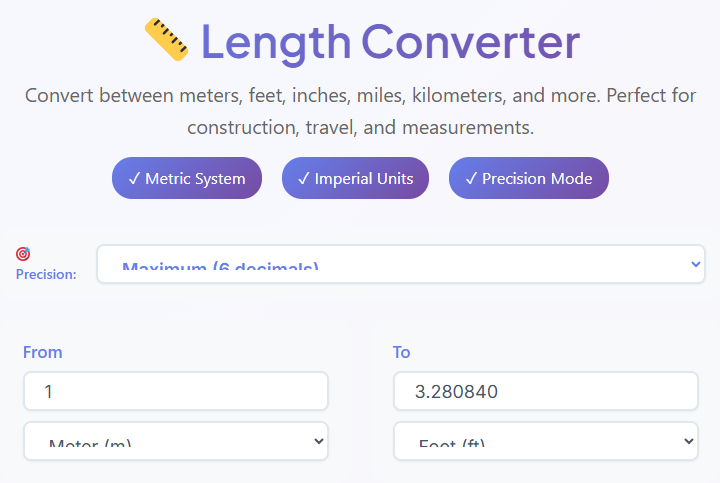
This powerful Length Converter is designed with user-friendliness and precision at its core. Its intuitive interface ensures that anyone can get accurate conversions in just a few simple steps, without any prior experience. The process is streamlined to deliver instant results, removing any barriers to quick and effective distance conversion.
Your journey begins at the input field. Here, you simply type the numerical value of the length you wish to convert. For instance, if you need to convert 10.5 meters, you would enter “10.5” into this box. The next step is to select your units.
The tool provides two dropdown menus: “From” and “To.” In the “From” menu, you select the unit of your original measurement—in this case, meters. In the “To” menu, you select the unit you want to convert into, such as feet. The moment you make your selections, the tool automatically performs the calculation and displays the result. There is no need to click a “convert” or “submit” button; the process is instantaneous, reflecting a commitment to user efficiency. This seamless workflow is a key feature of a superior Length Converter.
Converting Between Popular Length Units
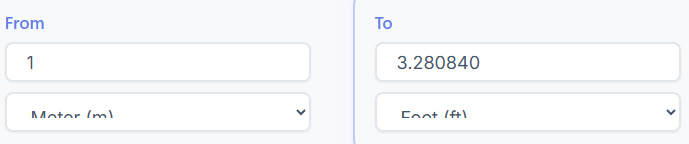
The ability to seamlessly convert between commonly used length units is one of the most practical functions of this tool. Many daily tasks and professional projects hinge on the accurate translation between the metric and imperial systems. For instance, the meter to feet conversion is incredibly common in construction, real estate, and even personal fitness.
An architect working with international plans might need to convert building dimensions from meters to feet for local contractors. A runner tracking their progress might want to convert their distance from meters to feet to better visualize the scale of their workout. Our Length Converter handles these requests instantly, providing a precise figure that eliminates guesswork.
Another frequent requirement is converting kilometers to miles (km to miles). This is particularly useful for travelers, logistics planners, and automotive enthusiasts. When you are planning a road trip in a country that uses the metric system, converting distances on road signs from kilometers to miles helps you better gauge travel time and fuel consumption. Conversely, someone in the U.S.
reading about a European marathon will want to convert the 42.195 kilometers to miles to understand the race’s length. Similarly, converting inches to cm is essential for manufacturing, e-commerce, and design. Product specifications are often provided in one system, and a Length Converter is needed to translate them for a global audience, ensuring that parts fit and product descriptions are universally understood.
Using Precision Settings for Accurate Results
Accuracy is not a one-size-fits-all concept; the level of detail required for a measurement can vary dramatically depending on the application. A casual distance estimate for a walk in the park does not need the same precision as a measurement for an aerospace engineering component. This is why our Length Converter includes an adjustable precision setting. This feature allows you to control the number of decimal places in your conversion result, ensuring that the output matches the specific requirements of your task. You can typically choose a precision level ranging from two to eight decimal places.
For general everyday use, such as converting the length of a room from meters to feet for furniture placement, two or three decimal places are usually sufficient. This provides a practical and easy-to-read number. However, in fields like science, engineering, and manufacturing, higher precision is often critical.
A scientist conducting an experiment or an engineer designing a microchip needs calculations to be as exact as possible, as even a tiny error can have significant consequences. By allowing users to select a higher number of decimal places, the Length Converter empowers these professionals to work with the level of accuracy their discipline demands. This customizable precision transforms the tool from a simple calculator into a sophisticated instrument for technical work.
Read about: volume-converter
Swap Feature: Faster Length Conversion
Efficiency is a cornerstone of good tool design. When you are working on a project that requires multiple conversions back and forth between two units, manually re-selecting them from dropdown menus can become repetitive and slow you down. To address this, our Length Converter includes a “Swap” feature.
This simple yet powerful button is designed to accelerate your workflow by instantly reversing your “From” and “To” unit selections. For example, if you just converted meters to feet, a single click on the swap button will immediately set up the tool to convert feet to meters.
This feature is particularly valuable for anyone who needs to perform reciprocal calculations. Imagine a designer working with both U.S. and European clients.
They might constantly need to switch between inches and centimeters. Instead of navigating the dropdown menus each time, they can simply perform the first conversion (e.g., inches to cm) and then use the swap button for all subsequent conversions in the opposite direction (cm to inches). This small enhancement has a big impact on productivity, saving clicks and mental effort. It reflects a deep understanding of user needs, making this Length Converter not just a utility, but a truly efficient partner in your work.
Essential Tools for Comprehensive Measurement
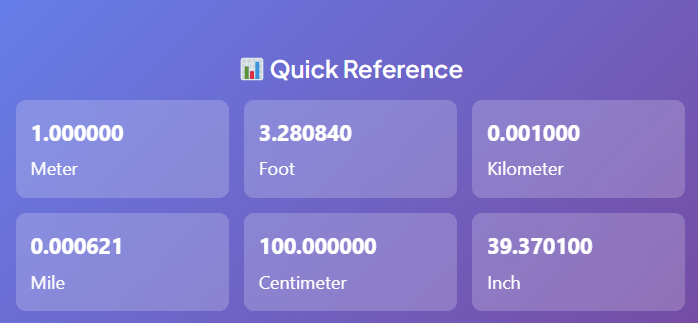
While a Length Converter is fundamental for linear measurements, many projects require calculations that go beyond simple distance. Understanding how length interacts with other physical dimensions is key to solving more complex problems. That is why it is helpful to be aware of related tools that complement a Length Converter.
For example, when you are working with three-dimensional objects, you often need a Volume Converter. Length, width, and height are the foundational measurements used to determine the volume of an object like a shipping container or the capacity of a liquid tank.
If your initial length measurements are in different units (e.g., meters and feet), you must first use a Length Converter to standardize them before you can accurately calculate the total volume. Without this initial step, the final volume calculation would be incorrect.
Similarly, in fields like physics and mechanical engineering, distance is directly linked to energy. An Energy Converter is a vital tool for calculations involving work, where force is applied over a certain distance. For instance, calculating the kinetic energy of a moving object requires knowing its velocity, which is distance divided by time.
If the distance is given in miles but the formula requires meters, a precise Length Converter is the first step toward a correct energy calculation. The accuracy of your distance conversion directly impacts the accuracy of your energy figures, making these tools interconnected.
Finally, the relationship between length and area is direct and critical. An Area Converter is used to calculate the size of a two-dimensional surface, such as a plot of land, a wall to be painted, or a piece of fabric. To calculate area, you multiply two length measurements, typically length and width.
If these measurements are in different units or need to be converted to a different system (e.g., from square feet to square meters), you must first ensure the base length units are consistent. Using a Length Converter to align your measurements before calculating the area is an essential step to avoid significant errors. This ensures that land surveys, architectural plans, and material estimates are all based on accurate and reliable data.
Length Converter for Construction & Engineering
In the fields of construction and engineering, precision is not just a goal; it is a requirement. The structural integrity of a bridge, the safety of a building, and the functionality of a machine all depend on exact measurements. A Length Converter is a non-negotiable tool in the arsenal of every architect, engineer, and construction worker. Projects today are often global in nature, with architectural plans originating in one country and construction taking place in another. This means that blueprints might be designed using the metric system (meters, centimeters), while the local construction crew and material suppliers operate on the imperial system (feet, inches).
A reliable Length Converter is the bridge that connects these two systems, ensuring that a 10-meter beam is not mistakenly cut as a 10-foot beam. Such an error could be catastrophic. Engineers use a Length Converter daily when designing components, calculating material stress, and ensuring that parts manufactured in different locations will fit together perfectly.
For civil engineers planning infrastructure like roads and tunnels, converting distances between kilometers and miles is a constant task. The ability to perform this distance conversion with high precision is fundamental to project planning, budgeting, and execution. The right Length Converter provides the confidence needed to move from blueprint to reality without costly or dangerous mistakes.
Length Converter for Travel & Navigation
Whether you are a globetrotter, a pilot, a sailor, or a logistics manager, a Length Converter is an essential companion for travel and navigation. The world is a patchwork of different measurement systems, and being able to quickly convert distances is crucial for effective planning and safe navigation.
For road travelers, a journey across Europe means encountering road signs in kilometers. For a driver accustomed to miles, a quick conversion using a Length Converter is necessary to understand speed limits, estimate travel times, and calculate fuel efficiency. This simple act of distance conversion brings clarity and reduces the stress of navigating in an unfamiliar system.
In aviation and maritime contexts, the nautical mile is a standard unit of distance. However, maps and plans may also reference kilometers or statute miles. Pilots and ship captains must be able to convert between these units seamlessly to ensure accurate course plotting and fuel management.
A mistake in conversion could lead to navigational errors with serious safety implications. Therefore, a dependable Length Converter that includes nautical miles is a vital tool for professionals in these fields. It helps ensure that everyone involved in the journey—from the planner on the ground to the captain at the helm—is working with the same accurate information, contributing to a safe and efficient voyage.
Length Converter in Education & Student Learning
Education is where the foundational understanding of measurement systems is built. For students, a Length Converter is an invaluable learning aid that helps them grasp the relationship between different units of length. When learning about the metric and imperial systems, students are often tasked with conversion problems, such as changing meters to feet or inches to cm.
While performing these calculations manually is important for developing mathematical skills, an online Length Converter can serve as an excellent tool for checking their work and reinforcing their understanding. It provides immediate feedback, allowing students to see the correct answer and analyze where they might have made a mistake.
Teachers can also integrate a Length Converter into their lesson plans to make learning more interactive and relatable. Instead of just working with abstract numbers, students can use the tool to solve real-world problems. For example, they could be asked to convert the height of the Eiffel Tower from meters to feet or the length of the Amazon River from kilometers to miles.
This application-based learning makes the concepts of length and distance conversion more tangible and engaging. By providing a bridge between theoretical knowledge and practical application, a Length Converter supports a deeper and more lasting comprehension of measurement for learners of all ages.
Common Mistakes People Make When Converting Length
Despite the availability of tools, errors in length conversion still occur, often due to a few common mistakes. One of the most frequent errors is using the wrong conversion factor. For example, people might mistakenly remember an approximate value, like using 3 instead of 3.281 for a meter to feet conversion, which can lead to significant inaccuracies, especially over large distances.
Relying on memory for these figures is a recipe for error, which is why using a vetted and reliable Length Converter is always the better choice. It eliminates the risk of using outdated or incorrect factors, ensuring your results are always based on standardized values.
Another common pitfall is confusion between similar-sounding units, such as statute miles and nautical miles, or mixing up imperial and U.S. customary units, which can have slight differences. An online Length Converter clearly labels each unit, preventing this kind of confusion.
Additionally, rounding numbers too early in a multi-step calculation can introduce compounding errors. It is always best to use the full precision provided by a tool and only round the final result to the desired number of decimal places. By being aware of these potential mistakes and relying on a quality Length Converter, you can avoid these common errors and ensure your conversions are always accurate.
Final Conclusion
Navigating the complexities of different measurement systems does not have to be a challenging task. A well-designed Length Converter provides a simple, immediate, and trustworthy solution for anyone needing to translate units of length and distance. By offering unparalleled accuracy, customizable precision control, and an exceptionally easy-to-use interface, this tool empowers users across all fields—from construction and engineering to education and travel. The inclusion of user-centric features like the instant swap button further streamlines the process, demonstrating a commitment to efficiency and a deep understanding of practical needs. When you need confidence in your measurements, trust in a Length Converter that is built to deliver it every time.
FAQs
Why do I need a Length Converter tool when I can just do the math myself?
While it is certainly possible to calculate conversions manually, using a Length Converter tool saves you time and eliminates the risk of human error. Manual calculations often require memorizing complex conversion factors (like 1 mile equals 1.60934 kilometers) and performing multiplication or division, which can easily lead to mistakes. Our tool automates this process instantly, providing precise results whether you are converting simple units like inches to centimeters or more complex distances like nautical miles to kilometers. It ensures accuracy for everything from homework assignments to professional construction projects.
Can I use this tool to convert height and distance for travel purposes?
Absolutely. The Length Converter is versatile enough to handle both small-scale measurements like personal height and large-scale distances for travel. For height, you can easily convert meters to feet and inches to see how tall someone is in a different system. For travel, the tool is perfect for converting road signs or map distances from kilometers to miles, helping you better understand your route, estimate travel times, and plan fuel stops accurately, regardless of which country you are driving in.
How accurate are the results provided by this Length Converter?
Accuracy is a top priority for our tool. You can trust the results for both everyday tasks and professional needs. The tool allows you to adjust the precision level, letting you choose how many decimal places you want