Calculate Weeks Between Two Dates With Our Free Tool
Trying to calculate weeks between two dates can feel like a mental puzzle. Whether you are managing a complex project, tracking a personal milestone, or simply trying to make sense of a schedule, understanding the span of time in weeks is essential. Many people need this information for accurate planning, reporting, and meeting deadlines.
Figuring out the exact time in between dates helps you organize your life and work more effectively. This guide will show you how to use our simple tool to instantly find this information and make sense of your timelines. For anyone who needs to calculate weeks between two dates, this is the perfect resource.
Our Week Calculator is designed to remove the guesswork. It provides a clear and precise way to understand weekly timelines. You might need to calculate weeks between two dates for professional reasons, like creating a project timeline, or for personal goals, such as tracking a fitness plan. The core challenge is converting a series of days into a neat count of weeks.
This process can be tricky due to how months have different lengths and how weeks cross over month boundaries. Our tool simplifies this, giving you the data you need to accurately calculate weeks between two dates without any manual counting or potential errors.
What This Week Calculator Does for You
This calculator is your go-to solution when you need to calculate weeks between two dates. It’s built to provide clarity on how time is structured weekly. At its heart, the tool helps you identify the specific week number for any given date according to the ISO 8601 standard.
This is the international standard for representing dates and times, ensuring consistency no matter where you are. Understanding the ISO week concept is simple: the first week of the year is the one that contains the first Thursday. This standardization prevents the confusion that can arise from different regional conventions.
The tool provides more than just a week number; it gives you a complete picture of a specific date. This detailed information is the foundation you need to accurately calculate weeks between two dates. While we often think in terms of days, many schedules and plans operate on a weekly basis.
Our tool bridges that gap by translating a single day into its corresponding week, making it much easier to determine the number of weeks between dates. You can use this information to see the bigger picture of your schedule. For anyone who has struggled to manually calculate weeks between two dates, this tool offers a straightforward and reliable alternative. It provides the essential data points so you can easily figure out the time in between dates.
You can select any date and instantly see its place within the year. The tool shows you the day of the week, the week number, the year, and how many days have passed in that year. This comprehensive view is what empowers you to calculate weeks between two dates with confidence. Instead of just counting days and dividing by seven, you get a standardized week number that serves as a solid reference point. This makes it easier to measure durations and plan events that span multiple weeks. Knowing the exact week number for a start and end date allows for a simple subtraction to calculate weeks between two dates.
Step-by-Step: How to Use the Tool to Calculate Weeks Between Two Dates
Using our Week Calculator is incredibly simple. We designed it to be intuitive, ensuring you can get the information you need in just a few clicks. The primary purpose is to provide the details necessary to calculate weeks between two dates. Follow these easy steps to get started.
Step 1: Select a Date

The first step is to choose your starting date. You will see a calendar interface. Simply click on the month, day, and year you want to analyze. This could be the start date of a project, the beginning of a new quarter, or any other significant date. This is the first piece of information you need to calculate weeks between two dates.
Step 2: Click “Calculate”

Once your desired date is selected, click the “Calculate” button. The tool will instantly process your selection. There are no complicated settings or options to configure. The goal is to get you the data you need as quickly as possible so you can proceed to calculate weeks between two dates.
Step 3: View the Week Number
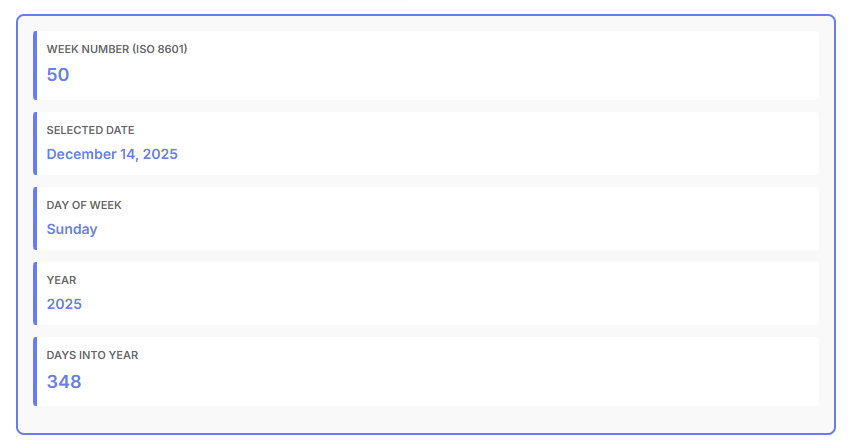
After clicking “Calculate,” the tool will display the ISO week number for the date you selected. This number, from 1 to 53, is your key reference point. Note this number down. To calculate the number of weeks between dates, you will repeat this process for your end date and find the difference between the two week numbers.
Step 4: Understand the Year and Day Information
The tool also shows you the year, the day of the week, and the total number of days that have passed in the year up to your selected date. This additional context is valuable for more detailed planning. For example, if you need to know the specific day a project starts on, our helpful Day of Week Calculator can also provide that information directly. This data enriches your understanding and helps you more accurately calculate weeks between two dates.
Step 5: Use the Data to Calculate Weeks Between Two Dates
Now you have all the components. To find the duration between a start and end date, perform these steps for both dates. Record the week number for your start date and the week number for your end date. Subtracting the first from the second gives you the total number of weeks. This manual but logical step, powered by our tool’s data, is the most reliable way to calculate weeks between two dates.
Understanding the Results from the Calculator
The results our tool provides are designed to be clear and immediately useful. Each piece of information serves a specific purpose, collectively helping you to calculate weeks between two dates. Let’s break down what each result means and how you can use it.
The most important result is the Week Number. This is the ISO 8601 week number for the selected date. This standardized number is crucial when you need to calculate weeks between two dates because it provides a universal reference. For instance, if your project starts on a date in Week 10 and ends on a date in Week 25, you know the project spans 15 weeks. This is a far more accurate method than estimating based on months.
You also get the Day of the Week. Knowing whether a date falls on a Monday or a Friday is essential for logistical planning. The Year is displayed to ensure there is no confusion when you are looking at dates far in the future or past. Finally, the Days into Year tells you the ordinal day number. For example, February 1st is the 32nd day of the year. This helps you understand the progression from date to date and is another data point you can use.
This information is powerful when you need to find the time in between dates. Let’s consider a practical example. Imagine you want to know how many weeks from January 1st to today. You would first use the tool to get the week number for January 1st. Then, you would get the week number for today’s date. The difference between these two numbers gives you the answer. This is how the tool empowers you to calculate weeks between two dates. This “from date to” logic is simple and effective for all your scheduling needs. Understanding this logic is key to effectively calculate weeks between two dates for any scenario.
Practical Use Cases for When You Calculate Weeks Between Two Dates
The need to calculate weeks between two dates appears in many aspects of our professional and personal lives. Having a reliable method is not just a convenience; it’s a necessity for effective planning and tracking. Here are some common scenarios where people need to calculate weeks between two dates.
Project Planning
In project management, timelines are everything. Projects are often broken down into weekly sprints or phases. Project managers must accurately calculate weeks between two dates to set realistic deadlines, allocate resources, and track progress. For example, knowing a project phase spans exactly eight weeks helps in creating a detailed schedule. For tasks where every second counts, a Stopwatch Timer can be used to track the exact duration of smaller activities within the project’s weekly structure. This accuracy prevents delays and ensures everyone on the team is aligned. The ability to calculate weeks between two dates is fundamental to keeping a project on track.
Academic Timelines
Students and educators operate on strict academic calendars. A semester is typically 15 or 16 weeks long. Knowing how to calculate weeks between two dates is essential for planning course syllabi, scheduling exams, and managing study time. A student might need to calculate the number of weeks between the start of the semester and final exams to create a study plan. This helps in pacing their learning and avoiding last-minute cramming. For any academic planning, being able to calculate weeks between two dates provides a clear roadmap for the semester.
HR and Payroll Cycles
Human resources and payroll departments often work with bi-weekly or monthly pay cycles. However, many other processes, like employee onboarding, performance reviews, and leave management, are planned in weeks. An HR manager might need to calculate weeks between two dates to determine an employee’s eligibility for benefits or to schedule a 12-week family leave period. This ensures compliance with company policies and labor laws. Accurate weekly calculations are crucial for smooth administrative operations, and the need to calculate weeks between two dates is constant.
Pregnancy and Medical Tracking
Pregnancy is famously tracked in weeks, typically over a 40-week period. Expectant parents and healthcare providers constantly calculate weeks between two dates to monitor development and prepare for the birth. Using a Due Date Calculator is common, but understanding the weekly progression from the last menstrual period is just as important. Similarly, some medical treatments or recovery periods are scheduled over a specific number of weeks. Being able to easily calculate weeks between two dates helps patients and doctors stay on the same page.
Delivery Estimates and Logistics
In logistics and e-commerce, delivery windows are often quoted in weeks. A company might promise delivery within 3-4 weeks. Operations managers need to calculate weeks between two dates to manage inventory, plan shipping routes, and provide customers with accurate estimates. This is closely related to a days till calculator, but weekly tracking is often more practical for longer-lead-time items. For a business, providing reliable estimates depends on the ability to calculate weeks between two dates effectively. The simple act to calculate weeks between two dates can significantly impact customer satisfaction.
Why Our Tool Is Better for This Task
When you need to calculate weeks between two dates, you want a tool that is fast, accurate, and easy to use. Our Week Calculator was built with these principles in mind, making it the superior choice for anyone needing to understand weekly timelines. Here are the key benefits that set our tool apart.
First, it is incredibly Fast and Accurate. You get the information you need in an instant. The calculations are based on the universally accepted ISO 8601 standard, so you can trust the results are correct. This removes the risk of human error that comes with manual counting, ensuring your plans are built on a solid foundation. This accuracy is vital when you calculate weeks between two dates for important projects or deadlines.
Our tool is also Simple and User-Friendly. There is no software to download and no registration required. The interface is clean and intuitive, making it accessible to everyone, regardless of their technical skill level. It is also mobile-friendly, so you can calculate weeks between two dates on the go, from any device. This focus on user experience ensures you can get your answer without any frustration.
The primary advantage is that it directly helps you calculate weeks between two dates without any confusion. It provides the essential building blocks—the week numbers for your start and end dates—empowering you to find the duration yourself. This approach is more transparent and educational than a black-box calculator that just spits out a number. It helps you understand the logic behind the time in between dates.
Ultimately, our tool is designed to solve a very specific problem efficiently. When the task is to calculate weeks between two dates, you need a dedicated solution. Our calculator strips away unnecessary features and focuses on providing the core data you need for planning and scheduling. It is the most practical way to determine the number of weeks between dates, supporting a wide range of use cases from professional project management to personal life planning. Rely on our tool the next time you need to calculate weeks between two dates.
FAQs
Does the calculation include the start and end dates?
Typically, when you calculate weeks between two dates, the result represents the duration of time between the start and the finish. This usually means the start date is excluded from the count, while the end date is included. However, for project planning or payroll, you may need to count both days to get the full scope of work. It is always best to clarify if your specific deadline requires “inclusive” (counting both days) or “exclusive” (counting the time in between) dates to ensure your schedule is accurate.
How do I calculate weeks if my dates cross over into a new year?
Crossing into a new year can make manual calculations tricky because week numbers reset (usually going from Week 52 or 53 back to Week 1). To calculate this accurately, you cannot simply subtract the week numbers. Instead, you should calculate the remaining weeks in the first year and add them to the week number of the date in the new year. Using a digital tool is often the safest method here, as it automatically accounts for the calendar change and ensures you don’t miss any days during the transition.
Why is calculating in weeks often better than months?
Calculating in weeks offers more precision than using months. Since months vary in length (28, 30, or 31 days), a “three-month” project could vary significantly in actual working days depending on the season. Weeks are standard seven-day units, providing a consistent measure of time that helps avoid scheduling errors. This consistency
Does the calculator account for leap years automatically?
Absolutely. The calculator is designed to handle leap years for you. When you calculate weeks between two dates, it automatically accounts for any extra days in leap years, so your result stays accurate no matter what range you select. You don’t need to make any special adjustments—just enter your dates, and you’ll get the right number of weeks every time.