
Waist-to-Hip Ratio Calculator
Calculate your waist-to-hip ratio for health assessment
Enter Your Measurements
Your Waist-to-Hip Ratio (WHR)
—
Waist to Hip Ratio Calculator
If there is one thing I have learned after years of training clients, it is that the bathroom scale is often a liar. It tells you how much gravity is pulling on you, but it tells you absolutely nothing about the composition of that weight or where it is sitting on your body. You could lose five pounds of muscle and gain five pounds of fat, stay the same weight, and be in significantly worse health. This is why I constantly steer my clients away from obsession with total weight and toward metrics that actually matter for metabolic health.
The single most powerful metric for assessing body fat distribution and chronic disease risk isn’t BMI—it is your waist-to-hip ratio (WHR). By using a reliable waist to hip ratio calculator, you can peel back the layers of generic weight data and see what is actually happening with your body composition. This isn’t just about aesthetics or fitting into a specific pair of jeans; it is about understanding how your body stores energy and what that storage method says about your future heart health.
In this deep-dive guide, we are going to walk through exactly how to use the tool above, why the numbers matter, and how to interpret your results like a pro.
Why Your Body Shape Tells a Medical Story
Before we jump into the mechanics of the tool, you need to understand the “why.” Why do we care about the ratio between your waist and your hips? It comes down to two types of fat: subcutaneous and visceral. Subcutaneous fat is the stuff you can pinch; it sits right under your skin. While some people find it annoying, it is generally metabolically safer. Visceral fat, however, is the silent danger. This is the fat that wraps around your internal organs—your liver, pancreas, and intestines.
When you use a waist to hip ratio calculator, you are essentially screening for visceral fat. If your waist measurement is high relative to your hips, it suggests you are storing fat centrally (the “apple” shape). This central storage is highly correlated with cardiovascular disease, type 2 diabetes, and metabolic syndrome. Conversely, a lower ratio (the “pear” shape) usually indicates fat storage in the hips and thighs, which, while stubborn to lose, does not carry the same heavy health risks.
This is why I consider the waist to hip ratio calculator to be a superior tool to BMI. BMI is a blunt instrument; WHR is a scalpel. It gives us a precise look at your risk factors based on biology, not just mass.
Navigating the Tool: A Step-by-Step Walkthrough
I want you to scroll up to the tool we have embedded. It is designed to be intuitive, but let’s break down exactly what you are seeing so you can get the most accurate result possible. Accuracy here is key—a variance of an inch can change your risk category, so we want to get this right.
The Hero Section: Your Starting Point

At the very top of the tool, you will see a card with a subtle purple gradient. This isn’t just decoration; it’s your dashboard header. You’ll see a ruler icon next to the title “Waist-to-Hip Ratio Calculator.” We designed this area to set the stage. The short description there reminds you that we are calculating this for health assessment. When you look at this section, remember that you are about to perform a health check that is used by cardiologists and endocrinologists worldwide. The waist to hip ratio calculator is clinical power in a user-friendly package.
The Input Section: Getting Your Measurements Right
This is the most critical part of the process. If you put garbage data in, you get garbage results out. The input form is designed to guide you, but you need to execute the physical measurements correctly.
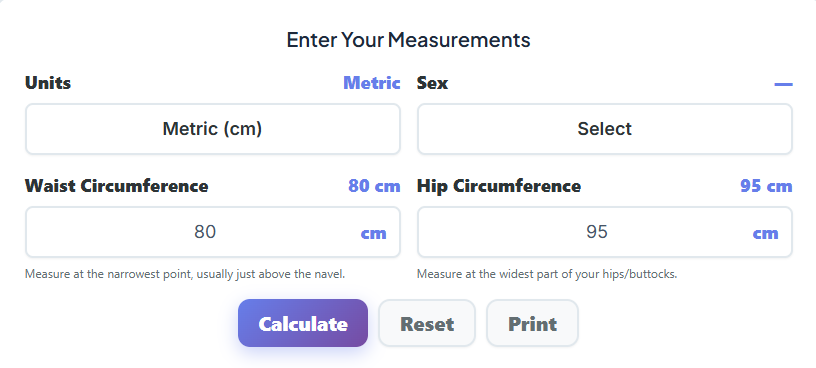
1. Units Dropdown (Metric / Imperial)
First, select your language of measurement. Whether you prefer centimeters or inches, the tool adapts instantly. I usually tell my clients to use whichever tape measure they have handy. The beauty of this waist to hip ratio calculator is that switching between metric and imperial updates the live values immediately. You don’t need to do mental math.
2. Sex Selection
This is biologically non-negotiable. Men and women have fundamentally different hormonal profiles that dictate fat distribution. A “healthy” ratio for a man is considered risky for a woman. By toggling between “Male” and “Female,” you are telling the backend which set of medical thresholds to apply to your results.
3. The Waist Input
Here is where most people make a mistake. When you enter your number into the “Waist Circumference” field, look at the live updating label. You need to measure at the narrowest point of your torso. This is usually just above the belly button and below the rib cage. Do not suck your stomach in. Exhale naturally and wrap the tape snug, but not tight. As you type, the waist to hip ratio calculator is already priming the math.
4. The Hip Input
Next is the hip measurement. The instructions on the live label will remind you to measure at the widest part of your buttocks and hips. This is crucial because we need the maximum circumference to get an accurate ratio. If you measure too high on the hips (near the pelvic bone), you will artificially lower your ratio, and the waist to hip ratio calculator won’t give you a true risk assessment.
5. Live Preview Values
As you type in these fields, you might notice the numbers previewing or shifting. The tool is designed to be responsive. It confirms what you are typing in real-time so you can catch typos before hitting the big button.
The Buttons Section
Once your data is in, you have three clear options.

- Calculate: This crunches the numbers and reveals your health card.
- Reset: If you want to start over—maybe you want to measure a friend or family member next—this clears the form instantly.
- Print: This is a feature I love for my clients. You can print your results to keep a physical log. Tracking your stats over time using a waist to hip ratio calculator is the best way to prove that your diet and training are working, even if the scale weight hasn’t moved.
The Output Section: Interpreting Your Health Status
Once you hit “Calculate,” the tool expands to reveal your truth. This is the section that requires the most attention.
The Final Value
You will see a large number in a 0.00 format. This is your raw ratio. For example, if you see 0.85, that means your waist is 85% the size of your hips. This number is the core of what the waist to hip ratio calculator provides.
The Colored Risk Pill
Right next to or below the value, you will see a colored pill labeled “Low,” “Moderate,” or “High.” This is your instant snapshot.
- Green (Low Risk): You are in a healthy range. Your fat distribution is optimal.
- Yellow (Moderate Risk): You are bordering on central obesity. It is a warning sign to tighten up nutrition.
- Red (High Risk): This indicates significant visceral fat storage. From a health perspective, this is a call to action.
The Color Bar Scale and Marker
Visual learners will appreciate the gradient bar that runs from green to red. A small marker pointer slides along this bar to show exactly where you fall on the spectrum. It helps you see how close you are to the next category. If you are just barely in the “High” risk zone, seeing that marker near the border of “Moderate” can be a huge psychological boost—you know you only need to lose an inch or two to shift categories.
Difference Thresholds
The text explanation will adapt based on the sex you selected earlier. The waist to hip ratio calculator knows that a 0.85 is excellent for a man but borderline for a woman. It contextualizes the data so you aren’t left guessing.
Auto Unit Conversion & Live UI Updates
One of the slickest features of this specific tool is the auto-conversion. If you measured in inches but are curious what that is in centimeters, just toggle the unit switch. The waist to hip ratio calculator instantly converts your input values and recalculates the result without you needing to re-type anything. This improves usability significantly, especially for international users or those checking medical charts that might use different systems. The live labels update in real-time, ensuring you never get lost in the process.
Deep Dive: What Your Ratio Actually Means
You have used the waist to hip ratio calculator and you have your number. Now, let’s sit down and talk about what it means for your life.
The “Apple” vs. The “Pear”
These terms sound cute, but they represent serious biological differences.
If the waist to hip ratio calculator gives you a high number, you have an android (apple) fat distribution. This is influenced heavily by cortisol (the stress hormone) and insulin. High levels of stress and a diet high in refined sugars often lead to this belly-fat accumulation.
If you have a lower ratio, you have a gynoid (pear) distribution. While many of my clients complain about having wider hips or thicker thighs, biologically, this fat is protective. It acts as a sink for fatty acids, keeping them away from your heart and liver. Using the waist to hip ratio calculator regularly helps you ensure you aren’t migrating from a pear shape toward an apple shape as you age, which is common during menopause for women or andropause for men.
Metabolism and Visceral Fat
Your metabolism is the engine that drives your body. Visceral fat is metabolically active tissue—it’s not just sitting there. It pumps out inflammatory cytokines that disrupt your hormones. A high result on the waist to hip ratio calculator is a strong indicator that your metabolism is under stress. This inflammation can lead to insulin resistance, making it harder to lose weight, creating a vicious cycle.
If you find that your ratio is high, you might want to look at your overall energy expenditure. To get a better handle on how many calories your body burns at rest, you should check out our BMR Calculator. Understanding your Basal Metabolic Rate combined with your WHR gives you a comprehensive roadmap for fat loss.
Cardiovascular Risk Factors
I cannot stress this enough: The heart does not like belly fat. Numerous studies have shown that WHR is a better predictor of heart attacks than BMI. If the waist to hip ratio calculator flags you as “High Risk,” it is time to take cardiovascular training seriously. This doesn’t mean you need to become a marathon runner, but you do need to get your heart rate up.
Integrating Zone 2 cardio (steady state) and Zone 5 (high intensity) can help mobilize visceral fat. To train safely and effectively, you need to know your training zones. Use our Heart Rate Calculator to find your specific zones so you can target that belly fat efficiently without burning out.
How to Improve Your Waist to Hip Ratio
So, the waist to hip ratio calculator gave you a number you aren’t happy with. Don’t panic. This is just data, and data can be changed. You can find waist to hip ratio improvements by focusing on two things: reducing the waist and maintaining (or building) the hips.
1. Attack the Visceral Fat (The Waist)
You cannot spot-reduce subcutaneous fat effectively, but you can spot-reduce visceral fat because it is incredibly sensitive to exercise.
- Cut the Sugar: Insulin drives belly fat. Reduce liquid calories and processed carbohydrates.
- Manage Stress: High cortisol sends fat directly to the stomach. Sleep and meditation are fat-loss tools.
- Increase Protein: It keeps you full and burns more calories during digestion.
2. Build the Glutes (The Hips)
This is the secret weapon for a better ratio. The waist to hip ratio calculator is a comparison. If your waist stays the same but your hips get more muscular, your ratio improves (and you look more athletic).
- Heavy Lifting: Squats, deadlifts, and hip thrusts add muscle to the glutes.
- Sprinting: Look at sprinters; they have powerful glutes and lean waists.
3. Hydration
It sounds simple, but water is essential for metabolizing stored fat. If you are dehydrated, your liver has to help your kidneys filter toxins instead of burning fat. To ensure you are drinking enough to support this metabolic process, use our Water Intake Calculator. It will tell you exactly how much fluid you need based on your activity level.
Monitoring Your Progress
I recommend using the waist to hip ratio calculator once every two to four weeks. Do not do it daily; body composition changes take time.
When you track this, measure at the same time of day, ideally in the morning before eating. This consistency ensures that bloating doesn’t throw off your waist measurement. Over time, you want to see that trend line moving down (or stabilizing in the green zone).
If you are a man, you generally want to aim for a waist hip ratio of 0.90 or less. For women, the goal is typically 0.85 or less. However, these are general guidelines. If you are very muscular, your BMI might be “obese” while your hip to waist ratio calculator result is “Low Risk.” This is the ultimate proof that you are fit, regardless of what the scale says.
The Verdict on Health
It is easy to get lost in the numbers, but remember that the waist to hip ratio calculator is a tool for longevity. It is about living longer and living better. A better ratio means better insulin sensitivity, lower blood pressure, and more energy.
It is also vital to understand that “skinny” does not always mean healthy. You can be “skinny fat”—low weight but high visceral fat. In this scenario, a standard scale tells you you’re fine, but the waist to hip ratio calculator will reveal the hidden risk. This is why I insist every client, regardless of their size, knows their numbers.
You might see terms like hip waist ratio thrown around in medical literature. While the order of words is swapped, the concept is identical. It is all about the relationship between the central storage and the peripheral storage. Whether you call it that or use a hip to waist ratio calculator, the goal remains the same: minimize the middle.
Summary
To wrap this up, your journey to health is multidimensional.
- Use the waist to hip ratio calculator at the top of this page.
- Input your measurements accurately (narrowest waist, widest hips).
- Check the “Live Preview” to ensure your data is correct.
- Hit Calculate and analyze the “Output Section”—specifically the risk pill and color bar.
- Use the result to adjust your diet and training.
Don’t guess about your health. We have the technology and the formulas to know for sure. Take two minutes, grab a tape measure, and find waist to hip ratio clarity today. Your future self will thank you for paying attention to the details that actually matter. The waist to hip ratio calculator is more than a widget; it’s a wake-up call or a high-five, depending on your lifestyle. Use it wisely.
FAQs
What is the waist-to-hip ratio calculator, and why is it important?
The waist-to-hip ratio calculator is a tool that helps you measure the proportion of your waist circumference to your hip circumference. This ratio is a key indicator of body fat distribution and can reveal potential health risks, such as cardiovascular disease, type 2 diabetes, and metabolic syndrome. Unlike BMI, which only considers weight and height, the waist-to-hip ratio focuses on where fat is stored in your body, making it a more accurate predictor of health risks.
How do I measure my waist and hips correctly for the calculator?
To measure your waist, wrap a tape measure around the narrowest part of your torso, typically just above your belly button and below your rib cage. For your hips, measure the widest part of your buttocks and hips. Ensure the tape is snug but not tight, and avoid sucking in your stomach for accurate results. Enter these measurements into the calculator to get your waist-to-hip ratio.
What is a healthy waist-to-hip ratio?
A healthy waist-to-hip ratio differs for men and women due to biological differences in fat distribution. For men, a ratio of 0.90 or less is generally considered low risk, while for women, a ratio of 0.85 or less is ideal. Ratios above these thresholds may indicate higher levels of visceral fat, which is associated with increased health risks. Always consult a healthcare professional for personalized advice.