🐠 Tank Measurements Calculator
Precise dimensions for your aquarium setup with visual diagrams
| Dimension | Inches | Centimeters |
|---|---|---|
| Length | — | — |
| Width | — | — |
| Height | — | — |
| Volume | — | — |
15 Gallon Tank Measurements: The Complete Guide to Dimensions & Setup
Setting up a new aquarium is one of the most exciting journeys a hobbyist can embark upon, yet it often begins with a moment of hesitation standing in the middle of a pet store or staring at an online listing. The sheer variety of glass boxes available today is enough to make anyone pause, wondering if they have the right sturdy furniture or enough wall space to accommodate their aquatic dreams. Often, the confusion stems not from the fish themselves, but from the physical reality of the tank—specifically, how much room it actually takes up.
Among the myriad of options available to modern keepers, the 15 gallon tank holds a unique position as a perfect bridge between small nano setups and larger, more demanding community tanks. This is why 15 gallon tank measurements are searched frequently by both beginners looking for a manageable start and experts seeking a specialized breeding or quarantine vessel. Understanding the footprint of your aquarium is the first critical step in ensuring long-term success, preventing the headache of purchasing equipment that doesn’t fit or realizing too late that your stand cannot support the weight.
When we talk about aquarium sizes, it is easy to assume that gallons are a standard unit of measurement that translates universally across all brands and styles, but experienced keepers know this is rarely the case. A “15 gallon” tank can be a standard rectangle, a tall column, or a long, shallow bookshelf style, and each of these variations has completely different dimensions despite holding the same volume of water.
This discrepancy is why knowing the exact 15 gallon tank measurements is so vital before you buy a single bag of substrate. Without checking the specific length, width, and height, you might find yourself with a lighting fixture that hangs over the edges or a filter intake that hits the bottom glass before it is fully submerged. Our goal here is to demystify these dimensions, helping you understand exactly what you are getting into and ensuring that your aquatic environment is safe, stable, and aesthetically pleasing in your home.
Understanding Aquarium Tank Sizes
The world of aquarium manufacturing is surprisingly complex, with different companies adhering to different standards based on whether they prioritize floor space or viewing height. When you see a tank labeled as 15 gallons, that number refers strictly to the internal volume—the amount of water the vessel can hold—rather than the external space it occupies.
This distinction is crucial because the glass thickness and the trim can add fractions of an inch to the overall footprint, which matters immensely if you are trying to fit the tank into a tight alcove or on a specific piece of furniture. While standard sizes exist, the variation in “designer” tanks means that 15 gallon tank measurements can fluctuate significantly depending on whether you are looking at a rimless high-clarity tank or a standard black-rimmed starter kit.
Furthermore, dimensions change drastically across different tank styles even within the same volume category, affecting how you interact with the tank daily. A “high” style tank provides a dramatic vertical viewing area which is excellent for tall plants like Vallisneria, but it presents challenges for lighting to penetrate to the bottom and makes maintenance harder for those with shorter arms.
Conversely, a “long” style tank offers a greater surface area for gas exchange and swimming room for active fish like danios, but it requires a longer stand and more horizontal wall space. As you compare options, you will naturally find yourself looking at 20 gallon tank dimensions or even 10 gallon tank dimensions to see if a slightly larger or smaller footprint might better suit your room, but the 15 gallon remains a sweet spot for many because it offers stability without overwhelming a small apartment or bedroom.
Why Accurate Tank Measurements Matter
The health of your fish is directly tied to the physical dimensions of their environment, making accuracy in measurement far more than just a logistical concern. Fish species have specific swimming requirements; for instance, active swimmers need horizontal length rather than vertical depth, meaning that even if the volume is correct, the shape might be wrong.
If you misunderstand your 15 gallon tank measurements, you might inadvertently stock species that feel cramped and stressed, leading to illness and poor coloration. Stress in fish is often invisible until it is fatal, and a tank that is too narrow or too shallow for a specific species is a silent stressor that slowly degrades their immune systems. Accurate measurements allow you to plan your stocking list responsibly, ensuring that every inhabitant has the room they need to thrive rather than just survive.
Beyond the biological needs of the fish, aquascaping relies heavily on precise knowledge of your tank’s boundaries. Hardscape materials like driftwood and dragon stone often need to be purchased with specific dimensions in mind; there is nothing more frustrating than bringing home a stunning centerpiece rock only to find it stands two inches taller than the rim of your tank.
Knowing your 15 gallon tank measurements beforehand allows you to visualize and plan your layout, creating depth and perspective that makes the tank look larger than it is. It also ensures that equipment fits correctly—heaters need to be fully submerged without touching the substrate, and filters need clearance behind the tank. Avoiding these costly mistakes saves money and frustration, preventing the accumulation of useless gear that doesn’t fit the tank you actually own.
Overview of This Tank Measurements Calculator
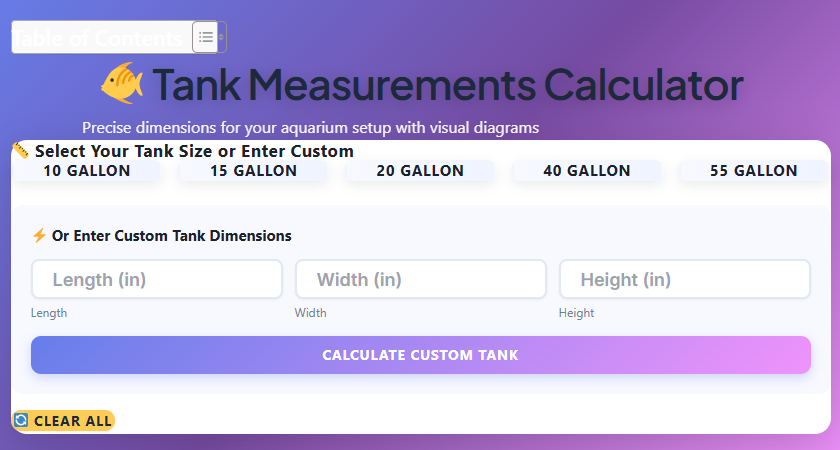
We have developed a specialized Tank Measurements Calculator designed specifically to alleviate the guesswork that plagues so many hobbyists during the planning phase. This tool is not just a simple volume checker; it is a comprehensive guide that helps you visualize and confirm the physical reality of the aquarium you are considering.
By focusing on user experience, the tool bridges the gap between abstract numbers and tangible reality, making it incredibly useful for anyone from a first-time parent buying a tank for their child to a seasoned aquarist planning a complex planted setup. The tool allows you to interact directly with the data, ensuring that when you search for 15 gallon tank measurements, you get instant, reliable answers that you can trust for your project planning.
The primary benefit of using this calculator is the elimination of manual errors and the confidence it provides in your purchasing decisions. Instead of scribbling numbers on a napkin or trying to recall if a tank was 20 or 24 inches long, you have a digital resource that standardizes these figures for you.
It simplifies the process by pre-loading common sizes while still allowing for full customization if you have a unique, custom-built vessel. For those specifically interested in 15 gallon tank measurements, this tool streamlines the workflow by instantly providing the length, width, and height data you need to check against your stand or desk space. It removes the ambiguity, letting you focus on the fun parts of the hobby like selecting fish and plants rather than worrying about whether the tank will actually fit in your living room.
Selecting a Tank Size

When you first engage with the calculator, you are presented with a straightforward interface featuring preset buttons for the most common standard aquarium sizes. This design choice is intentional, meant to save you time and provide immediate access to industry-standard dimensions without the need for typing. You simply click on the button labeled for the size you are interested in, and the fields populate automatically.
This feature is particularly helpful for quickly comparing how much more space a larger tank might take up compared to your current plan. For example, you can toggle between presets to see the difference between standard sizes and 15 gallon tank measurements, helping you decide if you can squeeze in that extra water volume or if you need to stick to a smaller footprint.
Choosing the correct size at this stage is the most fundamental decision of your setup because it dictates everything that follows, from the weight on your floor to the cost of the lighting system. The presets act as a safeguard against common misconceptions, showing you the “standard” dimensions that most equipment manufacturers use.
If you select the 15 gallon preset, you are seeing the dimensions that major filter and hood brands build their products around. This alignment ensures that if you stick to these standard 15 gallon tank measurements, you will have a much easier time finding compatible accessories at your local pet store, saving you from the headache of custom-ordering lids or trying to modify equipment to fit an odd-sized tank.
Focusing on the 15 Gallon Tank
From a user’s perspective, selecting the 15 gallon option in the tool reveals why this specific size is such a versatile and popular choice in the hobby. It offers a significant step up in water stability compared to smaller nano tanks, yet it remains manageable for a single person to move (when empty) and clean.
The tool highlights the specific geometry that makes 15 gallon tank measurements so appealing: typically offering a nice balance of length for swimming space and height for plant growth. For a freshwater enthusiast, this size is perfect for a small school of tetras, a centerpiece betta, or a thriving colony of shrimp, offering enough volume to dilute waste products effectively while still fitting comfortably on a sturdy desk or dedicated cabinet.
The versatility of the 15 gallon size extends to its ability to fit into various roles within a fish room or home setup. Unlike larger tanks that demand a dedicated wall, a 15 gallon tank can tuck into a kitchen corner, sit on a bedroom dresser, or brighten up a home office.
When you view the 15 gallon tank measurements in our tool, you can immediately start visualizing these placements in your own home. You can grab a tape measure and physically mark out the dimensions on your furniture, confirming that the tank won’t overhang or obstruct walkways. This tangible connection between the digital tool and your physical space is what makes checking the measurements so empowering—it turns a vague idea into a concrete plan that you can execute with confidence.
Entering Custom Tank Dimensions
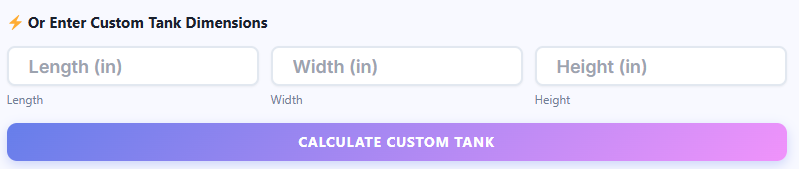
While standard sizes are convenient, the reality of the aquarium hobby is that custom and non-standard tanks are increasingly common, which is why our tool allows for precise custom inputs. There are times when you might find a unique rimless tank at a boutique shop or perhaps a vintage tank at a garage sale that doesn’t adhere to modern standards.
In these instances, relying on standard 15 gallon tank measurements would be a mistake. Our tool accommodates this by allowing you to manually type in the exact length, width, and height of the tank you have in front of you. This feature is indispensable for ensuring that your volume calculations and equipment fittings are accurate for your specific, unique piece of glass.
As you type these values into the input fields, the experience is designed to be responsive and intuitive, giving you immediate control over the data. You don’t need to worry about complex navigation; you simply click into the length, width, or height box and enter your numbers.
This flexibility is crucial because a “15 gallon” tank could technically be a shallow frag tank, a tall hexagon, or a custom-built cube. By entering your specific dimensions, you override the presets and get a tailored result that reflects reality. Even if your tank deviates slightly from standard 15 gallon tank measurements, the tool processes your inputs instantly, preparing to show you the calculated results that are relevant to your specific situation, ensuring you aren’t basing your decisions on generic averages.
Viewing Results Instantly
Once you have selected your preset or entered your custom dimensions and clicked the calculate button, the results are displayed instantly on clear, easy-to-read cards. This immediate feedback loop is designed to give you the key information—length, width, height, and calculated volume—without any clutter or confusion.
For a user investigating 15 gallon tank measurements, seeing these numbers clearly displayed confirms whether the tank is truly 15 gallons or if the manufacturer was rounding up or down. It provides a moment of clarity where the math is done for you, and you are presented with the hard facts needed to proceed with your setup.
The presentation of volume alongside dimensions offers a high degree of confidence for buyers who might be skeptical of labeled sizes. It is not uncommon for tanks sold as “15 gallons” to actually hold 13.5 or 16 gallons when the dimensions are strictly calculated.
Seeing the precise volume derived from your input 15 gallon tank measurements helps you understand the actual capacity you are working with. This is vital for dosing medications, adding water conditioners, or calculating stocking levels. The result cards are designed to be the final word on your tank’s physical properties, acting as a reliable reference point that you can screenshot or write down to take with you to the fish store.
When planning your budget, you often need to consider ongoing costs like water changes and chemical additives. To help with the financial aspect of the hobby, you can use our internal tool.
💳 Payment Terms Calculator
Open Calculator →
This can be helpful if you are financing a larger custom setup, but for a standard 15 gallon, it simply helps you keep your hobby budget on track by allowing you to calculate potential installment payments on expensive equipment.
Visual Tank Diagram Explained
Beneath the numerical results, the tool generates a visual tank diagram that dynamically adjusts to represent the proportions of the dimensions you entered. This visual aid is incredibly helpful for understanding the shape of the aquarium, which numbers alone often fail to convey.
When you are looking at 15 gallon tank measurements, seeing a diagram that represents a long, low rectangle versus a tall, thin square helps you intuitively grasp the “feel” of the tank. It aids in visualizing how the tank will look when placed in your room—will it look like a towering column or a panoramic display? The diagram bridges the gap between raw data and aesthetic appreciation.
This visual component is particularly useful for understanding proportions relative to the equipment you plan to use. If the diagram shows a very tall and narrow tank based on your 15 gallon tank measurements, you immediately know you will need a powerful light to reach the bottom substrates.
Conversely, if the diagram is long and shallow, you can see that you will have plenty of room for horizontal layouts but might be limited in plant height. This immediate visual understanding helps you make design decisions before you even own the tank. It serves as a sanity check, ensuring that the numbers you entered correspond to a shape that makes sense for your intended use, preventing you from accidentally planning a setup that is physically awkward or impossible to maintain.
Tank Type and Recommended Usage
The tool also features a tank type badge or indicator that helps categorize the potential usage of the aquarium based on the dimensions provided. For standard 15 gallon tank measurements, the tool will often indicate suitability for a variety of setups, from community freshwater tanks to specialized species-only biotopes. This guidance is invaluable for beginners who might not know that certain dimensions are better suited for specific types of aquatic life. It serves as a gentle nudge in the right direction, suggesting that your tank is “Standard” or perhaps “Reef Compatible” if the dimensions allow for the necessary equipment and water volume stability required for saltwater environments.
Speaking of saltwater, while 15 gallons is considered a “nano” size for marine setups, it is a popular challenge for experienced keepers. If your 15 gallon tank measurements provide enough width for live rock structures, you might consider a reef tank kit. These kits are designed to fit specific standard dimensions, and knowing your exact measurements ensures compatibility. The tool helps you identify if your tank falls into the category that can support a small reef environment, reminding you that while volume is important, the shape and surface area are critical for gas exchange and light penetration in a delicate reef system.
If you are curious about how fast your coral or plants might grow in this setup, or how your colony of shrimp might expand, we have a resource for that as well.
📈 Growth Rate Calculator
Open Calculator →
This tool allows you to project biological growth over time, which is fascinating when applied to a new 15 gallon ecosystem.
Comparing Other Popular Tank Sizes
It is natural during the research phase to compare your current choice with other popular sizes to ensure you are making the best decision. While 15 gallon tank measurements offer a great balance, looking at the alternatives helps frame why this size is unique. For instance, 10 gallon tank dimensions are smaller and lighter, making them easier to place, but they lack the water volume stability that the extra five gallons provide. The 15 gallon tank is often the same length as a 10 gallon but taller, or the same height but longer, providing that crucial extra room without a massive increase in footprint.
On the other hand, when you compare with 20 gallon tank dimensions, you often find a significant jump in weight and space requirements. A 20 gallon “long” tank takes up considerably more wall space, which might not be feasible in a small apartment. The 15 gallon sits comfortably in the middle, offering more resilience than the 10 gallon but less physical intrusion than the 20 gallon. It is a compromise that doesn’t feel like a compromise, giving you the best of both worlds.
Moving up the scale, 40 gallon tank dimensions represent a move into “serious” aquarium territory, often requiring dedicated stands and significantly more expensive equipment. The jump from 15 to 40 is massive in terms of maintenance time and water change volume. Similarly, 55 gallon tank dimensions are the standard for large community tanks, but they are heavy, difficult to move, and require substantial floor support. By comparing these larger sizes, the appeal of 15 gallon tank measurements becomes clear: they offer a manageable slice of the aquatic world that fits into a busy lifestyle without dominating it.
Sometimes you need to convert between different units or metrics when comparing these tanks and their equipment ratings.
🎯 Conversion Rate Calculator
Open Calculator →
This tool is embedded to help you swiftly handle any necessary conversions, ensuring you can compare specs from different manufacturers easily.
Real World Aquarium Setup Scenarios
In practical terms, 15 gallon tank measurements lend themselves perfectly to beginner setups where the goal is to learn the ropes of water chemistry and fish keeping without being overwhelmed. A novice can set up a beautiful planted tank with a school of neon tetras and a few corydoras catfish, creating a vibrant ecosystem that is forgiving of minor mistakes thanks to the decent water volume. The dimensions allow for standard heaters and filters found at any pet store, removing barriers to entry. The tank is large enough to be stable but small enough that a 25% water change is just a few buckets, making weekly maintenance a quick chore rather than a weekend-long project.
For those interested in community tanks, the 15 gallon tank measurements provide just enough room to create distinct zones within the aquarium. You can have a rock pile on one side for hiding spots and an open swimming area on the other. This zoning capability is often lost in smaller tanks but is fully achievable here. It allows for a mix of species that occupy different levels of the water column, such as top-dwelling hatchet fish and bottom-dwelling shrimp, creating a dynamic and interesting display that is constantly in motion.
Finally, experienced hobbyists often look at 15 gallon tank measurements when deciding to upgrade from a nano tank or downsize from a giant setup. It serves as an excellent upgrade for a betta fish currently living in a 5-gallon bowl, offering them a palace to patrol. Conversely, for an empty nester looking to keep a foot in the hobby without the labor of a massive tank, the 15 gallon offers a perfect canvas for a high-tech aquascape or a specialized breeding project. It is a size that respects the user’s time and space while rewarding them with a fully functional, beautiful slice of nature.
Why the 15 Gallon Tank Remains a Staple
The enduring popularity of the 15 gallon tank is no accident. It exists at the intersection of affordability, manageability, and biological stability. By understanding the specific 15 gallon tank measurements, you unlock the potential to create a stunning aquatic display that fits seamlessly into your life. Whether you use our calculator to confirm a standard size or to input custom dimensions for a unique find, the clarity you gain is the foundation of a successful tank.
Knowing your dimensions empowers you to make smarter choices about equipment, livestock, and placement. It prevents the common pitfalls of the hobby and sets you up for success from day one. As you look at the 15 gallon tank measurements one last time, remember that these numbers represent the boundaries of a world you are about to create—a world that, with the right planning, will bring beauty and tranquility to your home for years to come.
When considering a saltwater setup, many enthusiasts eventually look toward a reef tank kit to simplify the process, and knowing that your 15 gallon dimensions match these kits can be a huge relief.
Furthermore, as you browse options, you might glance again at 40 gallon tank dimensions or 55 gallon tank dimensions, only to realize that the compact efficiency of the 15 gallon is exactly what you need right now.
Even the temptation of 20 gallon tank dimensions or the simplicity of 10 gallon tank dimensions often cannot beat the perfect balance found in the 15 gallon size.
It is a choice that balances ambition with reality, and armed with the correct 15 gallon tank measurements, you are ready to build something truly special.
Ultimately, the success of your aquarium relies on this foundational knowledge. By verifying your 15 gallon tank measurements, you ensure that every filter, light, and stand you purchase is the correct fit. This attention to detail at the start is what separates a struggling tank from a thriving ecosystem. So, take those measurements, use the calculator, and dive into the hobby with the confidence that you have mastered the physical reality of your new tank.
In the end, whether you are building a lush jungle for freshwater shrimp or a minimalist hardscape for a betta, the journey begins with the tape measure. Respecting the 15 gallon tank measurements is respecting the needs of the life you will keep, and that is the mark of a true aquarist.
FAQs
What are the standard dimensions for a 15-gallon aquarium?
While dimensions can vary slightly by manufacturer, the most common standard size for a 15-gallon tank is 24 inches long, 12 inches wide, and 12 inches high. You might also find “high” versions (often 20″ x 10″ x 18″) or column styles. Because of these variations, it is always best to measure the actual tank or check the specific brand’s label before buying a stand or lid to ensure everything fits perfectly.
Is a 15-gallon tank big enough for a community of fish?
Yes, a 15-gallon tank is a great entry point for a small community setup. It offers more stability than a 10-gallon tank, giving you room for a school of small fish (like neon tetras or rasboras) along with a centerpiece fish (like a betta or dwarf gourami) and some bottom dwellers (like shrimp or pygmy corydoras). Just be careful not to overstock it, as overcrowding can lead to water quality issues.
How much does a 15-gallon tank weigh when full?
A 15-gallon tank can be deceptively heavy. Water weighs about 8.34 pounds per gallon, so just the water alone is roughly 125 pounds. When you add the weight of the glass tank itself (around 20 pounds), plus substrate (gravel or sand) and decorations, the total weight usually sits between 170 and 200 pounds. Make sure you place it on a sturdy stand or piece of furniture designed to hold that kind of weight securely.