
Carriage Bolt Measurements & Dimensions Tool
Professional Specifications for Carriage Bolts and Square Neck Bolts
How to Get Perfect Carriage Bolt Measurements Every Time
Getting the right measurements for a project is crucial, whether you’re an industrial pro or a DIY fan at home. With fasteners, a small error can have big consequences, and this is especially true for carriage bolt measurements.
Many people search for carriage bolt measurements because guessing isn’t an option. Too short and the bolt won’t hold; too long and it can be unsafe or look sloppy. Confusing bolt types and sizes often leads to delays, wasted material, and frustration. With accurate carriage bolt measurements from the start, you save time, money, and avoid project failure.
It gets even trickier when you factor in the differences between fastener types. Telling a standard carriage bolt from a square neck bolt can be tough unless you know what to look for. Both industrial and DIY users need a reliable way to get specs right or risk costly mistakes. This guide shows you how to get flawless carriage bolt measurements using a straightforward online tool—no guesswork required. We’ll break down different bolts, why accuracy is a must, and how these measurements make a real difference. Mastering carriage bolt measurements is the start of any solid project.
Understanding Carriage Bolts and Square Neck Bolts
Before you worry about measurements, you need to know what you’re working with. Carriage bolts have a domed or countersunk head and a square section—the “neck”—just under the head. That square neck slots into a square hole in wood or a pre-punched metal hole, stopping the bolt from spinning as you tighten the nut.
Carriage bolts are trusted for their self-locking ability. They work great for jobs where you can only reach one side. The smooth head also avoids snags and looks neat.
People often compare carriage bolts to the square neck bolt, which also uses a square section to prevent rotation. Sometimes, the names get mixed up. Small design changes, like a slightly wider head or different materials, can make a difference that matters in your project. Choosing between them depends on the job—for example, one might spread force better if you’re working with soft wood.
Understanding these differences is part of getting the right carriage bolt measurements. The way you measure remains the same for either, since their core dimensions decide if they’ll fit. Knowing when to use a square neck bolt or a carriage bolt depends on your material and the look you want.
If you need an extra-low profile, a countersunk carriage bolt is often the answer. Some projects demand a certain steel grade or a unique head shape, and that often points to one bolt over the other. Double-checking the details guarantees your effort in getting precise carriage bolt measurements will pay off in the end.
Why Accurate Measurements Matter
Getting accurate carriage bolt measurements is about more than just convenience—it’s about safety. A bolt that’s too short or too long can compromise whatever it’s holding together.
Imagine building a playground set and using bolts too short to catch the nut. That connection could fail, putting kids at risk. In a factory, the wrong bolt in a machine could lead to damage, lost production time, or injury. Careful attention to carriage bolt measurements is part of any responsible building or engineering process.
Proper fit is just as important as safety. Too large a diameter and the bolt won’t go through your pre-drilled hole. Too small and you’ll have a loose, wobbly fit. A bolt that’s too long can snag or get in the way. If the square neck is off, it won’t grip and you won’t get a tight seal.
This is why you need a deep understanding of carriage bolt measurements—so each part comes together as planned.
Ignoring measurements can ruin a project. Maybe a deck looks great at first, but if the bolts are wrong, it’ll loosen and fail over time. Replacing or fixing everything eats up your time and money, damaging your reputation. Taking a moment to check the correct carriage bolt measurements is an investment in quality work.
Overview of This Carriage Bolt Tool
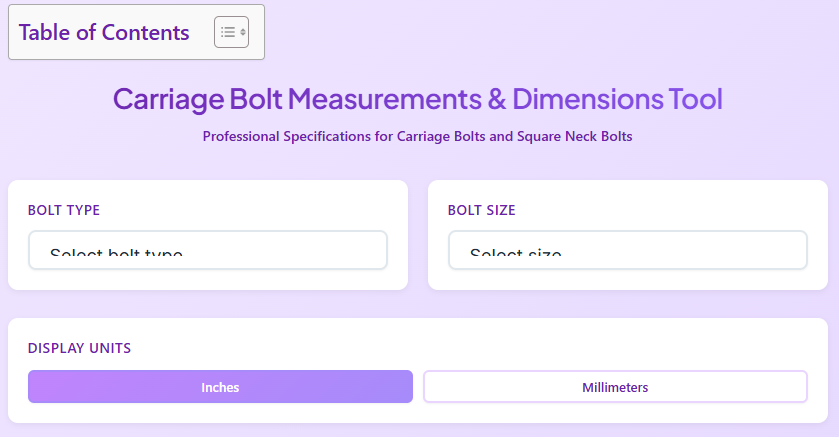
Common measurement mistakes are easy to avoid when you use an online tool made for carriage bolt measurements. This tool brings up instant, accurate sizes for a huge range of bolts. You don’t need to read hard-to-follow charts or mess with rulers. You see the info you need—head diameter, height, square neck size, shank length—all in one clean display.
The best part? The diagram updates as you pick your options. You can actually see the bolt change, which makes it much easier to be sure you’re looking at the right option. Suddenly, getting accurate carriage bolt measurements is easy for everyone.
This tool isn’t just for engineers or big project managers. Home DIYers benefit too. Wondering which bolt to buy at the shop? Need to double-check a drawing? This tool is for you.
The simple, jargon-free interface puts confidence in your hands. No tricky forms—just pick what you need and the answer pops up. You’ll make better decisions, back them up with real data, and avoid mistakes thanks to dependable carriage bolt measurements.
Selecting the Bolt Type
When you start with the tool, your first choice is which type of bolt to measure. Usually you’ll see options with icons, so you can easily pick between Carriage Bolt and square neck bolt.
This basic choice matters because it tailors every option after that. Even small design changes, like the head’s curve or the neck’s length, will affect the final specs. The tool sorts all this for you.
Choosing the right type sets you up for correct carriage bolt measurements. If you choose wrong, you could design around the wrong bolt and run into surprises later.
Picking your type means every number you see—from head size to neck shape—matches what you’ll actually buy. That’s the advantage of an online tool for carriage bolt measurements: no guessing, just clarity.
Choosing the Bolt Size
Next, choose your bolt’s size. This is the step that can truly make or break your project.
A dropdown or button menu lets you scroll through common diameters, including the 1 4 in carriage bolt and the 1 2 carriage bolt. Just click on the size that matches your project.
You’ll see the diagram and all the measurements change instantly as you pick a size. There’s no need to hit a “submit” button or wait for a refresh. Pick the 1 4 in carriage bolt and compare it to the 1 2 carriage bolt—one gives you a slim fastener, the other a thick, strong solution.
This hands-on approach makes finding your carriage bolt measurements quick and keeps mistakes at bay. You can cycle through several sizes and see which one suits your design or fixes your need. If you want to check material costs, try out the 💵 Discount Calculator to see the savings from bulk orders. Open Calculator → It makes getting the right carriage bolt measurements even easier.
Switching Measurement Units
One great feature of this tool is switching units quickly. Need inches? Need millimeters? Just click the toggle and the whole display updates.
This helps when you’re sharing plans between countries or working with a team that uses the opposite system from yours. Maybe your blueprint is metric, but your supplier talks in inches. No problem—your carriage bolt measurements display instantly in whichever form you need.
Sometimes a U.S. woodworker buys a machine that specs metric bolts, and manual math becomes a pain. Changing units with a tap takes away the risk of errors. It also helps with creating documents or spec sheets. Your team gets data in the right format every time. Switching units keeps your carriage bolt measurements clear and reliable.
Viewing the Measurement Results
After you make your selections, your results show up front and center. The screen brings up a big, detailed image of the bolt marked with dimension labels.
You’ll see values for body diameter, head diameter, head height, square neck width, and neck depth. It’s far more visual than just reading numbers from a chart, and you can easily understand what each measurement means.
Having clear, accurate images helps you feel confident. You see your carriage bolt measurements at a glance, making sure you’re not ordering the wrong part or planning around the wrong size.
This is especially useful for tight tolerances. Instant, visual data makes carriage bolt measurements quick and error-free. Need to manage material inventory? The 📈 Stock Calculator is handy for projecting how many bolts you’ll need or when to reorder. Open Calculator →
Understanding Size-Specific Use Cases
Knowing what each bolt size is for helps you use measurements better. For example, the 3/8 carriage bolt dimensions are perfect for deck building or heavy-duty shelves. You use the tool, select this size, and immediately see exactly the head width and the square neck’s width.
That way, you know which drill bit to grab, which wrench to use, and how thick your wood can be without trouble. 3/8 carriage bolt dimensions are a common solution for wood framing where a firm, sturdy hold is needed.
Some projects use bigger bolts, like the 9/16 carriage bolt. Think giant timbers, heavy machinery, or specific car frames. Select this size on the tool and you see all necessary data. You make sure the hole is big enough and the neck will lock in place.
This saves you from the headache of reworking metal or wood. Knowing exactly what a 9/16 carriage bolt involves before you start—thanks to instant data—helps you avoid costly mistakes. The tool’s breakdown of carriage bolt measurements gives you what you need for both basic and complex projects.
Reset and Print Experience
Sometimes you need to restart your search, maybe to compare sizes or fix an error. That’s where a reset or clear button helps. With one click, you clear choices and the tool is fresh.
This way, looking up a new set of carriage bolt measurements remains smooth. If you want to compare multiple sizes, you can quickly go back to zero and start looking again.
Printing or exporting your results is just as simple. After you find the right carriage bolt measurements, hit print or save as PDF. Now you have a physical copy for the hardware store or specs for your team. No need to write it down by hand or risk forgetting details.
Saving your measurements ensures you’re always working with reliable numbers. These printed or digital specs lock in the accuracy you got from the tool, so you can trust your choices—on-site or in the office.
Real World Applications
Accurate carriage bolt measurements are a must in many industries. In construction, they’re standard for decks, timber frames, and fences. Builders depend on good measurements for connections that are strong, safe, and up to code.
Machinery and equipment assembly use carriage bolts for frames and mounting. Engineers need solid carriage bolt measurements to build digital models and parts that fit, with no tolerance errors during assembly.
For business plans, like deciding whether to lease or buy space for your shop, the 🏢 Rent vs Buy Calculator can help you crunch numbers for long-term investment. Open Calculator →
Furniture makers also use these bolts for things like rustic tables or play sets. The right measurements make the final piece safer and longer-lasting. That domed head is about more than looks—it keeps kids safe and furniture sturdy.
The ease and speed of a good measurement tool mean anyone can create a professional-level project. Mastering carriage bolt measurements pays off wherever strong, reliable connections are needed—no matter your craft.
Frequently Asked Questions
How do I measure the length of a carriage bolt correctly?
Unlike hex bolts where you might measure from the top of the head, carriage bolts are measured from directly underneath the rounded head to the end of the threaded shank. The domed head itself sits above the surface of the material and is not included in the length measurement. To get an accurate reading, place your tape measure or ruler at the base of the square neck (where it meets the head) and measure to the very tip of the bolt.
What is the square neck for, and do I need to measure it?
The square neck is a critical feature that locks the bolt into place, preventing it from spinning while you tighten the nut. You typically don’t need to measure the neck depth for standard applications, as it corresponds to the bolt’s diameter standards. However, you should ensure the square hole in your material (if you are using metal) matches the neck width. If you are using the bolt in wood, the square neck will pull into the wood fibers to create its own pocket, so specific neck measurements are less critical than the overall diameter and length.
Can I use a different bolt diameter than what my project specifies?
It is highly recommended to stick to the exact diameter specified for your project to ensure safety and structural integrity. A bolt that is too small (e.g., using a 1/4-inch bolt in a 3/8-inch hole) will be loose, reducing the holding power and potentially allowing the joint to shift or wobble. A bolt that is too large will simply not fit through the pre-drilled holes or the square slot designated for the neck. Always confirm the diameter using a gauge or measurement tool before purchasing.