Hair Dye Color Mixing Calculator
Professional Hair Color Developer Ratio & Mix Chart Calculator
Professional mixing hair dye color chart for common salon applications using the hair color developer ratio 1 to 1.5:
1 to 1.5 Ratio Hair Color Calculator: The Complete Guide to Perfect Mixes
Introduction
Achieving the perfect hair color is a science that balances chemistry, artistry, and precise measurements. For professional stylists and serious home enthusiasts alike, the difference between a radiant, long-lasting hue and a muddy, uneven disaster often comes down to a single variable: the mixing ratio. This is where the 1 to 1.5 ratio hair color calculator becomes an indispensable asset in your color formulation process. Unlike generic mixing strategies that rely on guesswork, a precise calculator ensures that the chemical reaction between the oxidative dye and the developer occurs exactly as the manufacturer intended.
In professional salons, accuracy is the cornerstone of client satisfaction. When you are lifting a natural level 4 to a level 7 or depositing a rich copper tone on pre-lightened hair, the stability of your mixture dictates the outcome. The 1 to 1.5 ratio hair color calculator is designed to eliminate the common mathematical errors that plague busy salon environments. While home kits often come with pre-measured bottles, professional tube colors require you to manually measure your components. A slight deviation in developer volume can lead to “hot roots,” insufficient grey coverage, or accelerated fading.
Using a specialized tool like the 1 to 1.5 ratio hair color calculator bridges the gap between professional consistency and amateur uncertainty. Whether you are mixing a standard permanent color or a high-lift series, understanding the exact proportions required for a 1:1.5 mix is critical. This guide will walk you through the chemistry behind the ratios, how to navigate complex mixing charts, and exactly how to utilize our calculator to guarantee flawless results every single time. By prioritizing precision, you protect the integrity of the hair fiber while ensuring the pigment develops to its full vibrancy.
Understanding Hair Dye Ratios
To truly master hair coloring, one must understand the language of ratios. A ratio simply tells you how much developer (hydrogen peroxide) to use relative to the amount of hair color cream. While it sounds simple, the implications for the hair’s cuticle and cortex are profound. The three most common ratios you will encounter in a salon are 1:1, 1:1.5, and 1:2.
A 1:1 ratio is the traditional standard for many permanent hair color lines, particularly those focused on maximum grey coverage. In this scenario, you mix equal parts color and developer. For example, 50 grams of color would require 50 grams of developer. This creates a thicker, more opaque mixture that deposits pigment heavily. It is excellent for stubborn white hair but can sometimes result in a darker appearance than expected if the hair is porous.
The 1:2 ratio, often referred to as “high lift,” involves using double the amount of developer compared to the color. This is typically reserved for high-lift blonde series where maximum lightening power is needed. The extra developer provides more oxygen to oxidize the melanin, allowing for greater lift, but it dilutes the pigment significantly. This mixture is often runnier and can be harsher on the scalp if not formulated correctly.
This brings us to the “sweet spot” of modern formulation: the 1:1.5 ratio. Many leading professional brands have shifted to this standard because it offers the best of both worlds. The 1 to 1.5 ratio hair color calculator is specifically calibrated for this popular mixing style. A 1:1.5 mix (e.g., 50g color to 75g developer) provides a consistency that is easy to apply—creamy enough to stay put, but fluid enough to saturate the hair shaft thoroughly. It offers better spreadability than a 1:1 mix, meaning you use less product to cover the same amount of hair, which is economically beneficial for salons.
Furthermore, the 1:1.5 ratio provides an ideal pH environment for the dye precursors to couple and form large dye molecules within the cortex. It allows for excellent lift without compromising pigment density as much as a 1:2 mix. Using the 1 to 1.5 ratio hair color calculator ensures that you hit this specific consistency every time. If you eyeball this measurement, you risk creating a mix that is either too strong (damaging the hair) or too weak (failing to lift or deposit).
The developer volume plays a massive role here as well. The ratio dictates the quantity of the liquid, but the volume (10, 20, 30, 40) dictates the strength. A 1 to 1.5 ratio hair color calculator helps you manage the quantity side of the equation perfectly so that the volume you choose can do its job effectively. If you accidentally mix at 1:2 when the manufacturer calls for 1:1.5, you dilute the peroxide strength, potentially turning a 20 volume developer into something that acts more like a 10 volume, resulting in under-processed color.
Hair Dye Color Mixing Chart Explained
Visual aids are crucial in color theory, which is why every colorist relies on a hair dye color mixing chart. This chart is a visual representation of the available shades, usually arranged by level (depth) and tone (reflect). However, a static chart can only tell you what color to pick, not how to mix it. This is the primary difference between a hair dye color mixing chart and a dynamic calculator.
A traditional hair dye color mixing chart shows you the starting level and the target result. For instance, if a client has a natural level 6 (Dark Blonde) and wants to achieve a level 8 (Light Blonde), the chart helps you identify the target shade. But once you have selected the tube, the chart’s job is done. It does not calculate the ounces or milliliters needed for your specific bowl. This is where the 1 to 1.5 ratio hair color calculator takes over, translating the artistic choice from the chart into a chemical reality.
Let’s look at some examples of how a mixing hair dye color chart informs the calculator inputs:
Scenario 1: Blonde to Red
You consult the chart to take a client from a level 9 Blonde to a level 7 Copper Red. The chart indicates you need to fill the hair with missing pigments. You select a 7.4 (Copper Blonde). The chart gives you the color code. You then input this data into the 1 to 1.5 ratio hair color calculator, knowing you need 40 grams of dye. The calculator will immediately tell you that you need 60 grams of developer to maintain the integrity of that red pigment.
Scenario 2: Brown to Copper
A client with level 4 Brown hair wants a vibrant level 6 Copper. The chart suggests using a high-lift copper or pre-lightening. If using a single process color, the chart might suggest a 6.44 with 30 volume developer. The nuance here is critical: copper molecules are large and prone to fading. An incorrect mix (too much developer) will cause the copper to brown out or fade within a week. By strictly adhering to the output of the 1 to 1.5 ratio hair color calculator, you ensure the ammonia content is balanced to open the cuticle just enough for those copper dyes to anchor.
Scenario 3: Ash to Violet
A client with level 8 Ash Blonde wants to switch to a trendy level 8 Violet. The chart shows that violet cancels yellow, but since the client is already ash (cool), there is no yellow to neutralize. You want pure deposit. The hair dye mix chart helps you select a violet shade that won’t go muddy on the ash base. Once selected, the 1 to 1.5 ratio hair color calculator ensures you don’t over-dilute the violet. Violet pigments are delicate; a watery mix will result in a sheer, barely-there toner rather than a permanent color change.
Understanding how to measure hair color and developer works hand-in-hand with reading these charts. The chart provides the destination; the calculator provides the vehicle to get there.
How the Tool Works (Step-by-Step)
Navigating a digital color tool should be as intuitive as mixing in a bowl. Our 1 to 1.5 ratio hair color calculator is designed to replicate the stylist’s thought process, moving logically from consultation to formulation. Here is exactly how the tool functions, step-by-step.
Step 1: Selecting Base Hair Color
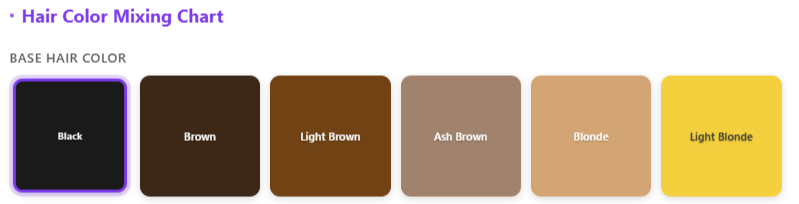
The first interaction with the 1 to 1.5 ratio hair color calculator involves establishing the canvas. You will see a dropdown menu or a visual selector for “Current Hair Level.” This ranges from Level 1 (Black) to Level 10 (Platinum Blonde). It is vital to assess the client’s natural hair correctly. If you select Level 5 but they are actually a Level 4, the calculator’s algorithm for lift might be slightly off regarding the developer suggestion, though the mixing ratio remains constant. This step anchors the calculation in reality.
Step 2: Selecting Target Hair Color

Next, you tell the 1 to 1.5 ratio hair color calculator where you want to go. You select the “Target Level.” This is the desired lightness or darkness. If you are staying at the same level, you select the same number. If you are lifting, you choose a higher number. This input triggers the logic regarding developer strength, which is a secondary recommendation often paired with the mixing ratio data.
Step 3: Tone Selection
Color is depth plus tone. In this step, you define the character of the color. The interface allows you to choose between Warm (Gold, Copper, Red), Cool (Ash, Violet, Blue), or Neutral (Natural). While this doesn’t change the fluid ounces of developer needed in a 1 to 1.5 ratio hair color calculator, it helps the tool generate a visual preview of the final result. It simulates the combination of the chosen level and the chosen reflect.
Step 4: Entering Hair Dye Quantity
This is the core variable. You must input the amount of color cream you intend to use. You might be using a full tube, half a tube, or a specific gram measurement based on the client’s hair density. You enter a numerical value, for example, “60”. This is the number the 1 to 1.5 ratio hair color calculator will use as the base for its mathematical operation (multiplying by 1.5).
Step 5: Choosing Unit
Professional salons vary in their preferred systems of measurement. Some use grams (metric) for precision, while others use fluid ounces (imperial). The tool features a toggle switch. If you select “ml/grams,” and you entered “60” in the previous step, the calculator treats it as 60ml. If you switch to “oz,” it treats it as 60 oz (though 60 oz would be a massive amount of color!). Typically, you might enter “2” for 2 ounces. The 1 to 1.5 ratio hair color calculator seamlessly handles both units without you needing to do manual conversions.
Step 6: Selecting Developer Volume
While the ratio is fixed at 1:1.5 for this specific calculation mode, the volume of the developer (10vol, 20vol, 30vol, 40vol) is a selectable option for your records and formulation notes. Selecting “20 Volume” ensures that when you save or copy the final recipe, it is complete. The 1 to 1.5 ratio hair color calculator reminds you that the ratio applies regardless of whether you use 10 volume or 40 volume.
Step 7: Choosing Mixing Ratio
Although this guide focuses on the 1:1.5 standard, our comprehensive tool often includes a dropdown for ratio confirmation. You will ensure “1:1.5” is selected. This tells the algorithm to apply the multiplier of 1.5. If you were to accidentally change this to 1:1, the output would change. However, the default setting for the 1 to 1.5 ratio hair color calculator locks this in to prevent error for this specific formulation technique.
Step 8: Automatic Developer Calculation
This happens instantaneously. As soon as you enter your dye quantity, the 1 to 1.5 ratio hair color calculator runs the math. If you entered 40 grams of dye, the tool calculates $40 \times 1.5 = 60$. It displays “60 grams” (or ml) clearly in the developer field. There is no “calculate” button to press; the result is dynamic and updates in real-time as you type. This prevents the lag and friction of clicking back and forth.
Step 9: Total Mixture Calculation
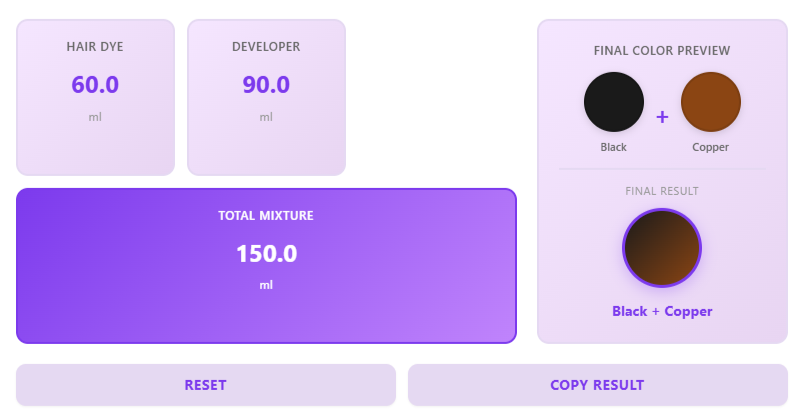
Knowing the total weight of the product is essential for ensuring you have enough bowl space and enough product for the client’s hair length. The 1 to 1.5 ratio hair color calculator sums the dye and the calculated developer. Using the previous example (40g dye + 60g developer), the tool will display “Total Mixture: 100g”. This helps you estimate if you need to mix more before you even start squeezing the tube.
Step 10: Color Preview Logic
Based on the Base, Target, and Tone selected earlier, the tool generates a digital swatch. While screens vary, this swatch gives a general idea of the target hue. The 1 to 1.5 ratio hair color calculator uses hex codes blended to approximate the result of layering the target tone over the base pigment.
Step 11: Copy Result Feature
Professional stylists need to keep client cards updated. A “Copy to Clipboard” button is located next to the final calculation. One click copies the text: “40g Dye + 60g Developer (1:1.5 Ratio) – Total 100g”. You can then paste this directly into your salon management software or a digital note. The 1 to 1.5 ratio hair color calculator makes documentation effortless.
Step 12: Reset Functionality
When you move to the next client, you need a clean slate. A prominent “Reset” button clears all fields, returning the dye quantity to zero and the inputs to their defaults. This ensures you don’t accidentally mix the previous client’s formula for the new client. The 1 to 1.5 ratio hair color calculator is ready for the next calculation instantly.
How to Measure Hair Color and Developer Correctly
Even with the best 1 to 1.5 ratio hair color calculator, physical measurement errors can ruin a formula. In the salon, there are two main ways to measure: by volume (using a beaker or measuring cup) and by weight (using a digital scale).
Measuring by weight is far superior and is the industry standard for precision. When you squeeze hair color into a measuring cup, air pockets can form, making it look like you have 2 ounces when you only have 1.8. Furthermore, the meniscus of the liquid developer can be hard to read quickly. Digital scales remove this ambiguity. You place your bowl on the scale, press “tare” to zero it out, squeeze your dye until the scale reads the amount you input into the 1 to 1.5 ratio hair color calculator (e.g., 50g), tare it again, and pour developer until it hits the calculated amount (e.g., 75g).
A common mistake is “eyeballing” the ratio based on markings on the mixing bowl. These markings are often inaccurate stamped plastic. Another error is assuming that “half a tube” is an accurate measurement. Manufacturers often fill tubes with a slight variance, or product gets stuck in the crimped end. Always squeeze the product out and weigh it.
Why is this so critical? Chemical reactions require specific stoichiometry. If you have too much developer (a runny mix), the pH of the mixture drops. This might prevent the cuticle from opening sufficiently, leading to spotty grey coverage. Conversely, if there isn’t enough developer (a thick mix), there isn’t enough oxygen to oxidize all the dye molecules. The result is a color that looks dark, muddy, and opaque, often described as “ink-stained.” The 1 to 1.5 ratio hair color calculator gives you the target; the digital scale ensures you hit it.
Using the calculator prevents the “mental math drift” that happens on a busy Saturday. If you are mixing 37 grams of color because that’s all that was left in the tube, calculating 1.5 times 37 in your head while answering the phone is risky. $37 \times 1.5 = 55.5$. The 1 to 1.5 ratio hair color calculator gives you this precise number instantly, preventing you from rounding up to 60 or down to 50, both of which would alter the chemical balance significantly.
Why Professionals Prefer the 1:1.5 Ratio
The shift toward the 1:1.5 ratio in professional color lines is not arbitrary. It represents a specific balance of performance and safety that modern stylists demand. When you use a 1 to 1.5 ratio hair color calculator, you are tapping into a formula optimized for pigment distribution.
Better Pigment Distribution
A 1:1 mix is very dense. It places a lot of dye molecules in a small space. While good for coverage, it can look flat. A 1:1.5 mix allows the pigment to be dispersed more evenly through the hair shaft. This creates a result that interacts with light more naturally, giving the hair that multidimensional “salon look” rather than a “box dye” appearance.
Even Lift
When lifting natural hair, the mixture needs to stay wet and active for the duration of the processing time (usually 35-45 minutes). A 1:1 mix can dry out faster because there is less liquid volume. Once color dries, it stops working. The 1:1.5 ratio provides enough moisture to keep the product active, ensuring an even lift from roots to ends without dry spots. The 1 to 1.5 ratio hair color calculator ensures you have enough total product volume to saturate the hair fully, which is key to even lifting.
Controlled Processing
Ammonia and MEA (monoethanolamine) are the alkaline agents that open the cuticle. In a 1:1.5 mix, the concentration of alkalinity is moderated by the extra developer. This results in a more controlled, steady oxidation curve. The color develops at a pace that allows the stylist to apply it thoroughly before the reaction is finished.
Scalp Safety
A 1:2 mix (high lift) has a high concentration of peroxide and alkalinity, which can irritate sensitive scalps. A 1:1 mix places a high concentration of ammonia directly on the skin. The 1:1.5 ratio dilutes the ammonia just enough to make it more comfortable for the client while maintaining full efficacy. By using the 1 to 1.5 ratio hair color calculator, you ensure you aren’t accidentally creating a mixture that is too aggressive for a sensitive scalp.
Predictable Results
Consistency is the currency of a stylist. If a client comes back in six weeks, they expect the same result. If you mixed 1:1.2 last time by accident and 1:1.6 this time, the results will differ. Using the 1 to 1.5 ratio hair color calculator locks in your consistency. It eliminates variables, so if a problem arises, you know it wasn’t the mixing ratio.
Design & User Experience
We built the 1 to 1.5 ratio hair color calculator with the salon environment in mind. We know that stylists are often working with wet hands, in varying lighting conditions, and under time pressure.
Visual Color Swatches
The tool doesn’t just show numbers; it shows color. The visual swatches help confirm that the inputs you selected match the client’s goal. It serves as a visual double-check. If the swatch looks dark brown but you wanted pale blonde, you know you selected the wrong target level before you waste product.
Live Preview
As mentioned in the step-by-step guide, the calculation happens live. There is no waiting for a page to reload. This responsiveness is crucial when you are at the dispensary (back bar) mixing color. The 1 to 1.5 ratio hair color calculator keeps up with your pace.
Mobile-Friendly Layout
Most stylists do not have a laptop at the color bar. They use their phones. The 1 to 1.5 ratio hair color calculator is fully responsive. The buttons are large enough to tap easily, the text is high-contrast for readability, and the layout adjusts to fit vertical screens perfectly.
Beginner-Friendly Interface
For apprentices or students, the world of color math can be intimidating. The interface is clean, removing unnecessary clutter. It guides the user from top to bottom logically. We stripped away complex chemical jargon where possible, focusing on the actionable data needed to mix the bowl.
Professional Salon Feel
The aesthetic is sleek and minimal, mirroring the clean lines of a high-end salon. It doesn’t look like a toy; it looks like a professional utility. This builds confidence in the user that the data coming out of the 1 to 1.5 ratio hair color calculator is trustworthy and professional-grade.
Salon Business Tools
Running a successful salon involves more than just perfect color formulations; it requires astute financial management. Just as you need precision with your chemicals, you need precision with your numbers. We offer several other calculators that integrate seamlessly into a salon owner’s workflow.
For independent stylists or commission-based employees, knowing your worth is vital. Our Hourly Rate Calculator allows you to input your monthly expenses, desired profit margin, and billable hours to determine exactly what you should be charging per hour to meet your financial goals. It takes the guesswork out of pricing your services, much like the color calculator takes the guesswork out of mixing.
If you are looking to sell your salon or bring on investors, you need a clear picture of your business’s worth. Our Business Valuation Calculator helps salon owners estimate the market value of their enterprise by analyzing revenue, assets, and market multiples. It provides a realistic baseline for negotiations and future planning.
Finally, salon equipment—from dryer chairs to washing stations—is a significant investment that loses value over time. Our Depreciation Calculator allows you to track the value of these assets for tax purposes and replacement planning. It calculates how much value your equipment loses each year, ensuring your accounting remains accurate and you aren’t caught off guard when it’s time to upgrade.
Conclusion
Precision is the difference between good and great. In the world of hair color, the 1 to 1.5 ratio hair color calculator is your tool for achieving greatness. It respects the chemistry of the product, ensures economic efficiency, and protects the integrity of the client’s hair. Whether you are mixing a root touch-up or a complex color correction, relying on accurate ratios is non-negotiable.
By understanding the logic behind the 1:1.5 ratio—the balance of lift, deposit, and consistency—you elevate your craft. You move away from “cooking” color by feel and move toward engineering color by design. This guide has equipped you with the knowledge of how to read charts, how to measure correctly, and how to utilize the digital tools available to you.
Make the 1 to 1.5 ratio hair color calculator a standard part of your dispensary routine. Bookmark it on your phone, teach your assistants how to use it, and watch as your color results become more consistent, vibrant, and reliable. The chemistry doesn’t lie, and with the right calculator, you won’t ever have to guess again.
FAQS
What happens if I don’t use the correct 1:1.5 ratio when mixing my hair color?
Using an incorrect ratio can significantly compromise your color results and hair health. If you use too much developer (e.g., a 1:2 ratio by mistake), you will dilute the pigment, potentially leading to weak color deposit, poor grey coverage, and a less vibrant final shade. Conversely, if you use too little developer (e.g., a 1:1 ratio), the mixture will be too concentrated and thick, which can result in a color that appears darker and flatter than intended, uneven application, and insufficient lift. The 1 to 1.5 ratio hair color calculator eliminates this guesswork, ensuring the chemical reaction is perfectly balanced for predictable, professional outcomes.
Can I use the calculator for color lines that recommend a 1:1 or 1:2 ratio?
This tool is specifically optimized for color lines that require a 1:1.5 mixing standard. While the principles of measuring are universal, you should always adhere to the manufacturer’s recommended ratio for the specific color product you are using. Forcing a 1:1.5 mix on a product designed for a 1:1 ratio could lead to unsatisfactory results. For best performance, use the 1 to 1.5 ratio hair color calculator exclusively with hair color brands that specify this popular and modern mixing standard to guarantee optimal pigment development and lift.
Why is measuring by weight better than using the lines on a mixing bowl?
Measuring by weight with a digital scale is the salon industry standard for accuracy. The measurement lines printed on plastic mixing bowls are often imprecise and can lead to significant errors in your formula. Furthermore, measuring by volume can be misleading due to air pockets in the color cream or difficulty reading the liquid level (meniscus) of the developer. A digital scale provides exact gram or ounce measurements, removing all ambiguity. Using a scale in conjunction with the 1 to 1.5 ratio hair color calculator ensures your formulation is chemically perfect, protecting hair integrity and delivering consistent, flawless color every time.