
2 Cycle Fuel Mix Calculator
Calculate the perfect oil-to-fuel ratio for your 2-stroke engines
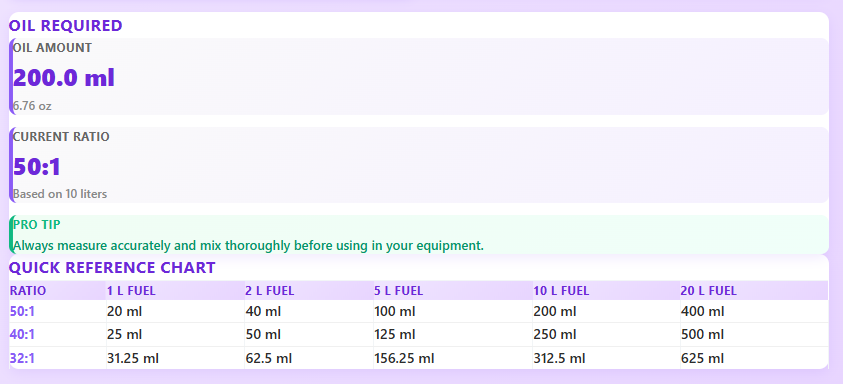
| Ratio | 1 L Fuel | 2 L Fuel | 5 L Fuel | 10 L Fuel | 20 L Fuel |
|---|---|---|---|---|---|
| 50:1 | 20 ml | 40 ml | 100 ml | 200 ml | 400 ml |
| 40:1 | 25 ml | 50 ml | 125 ml | 250 ml | 500 ml |
| 32:1 | 31.25 ml | 62.5 ml | 156.25 ml | 312.5 ml | 625 ml |
2 Cycle Calculator: Your Guide to 1 Perfect Fuel Mix
Introduction
A reliable 2 cycle calculator is an indispensable tool for anyone who operates equipment powered by a two-stroke engine. The correct fuel-to-oil ratio is not just a recommendation; it is the lifeblood of these high-performance machines, including chainsaws, string trimmers, leaf blowers, and even some motorcycles and scooters. Without the proper mixture, you risk catastrophic engine damage, costly repairs, and significant downtime. Unlike four-stroke engines that have a separate lubrication system, two-stroke engines rely on the oil mixed directly into the gasoline to lubricate critical internal components like the piston, cylinder, and crankshaft bearings.
This makes achieving the precise ratio absolutely essential for both engine longevity and peak performance. Understanding this fundamental principle is the first step toward becoming a more proficient and responsible equipment owner. This guide will walk you through everything you need to know about fuel mixing, demystifying the ratios and demonstrating how a 2 cycle calculator simplifies the entire process.
What is a 2-Cycle Fuel Mix?
A 2-cycle fuel mix, also known as a two-stroke or two-cycle oil mixture, is a precise blend of gasoline and specialized 2-cycle engine oil. This concoction serves a dual purpose: it acts as the fuel to power the engine’s combustion process and simultaneously provides the lubrication necessary to protect its moving parts from friction and heat.
In a two-stroke engine, the intake and exhaust functions occur in a single piston stroke, completing the power cycle in just two movements (one up, one down). Because of this simplified design, there is no internal oil reservoir or pump as found in four-stroke engines. The lubrication must be delivered along with the fuel.
As the fuel-oil mixture enters the crankcase, the gasoline vaporizes to be burned in the combustion chamber, while the oil droplets cling to the crankshaft, connecting rod, bearings, and cylinder walls. This thin film of oil creates a protective barrier that reduces wear and tear, dissipates heat, and prevents metal-on-metal contact that would otherwise quickly destroy the engine.
The specific ratio of gasoline to oil is determined by the engine manufacturer and is crucial for its operation. Using a 2 cycle calculator ensures this ratio is met with accuracy, preventing common maintenance issues. The mix is typically prepared in a separate, approved fuel can before being poured into the equipment’s fuel tank. Without this pre-mixed solution, a two-stroke engine would seize up in a matter of minutes. Therefore, a quality 2 cycle calculator is a key part of the maintenance toolkit.
Why Incorrect Ratios Damage Engines
The consequences of using an incorrect fuel-to-oil ratio in a two-stroke engine can range from poor performance to complete engine failure. The balance is delicate, and deviating in either direction—too much oil or too little—introduces significant risks. Using a dependable 2 cycle calculator is the best way to mitigate these dangers.
First, let’s consider a mixture with too little oil, often called a “lean” mixture. This is the most common and catastrophic mistake. Insufficient lubrication leads to increased friction and excessive heat buildup inside the engine. The piston and cylinder walls can overheat, causing the piston to expand and scrape against the cylinder, a condition known as scuffing or scoring.
In severe cases, the heat can become so intense that the piston rings weld themselves to the piston, or the piston itself melts and fuses to the cylinder wall. This is a catastrophic failure known as engine seizure, and it almost always requires a complete engine rebuild or replacement. An accurate 2 cycle calculator prevents this by ensuring the minimum lubrication requirement is always met.
On the other hand, a mixture with too much oil, or a “rich” mixture, creates a different set of problems. While it might seem that more oil means better lubrication, excess oil does not burn completely during combustion. This unburnt oil and its byproducts form hard carbon deposits on the piston crown, cylinder head, and exhaust port.
These deposits can cause the piston rings to stick in their grooves, leading to a loss of compression and reduced engine power. Furthermore, carbon buildup in the exhaust port can restrict the flow of exhaust gases, effectively “choking” the engine and causing it to run sluggishly. Excess oil can also foul the spark plug, leading to difficult starting, misfires, and poor idling. Over time, these issues degrade performance and can still lead to premature engine wear.
This is why guessing is never a good option; a 2 cycle calculator provides the necessary precision. A reliable 2 cycle calculator helps avoid both lean and rich conditions, ensuring your engine receives the exact amount of lubrication it was designed for. A simple 2 cycle calculator is a small tool that prevents large repair bills.
Understanding 50:1, 40:1, and 32:1 Ratios
When you look at the owner’s manual for a two-stroke engine, you will see a recommended fuel-oil ratio expressed as two numbers, such as 50:1, 40:1, or 32:1. These numbers represent the ratio of parts of gasoline to parts of oil. Understanding what these ratios mean is fundamental to mixing your fuel correctly, and a 2 cycle calculator is the perfect tool to help with the math.
A 50:1 ratio means you need to mix 50 parts of gasoline with 1 part of oil. This is a common ratio for modern, high-quality handheld equipment like chainsaws and trimmers from brands such as Stihl and Husqvarna. In practical terms, for every 50 milliliters of gasoline, you would add 1 milliliter of oil.
A 2 cycle calculator can instantly convert this for larger volumes. The 50 1 gas oil mix is popular because modern synthetic oils provide excellent lubrication even at lower concentrations, resulting in cleaner-burning engines with fewer emissions and carbon deposits. Many users rely on a 50 to 1 gas oil mixture chart for quick reference, but a digital 2 cycle calculator offers greater flexibility.
A 40:1 ratio, or a 40 to 1 fuel mix, means you need 40 parts of gasoline for every 1 part of oil. This ratio is often specified for slightly older equipment or engines that operate under heavy loads, such as some leaf blowers, small outboard motors, and certain motorcycles.
A 40 1 gas mixture provides a bit more lubrication than a 50:1 mix, offering an extra layer of protection, though it may produce slightly more smoke and emissions. For those who frequently switch between different equipment types, a 2 cycle calculator is essential for getting the 40 1 gas mixture right every time without confusion.
A 32:1 ratio, or a 32 1 fuel mix, requires 32 parts of gasoline to 1 part of oil. This is a richer oil mixture commonly found in older two-stroke engines, some racing applications, and certain vintage motorcycles or marine engines. The higher oil content in a 32 1 fuel mix was necessary due to the lower quality of oils available in the past. While it provides ample lubrication, it can also lead to more rapid carbon buildup and spark plug fouling if used in an engine designed for a leaner ratio like 50:1.
It’s crucial to stick to the manufacturer’s recommendation. Using a 2 cycle calculator helps ensure you don’t accidentally create a 32 1 fuel mix for an engine that needs a 50 1 gas oil mix. Each 2 cycle calculator is designed to handle these specific ratios with ease. For precision, the 2 cycle calculator is unbeatable.
How the 2 Cycle Calculator Works Step by Step
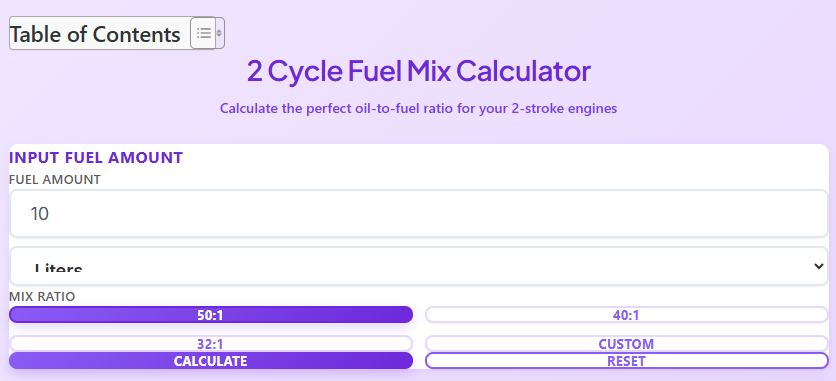
Using a 2 cycle calculator is a straightforward process designed to eliminate guesswork and prevent costly mixing errors. The tool is designed for simplicity, requiring only a few pieces of information to give you an exact measurement. Here is a step-by-step guide to using a typical digital 2 cycle calculator.
First, you need to determine the total amount of gasoline you intend to mix. Most fuel cans are marked in gallons or liters, so start by identifying the volume you will be working with. The 2 cycle calculator will have an input field labeled “Gasoline Amount” or something similar. Enter the quantity of fuel here. For example, if you are filling a 1-gallon can, you would enter “1”.
Second, you need to select the unit of measurement for your gasoline. A good 2 cycle calculator will allow you to choose between gallons and liters, accommodating users from different regions. There will typically be a toggle or dropdown menu next to the gasoline amount field where you can select the appropriate unit. This is a critical step, as the calculation for a gallon is significantly different from that of a liter.
Third, you must input the desired fuel-to-oil ratio. The 2 cycle calculator will provide common pre-set options like 50:1, 40:1, and 32:1. You can simply click on the ratio specified by your equipment’s manufacturer. If your engine requires a different ratio, a quality 2 cycle calculator will also include a “Custom” option where you can enter any specific ratio you need. For instance, if your manual calls for a 25:1 mix, you can enter “25” in the custom field. This flexibility makes the 2-cycle calculator a versatile tool for any two-stroke engine owner.
Finally, after entering these three pieces of information—gasoline amount, unit of measurement, and mix ratio—you simply press the “Calculate” button. The 2 cycle calculator will instantly process the inputs and display the precise amount of two-stroke oil you need to add to your gasoline.
The result is typically given in multiple units, such as fluid ounces (fl oz) and milliliters (mL), allowing you to use whichever measuring cup you have on hand. This clear, unambiguous result is the core benefit of using a 2 cycle calculator over manual calculations or charts. The precision of a 2 cycle calculator is truly invaluable.
How to Calculate Oil for Liters and Gallons
While a 2 cycle calculator automates the process, understanding the manual calculations behind it can deepen your knowledge and serve as a useful backup. The math is different for metric (liters) and imperial (gallons) systems, which is why a 2 cycle calculator that handles both is so convenient.
Let’s start with liters. The metric system is based on units of 10, making calculations relatively simple. One liter is equal to 1,000 milliliters (mL). To find the amount of oil needed, you divide the total volume of gasoline in milliliters by the first number in your ratio.
- Formula for Liters: Oil (mL) = (Gasoline in Liters × 1000) / Ratio
Example for a 50:1 ratio with 5 liters of gasoline:
- Oil (mL) = (5 × 1000) / 50
- Oil (mL) = 5000 / 50
- Oil (mL) = 100 mL
So, you would need 100 mL of oil for 5 liters of gas. A2 cycle calculatorperforms this calculation instantly.
Now, let’s look at gallons. The imperial system is a bit more complex because the conversions aren’t as straightforward. One US gallon is equal to 128 fluid ounces (fl oz). To find the amount of oil needed, you convert the gasoline volume to fluid ounces and then divide by the ratio.
- Formula for Gallons: Oil (fl oz) = (Gasoline in Gallons × 128) / Ratio
Example for a 40:1 ratio (40 to 1 fuel mix) with 1 gallon of gasoline:
- Oil (fl oz) = (1 × 128) / 40
- Oil (fl oz) = 128 / 40
- Oil (fl oz) = 3.2 fl oz
So, you would need 3.2 fluid ounces of oil for 1 gallon of gas.
As you can see, the math isn’t overly complicated, but it does require careful calculations and conversions. A simple mistake, like forgetting to convert gallons to ounces, can lead to a drastically incorrect mixture. This is where the true value of a digital 2 cycle calculator shines.
It eliminates the potential for human error, ensuring you get the correct amount every single time, whether you’re working with a 32 1 fuel mix or a custom blend. Using a 2 cycle calculator removes all doubt from the process. Any reliable 2 cycle calculator is a must-have for engine maintenance. The best 2 cycle calculator will support both units seamlessly.
When to Use Custom Fuel Ratios
While it is almost always best to adhere strictly to the manufacturer’s recommended fuel-oil ratio, there are specific, albeit rare, situations where a custom ratio might be considered. These scenarios typically apply to experienced mechanics, engine builders, or racers who have a deep understanding of two-stroke engine tuning. For the average user, deviating from the standard ratio is not recommended. However, a flexible 2 cycle calculator with a custom input field can be useful in these niche cases.
One common reason for using a custom ratio is during the engine break-in period. Some manufacturers or engine rebuilders suggest using a slightly oil-richer mixture for the first few hours of operation on a new or rebuilt engine. For example, if the standard recommendation is 50:1, they might advise using a 40:1 or 32:1 mix for the first tank of fuel.
The extra oil provides additional lubrication to newly machined surfaces, helping the piston rings seat properly against the cylinder wall and protecting components as they settle in. A 2 cycle calculator makes it easy to calculate this temporary, richer mix.
Another scenario involves high-performance or racing applications. Tuners may experiment with different fuel-oil ratios to squeeze every last bit of performance out of an engine. In some cases, they might use a leaner mix (e.g., 60:1) with very high-quality synthetic racing oil to reduce deposits and maximize power output, accepting the trade-off of a shorter engine lifespan.
Conversely, in endurance events, they might opt for a slightly richer mix to provide an extra margin of safety against engine seizure under extreme stress. A 2 cycle calculator with custom inputs is essential for this level of precision tuning.
Finally, custom ratios can come into play when using different types of oil than what the manufacturer specified. For example, if you are using an older piece of equipment that recommended a 25:1 ratio with conventional mineral oil, switching to a modern, high-quality full-synthetic oil might allow you to safely run a leaner ratio, like 40:1. This is because synthetics offer superior lubricating properties.
However, making such a change should only be done after careful research or consultation with an expert. It’s not a decision to be made lightly. A versatile 2 cycle calculator can assist in these advanced applications, but for most users, sticking to the standard 50:1, 40:1, or 32:1 presets is the safest and most effective approach. The simplicity of a 2 cycle calculator is beneficial for all user levels. The 2 cycle calculator is a gateway to precision.
Benefits of Using a Digital Calculator Over Manual Charts
For decades, equipment owners relied on printed charts, often found on the back of a two-stroke oil bottle or within a 50 to 1 gas oil mixture chart, to figure out their fuel mixes. While these charts are better than pure guesswork, they are significantly outclassed by the convenience, accuracy, and flexibility of a modern digital 2 cycle calculator.
The most significant benefit is accuracy. A printed chart is limited in the values it can display. It might show the oil required for 1 gallon, 2 gallons, and 5 gallons, but what if you only need to mix 1.5 gallons? You are left to estimate or perform manual calculations, which introduces the risk of error.
A digital 2 cycle calculator provides an exact answer for any volume of fuel you enter, down to the decimal point. This precision ensures your engine gets the perfect mixture every time, which is vital for its health and longevity. It is far more reliable than trying to do complex financial planning without a Tax Calculator.
Flexibility is another key advantage. A single chart is usually designed for one specific ratio, like 50:1. If you own multiple pieces of equipment that require different ratios—say, a chainsaw at 50:1 and an older string trimmer at 32:1—you would need to consult different charts or remember different formulas.
This creates confusion and increases the likelihood of a mistake. A 2 cycle calculator handles multiple ratios effortlessly. You can switch between 50:1, 40:1, and custom settings with a single click, making it a universal tool for your entire fleet of two-stroke machines. This adaptability is what makes the 2 cycle calculator so powerful.
Furthermore, a digital 2 cycle calculator is far more convenient. It can be accessed instantly on a smartphone, tablet, or computer, meaning it’s always with you when you need it. You don’t have to worry about finding, losing, or damaging a physical chart. The results are also displayed in multiple units (e.g., fluid ounces and milliliters), which is incredibly helpful.
If your measuring cup only has metric markings, you don’t have to perform another conversion; the 2 cycle calculator has already done it for you. This user-friendly interface saves time and removes hassle from the fuel-mixing process. Just as an Inflation Calculator helps you understand the changing value of money over time, a 2 cycle calculator provides clarity on a critical maintenance task. The 2 cycle calculator is the modern solution to an age-old problem. An effective 2 cycle calculator streamlines your workflow.
Practical Real-World Mixing Examples
To truly appreciate the utility of a 2 cycle calculator, let’s walk through some common, real-world scenarios that equipment owners face every day. These examples will illustrate how a 2 cycle calculator can be applied to different situations, ensuring a perfect fuel mix every time.
Scenario 1: The Homeowner with a New Chainsaw
A homeowner has just purchased a new chainsaw that requires a 50 1 gas oil mix. They have a standard 1-gallon (128 fl oz) fuel can they want to fill.
- Input Gasoline Amount: They enter “1” into the
2 cycle calculator. - Select Unit: They choose “Gallons”.
- Select Ratio: They click the “50:1” option.
- Calculate: The
2 cycle calculatorinstantly displays the result: 2.6 fl oz (or 76 mL) of oil.
Without the2 cycle calculator, they might have tried to interpret a50 to 1 gas oil mixture chartor used a pre-packaged oil pouch that might not be exactly 2.6 oz, leading to a slightly off mixture. The2 cycle calculatorprovides the exact number.
Scenario 2: The Landscaper with Multiple Tools
A professional landscaper has a string trimmer that needs a 40 to 1 fuel mix and a leaf blower that requires a 50:1 ratio. They are preparing a large 5-gallon batch of fuel for the trimmer.
- Input Gasoline Amount: They enter “5” into the
2 cycle calculator. - Select Unit: They choose “Gallons”.
- Select Ratio: They select the “40:1” preset for the
40 1 gas mixture. - Calculate: The
2 cycle calculatorshows they need 16 fl oz (or 473 mL) of oil.
Later, when they need to mix fuel for the blower, they can use the same2 cycle calculator, simply changing the ratio to 50:1 to get the correct oil amount for that specific tool. This prevents cross-contamination of fuel mixes. This highlights the indispensable nature of a versatile2 cycle calculator.
Scenario 3: The Vintage Motorcycle Enthusiast
An enthusiast is restoring a vintage two-stroke motorcycle. The original manual specifies a 32 1 fuel mix. They need to prepare 8 liters of fuel for an upcoming ride.
- Input Gasoline Amount: They enter “8” into the
2 cycle calculator. - Select Unit: They choose “Liters”.
- Select Ratio: They select the “32:1” preset.
- Calculate: The
2 cycle calculatorprovides the result: 250 mL of oil.
In this case, working with liters and a less common ratio could easily lead to manual calculation errors. The2 cycle calculatorhandles the metric conversion and the specific32 1 fuel mixflawlessly, ensuring the classic engine is protected. Just as one might use anFD Calculatorto plan investments, this tool helps protect a valuable physical asset. Every2 cycle calculatorsimplifies these otherwise complex tasks. The precision of the2 cycle calculatoris unmatched.
Maintenance and Safety Considerations
Properly mixing your fuel with the help of a 2 cycle calculator is a huge step toward good engine maintenance, but it’s not the only one. Following best practices for handling, storing, and using your fuel mix is just as important for both your safety and the longevity of your equipment.
First, always use a clean, approved fuel container for mixing and storage. Never mix fuel directly in the equipment’s tank. Use a dedicated can, preferably one that is red (for gasoline) and clearly labeled “Two-Stroke Fuel Mix” along with the ratio (e.g., “50:1 Mix”). This prevents accidental misfuelling. Before adding the oil and gasoline, ensure the can is free of dirt, debris, and water, as contaminants can clog fuel filters and carburetor jets. A great 2 cycle calculator is the start of a great maintenance routine.
When mixing, pour in about half of the gasoline first, then add the entire measured amount of two-stroke oil that you determined with the 2 cycle calculator. Screw the cap on tightly and swirl the can gently for about a minute to ensure the oil is thoroughly mixed with the gasoline. Then, add the remaining gasoline and swirl again. This two-step process helps ensure a homogeneous mixture. Never shake the can violently, as this can cause spillage and build up pressure.
Fuel has a limited shelf life. Modern gasoline, especially ethanol-blended fuel, can start to degrade in as little as 30 days. The oil in the mix can also separate from the gas over time. For this reason, it is best to only mix as much fuel as you expect to use within a month. Using old, stale fuel can lead to hard starting and gum deposits in the fuel system.
If you must store fuel for longer, use a high-quality fuel stabilizer, following the instructions on the product label. Even with a stabilizer, it’s good practice to gently swirl the can before each use to reintegrate any separated oil.
Finally, always prioritize safety. Handle gasoline and oil in a well-ventilated area, away from any open flames, sparks, or sources of ignition. Wear gloves to protect your skin from contact with petroleum products and safety glasses to guard against splashes. If you spill fuel, clean it up immediately.
Store your fuel cans in a cool, dry place away from living areas and direct sunlight. Following these simple maintenance and safety rules, in conjunction with using a precise 2 cycle calculator, will keep your two-stroke equipment running reliably and safely for years to come. Your 2 cycle calculator is your first line of defense. A good 2 cycle calculator promotes both performance and safety. A final check with the 2 cycle calculator is always a good idea.
FAQS
What is a 2 Cycle Calculator, and why is it important?
A 2 Cycle Calculator is a digital tool designed to determine the precise amount of oil you need to mix with gasoline for a two-stroke engine. These engines, found in equipment like chainsaws, leaf blowers, and string trimmers, require oil to be mixed directly into the fuel to lubricate critical internal components like the piston and crankshaft.
Using this calculator is important because an incorrect fuel-to-oil ratio can cause severe engine damage. Too little oil leads to overheating, friction, and potential engine seizure, which is a catastrophic and expensive failure. Too much oil can cause carbon buildup, foul the spark plug, and reduce performance. The calculator eliminates guesswork, ensuring you achieve the exact mixture recommended by the manufacturer for optimal performance and engine longevity.
How do I use the 2 Cycle Calculator for different fuel ratios?
Using the calculator is a simple, three-step process that works for any ratio. First, enter the total amount of gasoline you plan to mix. Second, select the appropriate unit of measurement, such as gallons or liters.
Finally, choose the correct fuel ratio specified in your equipment’s owner’s manual. Most calculators have presets for common ratios like 50:1 (50 parts gas to 1 part oil), 40:1, and 32:1. If your engine requires a unique ratio, you can use the “custom” field to enter it. Once you input this information, the calculator instantly tells you the exact volume of oil to add, often providing the result in both fluid ounces and milliliters for your convenience. This versatility makes it easy to mix fuel accurately for multiple tools with different requirements.
What are the common mistakes to avoid when mixing fuel with the calculator?
Even with an accurate calculation, mistakes can happen during the mixing process. The most common error is using old or contaminated gasoline, which can separate from the oil and clog your engine’s fuel system. Always start with fresh, high-octane gasoline.
Another mistake is improper mixing. Never pour the oil and gas into the can without agitating it. For a thorough blend, add half the gasoline first, then the calculated amount of oil. Seal the container and swirl it gently for about a minute before adding the remaining gasoline. Finally, avoid mixing fuel directly in the equipment’s tank; always use a clean, dedicated fuel can that is clearly labeled with the ratio to prevent accidental misfuelling.