Enter Your Lift Details
Your Estimated One-Rep Max (1RM)
Based on the Epley formula
Results from All Formulas
Weight for Reps (based on your 1RM)
| % of 1RM | Reps | Weight |
|---|---|---|
| — | ||
Mastering the One Rep Max Calculator for Weightlifting: Your Ultimate Guide
When it comes to weightlifting, there’s one number that reigns supreme: your one-rep max (1RM). It’s the ultimate measure of strength, the foundation of effective programming, and a key metric for tracking progress. Whether you’re a beginner, a seasoned gym-goer, or a competitive athlete, knowing your 1RM is essential for optimizing your training.
But calculating your 1RM doesn’t have to involve guesswork or risky max-out attempts. Enter the one rep max calculator for weightlifting—a powerful, user-friendly tool designed to estimate your 1RM with precision and ease. In this guide, we’ll walk you through every feature of the tool, breaking it down like a coach guiding you through a PR attempt.
Hero Section: Your Strength Journey Starts Here

The first thing you’ll notice when you open the one rep max calculator for weightlifting is the clean, intuitive Hero Section. This top banner sets the tone for the tool, combining simplicity with purpose.
🏋️ Icon: Strength at a Glance
The bold weightlifting icon immediately signals what this tool is all about: strength. It’s a visual cue that resonates with lifters of all levels, from beginners testing the waters to seasoned athletes chasing new PRs.
“1RM Calculator” Heading: Straight to the Point
The heading, “1RM Calculator,” is clear and direct. No fluff, no confusion—just a promise to help you calculate your one-rep max with accuracy.
Short Description: Why This Tool Matters
Beneath the heading, you’ll find a concise description: “Calculate your one-rep max for weightlifting.” This simple statement highlights the tool’s purpose and value. But what exactly is a one-rep max, and why should you care?
What Is a One-Rep Max?
Your one-rep max (1RM) is the maximum amount of weight you can lift for a single repetition of a given exercise—think bench press, squat, or deadlift. It’s the gold standard for measuring strength and serves as the foundation for percentage-based training programs.
Why Lifters Use It
Lifters use their 1RM to:
- Set training intensities: Most programs are based on percentages of your 1RM (e.g., 70% for hypertrophy, 85% for strength).
- Track progress: Your 1RM is a clear indicator of strength gains over time.
- Test limits safely: Estimating your 1RM with a calculator reduces the risk of injury compared to maxing out in the gym.
Who Benefits from This Tool?
- Beginners: Estimate your 1RM without risking injury.
- Athletes: Fine-tune your programming for peak performance.
- Gym-goers: Track progress and plan effective workouts.
Input Section: Tailored to Your Training
The Input Section is where the magic happens. This user-friendly form allows you to input your data and customize the calculation to suit your needs.
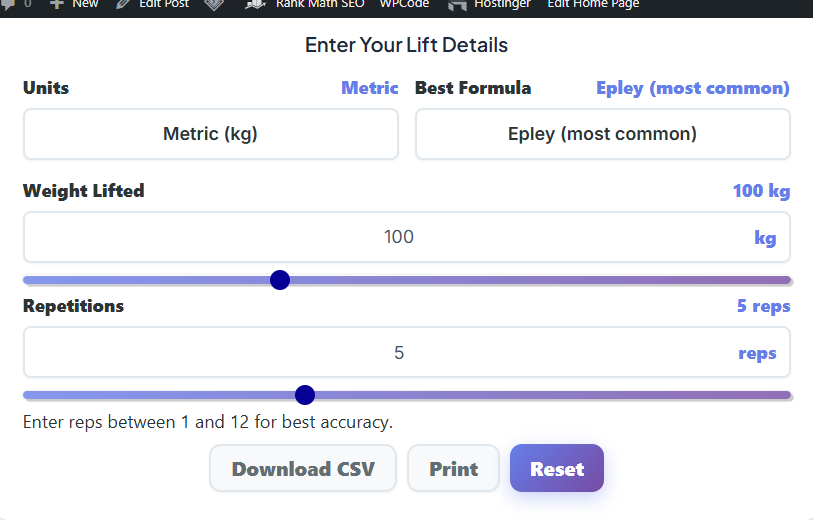
Units Selector: Metric (kg) or Imperial (lb)
The first field lets you choose between Metric (kg) and Imperial (lb) units. This flexibility ensures the tool works for lifters worldwide, whether you’re in a US gym using pounds or a European gym using kilograms.
- Why Unit Switching Matters: It’s all about convenience. No need to convert weights manually—just select your preferred unit, and the tool does the rest.
- Live Updates: As you switch units, the tool updates all values in real time, ensuring accuracy and ease of use.
Formula Selection Dropdown: Choose Your Method
Next, you’ll see a dropdown menu with several formula options. Each formula offers a slightly different approach to estimating your 1RM, catering to various lifting styles and goals.
- Epley: Ideal for beginners and general lifters. It’s simple, reliable, and works well for moderate rep ranges.
- Brzycki: Popular among strength athletes. It’s precise for lower rep ranges (1–5 reps).
- Lombardi: Great for powerlifters. It emphasizes heavier weights and fewer reps.
- Mayhew: Often used in sports performance settings. It’s tailored for bench press calculations.
- O’Conner: Perfect for endurance-focused lifters. It’s accurate for higher rep ranges (8–12 reps).
- Wathan: A favorite among bodybuilders. It balances accuracy across a wide range of reps.
- Lander: Designed for advanced lifters. It’s precise for heavy lifts and low reps.
Weight Lifted Input + Slider: Precision and Control
This field lets you input the weight you lifted during your set. You can type the number directly or use the slider for quick adjustments.
- Live Weight Preview: As you adjust the weight, the tool updates your estimated 1RM in real time.
- Choosing Working Sets: Beginners might use lighter weights to test their form, while advanced lifters often input their heaviest working sets.
Reps Input + Slider: The Sweet Spot
Here, you’ll input the number of reps you completed. The slider makes it easy to select a value between 1 and 12—the range that provides the most accurate 1RM estimates.
- Why 1–12 Reps?: This range balances accuracy and practicality. Beyond 12 reps, fatigue skews the results.
- RPE and Fatigue: Remember, your effort level (RPE) and fatigue can affect your estimated 1RM. For example, grinding out 10 reps at RPE 9 will yield a different estimate than cruising through 10 reps at RPE 6.
Buttons: Save, Print, Reset
At the bottom of the form, you’ll find three handy buttons:
- Download CSV: Save your results and tables for future reference.
- Print: Take a hard copy to the gym for easy access during your workout.
- Reset: Clear the form and start fresh—perfect for testing multiple sets or exercises.
Output Section: Your Results, Visualized
Once you’ve entered your data, the Output Section displays your results in a clear, actionable format.

Estimated One-Rep Max: The Big Number
Front and center, you’ll see your estimated 1RM in bold, easy-to-read text.
- What It Represents: This number is your theoretical max—the heaviest weight you could lift for one rep.
- Why It Matters: Your 1RM is the cornerstone of effective programming. Use it to:
- Set training percentages (e.g., 75% for hypertrophy, 90% for strength).
- Test your progress over time.
- Plan PR attempts safely.
- Formula Variations: Different formulas may produce slightly different estimates. This variation reflects the nuances of each method and your unique lifting style.
Chart Section: Visual Insights
The Chart.js bar graph provides a visual comparison of your estimated 1RM across all formulas.
- Why It’s Useful: Seeing all formulas side by side helps you understand your strength consistency and identify which method aligns best with your training.
- Example: A powerlifter might notice that the Brzycki formula aligns closely with their actual max, while a bodybuilder might prefer the Wathan formula.
Weight-for-Reps Table: Practical Application
Below the chart, you’ll find a detailed table that breaks down your estimated working weights for various rep ranges.
- Columns Explained:
- % of 1RM: Training intensity (e.g., 70%, 85%).
- Reps: Target rep range for each intensity.
- Estimated Working Weight: The weight you should use for that rep range.
- How Lifters Use It:
- Hypertrophy Programs: Use 65–75% of your 1RM for 8–12 reps.
- Strength Cycles: Focus on 80–90% for 3–6 reps.
- Accessory Lifts: Stay in the 60–70% range for higher reps and volume.
Additional Features: Designed for Lifters
The one rep max calculator for weightlifting is packed with features that enhance usability and accuracy.
Live Update Labels
As you adjust the weight, reps, units, or formula, the tool updates all labels and results in real time. This dynamic feedback ensures you always have the most accurate data at your fingertips.
Responsive Mobile Layout
Whether you’re at home or in the gym, the tool’s responsive design adapts seamlessly to any device. Use it on your phone, tablet, or desktop without missing a beat.
Auto-Updating Sliders
The sliders for weight and reps update automatically as you input data, making adjustments quick and intuitive.
Clean UI: Accuracy Meets Ease
The tool’s minimalist design prioritizes functionality. Every element is optimized for clarity, ensuring a smooth user experience.
Real-Life Scenarios: Putting the Tool to Work
Let’s explore how different lifters might use the one rep max calculator for weightlifting:
Powerlifting Scenario
A competitive powerlifter is preparing for a meet. They input their heaviest squat set (405 lb for 3 reps) and use the Brzycki formula to estimate their 1RM. The tool helps them plan their attempts: 90% for their opener, 95% for their second lift, and 100% for their final attempt.
Beginner Lifter
A beginner tests their 1RM for the first time. They input a moderate working set (50 kg for 8 reps) and use the Epley formula for a conservative estimate. The tool provides a safe starting point for their training program.
Female Lifter Testing Squat 1RM
A female lifter wants to test her squat strength. She inputs her best set (100 lb for 5 reps) and compares the Wathan and O’Conner formulas. The results guide her programming for both strength and hypertrophy.
Gym Athlete Preparing for PR Day
A gym athlete is gearing up for PR day. They use the tool to estimate their 1RM for bench, squat, and deadlift, ensuring they’re warmed up and ready to hit new personal bests.
Explore More Tools for Your Fitness Journey
The one rep max calculator for weightlifting is just one of many tools designed to optimize your training. If you’re tracking general health, check out our Ideal Weight Calculator or Waist to Hip Ratio tool. For expecting mothers, our Pregnancy Calculator offers valuable insights.
FAQs
How accurate is the one rep max calculator for weightlifting?
The calculator provides highly accurate estimates based on proven formulas like Epley, Brzycki, and Wathan. While it’s not a substitute for an actual max-out test, it’s a safe and reliable way to gauge your strength without risking injury. Keep in mind that factors like fatigue, form, and effort level (RPE) can slightly affect the results, so use the tool as a guide rather than an absolute measure.
Which formula should I use to calculate my one-rep max?
The best formula depends on your lifting style and goals:
Epley: Great for beginners and general lifters.
Brzycki: Ideal for powerlifters and low-rep sets.
Wathan: Perfect for bodybuilders and balanced rep ranges.
O’Conner: Best for endurance-focused lifters with higher reps.
If you’re unsure, start with Epley for a well-rounded estimate, then experiment with others to see which aligns best with your actual performance.
Can I use the one rep max calculator for bench, squat, and deadlift?
Absolutely! The calculator works for all major lifts, including bench press, squat, and deadlift. Simply input the weight you lifted, the number of reps, and select your preferred formula. The tool will estimate your 1RM for each lift, helping you plan your training percentages and track progress across all your key movements.